
NATO Reviews Future of US Military Role in Europe

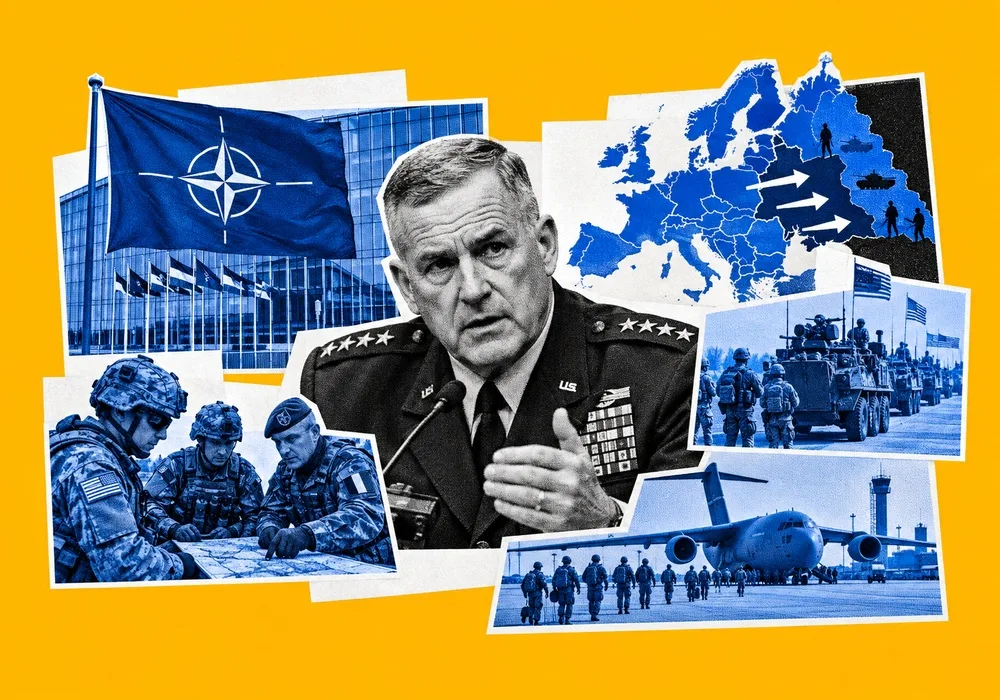
The Pentagon is reviewing options that could reduce the US military presence in Europe by around 25,000 troops, with a more extensive scenario involving up to 40,000 personnel. The review is part of a broader restructuring of NATO in which European allies are expected to assume greater responsibility for conventional defence while Washington concentrates on capabilities it considers strategically essential.
The United States is considering a substantial restructuring of its military presence in Europe as NATO moves towards a new division of responsibilities in which European allies are expected to carry a much larger share of the continent's conventional defence.
The review entered a more consequential phase on September 18, when General Alexus Grynkewich, NATO's Supreme Allied Commander Europe and head of US European Command, joined a virtual briefing for Pentagon policy chief Elbridge Colby. The meeting was part of a six-month review launched by Defence Secretary Pete Hegseth in June to reassess US troop deployments, force posture and basing arrangements across Europe. At least four options are being developed for consideration, although no final decision has been made on the scale or location of any withdrawal.
The scale of the potential changes has nevertheless become clearer in recent days. US media reports have described an option involving the withdrawal of around 25,000 American personnel from Europe, with a more extensive scenario involving up to 40,000 troops. With roughly 80,000 US military personnel currently stationed across the continent, the two scenarios would represent reductions of approximately one-third or one-half of the existing American presence. The options reportedly include changes to Army, Air Force and Navy deployments, as well as possible movements of forces within Europe rather than a simple withdrawal from the continent.
These figures remain proposals under review rather than announced policy. The Pentagon has not confirmed that either a 25,000- or 40,000-person reduction will take place, and the review still has to produce a final recommendation. The current process therefore represents a decision point for the future structure of the transatlantic military relationship rather than an immediate American departure from Europe.
From troop numbers to a different NATO structure
The review is rooted in a broader change in how Washington wants NATO to operate. Hegseth has argued that European allies should assume primary responsibility for the conventional defence of Europe while the United States retains capabilities that are difficult for European countries to replace and remains able to meet its wider global military commitments.
The Pentagon launched the formal review in June, describing it as an assessment of US force posture and basing in Europe. Colby said the objective was to accelerate NATO's transition towards Europe taking greater responsibility for its conventional defence. The review is also intended to reflect the US administration's wider defence priorities and the 2026 National Defense Strategy.
NATO's own military leadership has already acknowledged that such a transition is under way. In May, Grynkewich said European allies and Canada were taking greater responsibility for conventional defence in Europe while some US capabilities were being adjusted. He described the process as part of what has been referred to as “NATO 3.0”: a stronger European pillar within the Alliance that could eventually allow the United States to reduce its presence while retaining capabilities that European allies cannot yet provide.
That distinction is important. The emerging model does not necessarily mean that European countries are expected to reproduce the entire US military presence. Instead, the objective is to redistribute responsibilities: European allies would increasingly provide the forces and conventional capabilities required for territorial defence, while the United States would concentrate on capabilities where it retains a significant technological, logistical or strategic advantage.
The 25,000-troop option
The most consequential figure currently circulating is a potential withdrawal of approximately 25,000 US troops. According to reports on the Pentagon deliberations, Germany, Italy and Spain are among the countries most likely to be affected because they host some of the largest American military deployments in Europe.
Such a reduction would be considerably larger than the 5,000-person withdrawal already announced earlier this year. NATO's military leadership said in May that the previously announced movement involved approximately 5,000 troops, including the return of an armoured brigade combat team, while a previously planned long-range fires battalion deployment was also curtailed. Grynkewich said at the time that the adjustment did not affect the executability of NATO's regional plans.
The new review goes considerably further in scope. The options reportedly include not only reductions in ground troops but also changes involving American aviation and naval personnel, as well as aircraft, ships and weapons. This makes the debate less about the headline troop number and more about the military functions that could disappear, move or become the responsibility of European allies.
A potential reduction of 25,000 personnel would also be different from a complete disengagement. Some American forces could be moved from central or western European countries towards NATO's eastern flank, meaning that the geographical distribution of US military power could change even if the overall American presence declines.
Germany, Italy and Spain face the largest exposure
Germany is particularly important because it has long served as the central hub of US military activity in Europe. American installations there support command structures, logistics, training and the movement of forces across the continent.
A substantial reduction in Germany would therefore have consequences beyond the number of American soldiers physically stationed there. The country's infrastructure is deeply integrated into NATO's reinforcement system, making the question of which bases, headquarters, logistics facilities and enabling capabilities remain potentially more important than the number of troops removed.
Italy and Spain also host significant American capabilities and infrastructure. Any major reduction affecting these countries would therefore have implications for NATO's southern and Mediterranean posture as well as the Alliance's ability to move forces between theatres.
The potential changes also come at a complicated moment for US operations. American bases in Europe remain important for military activity beyond the continent, meaning that Washington must weigh European force reductions against its requirements elsewhere. This is one reason the Pentagon review is examining the broader force posture rather than simply calculating how many soldiers can be removed.
What Europe would actually have to replace
The central issue for NATO is not simply replacing American personnel with European personnel. European allies would need to compensate for specific military capabilities that have historically depended heavily on the United States.
These include strategic intelligence and surveillance, command-and-control capabilities, long-range strike, air and missile defence, strategic airlift, logistics, battlefield support and other high-end enablers. European militaries can increase their numbers and procurement, but developing sufficient quantities of these capabilities requires years of investment, industrial capacity and training.
This is where the gap between higher defence spending and usable military power becomes important. European governments have increased defence budgets and agreed to much more ambitious defence targets, but translating those allocations into deployable formations, ammunition stocks, air-defence systems, drones, long-range weapons, transport capacity and command infrastructure takes time.
A recent assessment cited by Stars and Stripes warned that European land forces are not yet the conventional backbone NATO requires. The assessment also pointed to continuing gaps in weapons stocks and military capacity even as European countries accelerate defence spending.
The transition therefore creates a period in which Europe could be spending significantly more on defence while still relying on US capabilities that cannot immediately be replaced.
The eastern flank is the most sensitive part of the equation
The possible restructuring has particular significance for Poland and the Baltic states — Estonia, Latvia and Lithuania — because they sit closest to Russia and depend heavily on NATO's ability to reinforce the eastern flank quickly.
US forces have played an important role in NATO's forward presence in the region, although European allies have also expanded their deployments and defence capabilities. The Pentagon review is therefore being watched closely by governments that see the continued presence of American forces as an important element of deterrence.
The political sensitivity is reflected in Washington as well. Democratic Senator Jeanne Shaheen has urged Secretary of State Marco Rubio to ensure that US diplomats are involved in the review, arguing that decisions about troop levels could have consequences for bilateral relationships, particularly with the Baltic allies. The State Department has disputed the suggestion that its officials are excluded, saying that ambassadors and other officials are in regular contact with the Pentagon during the review.
The concern is not limited to conventional Russian military power. European governments are increasingly dealing with sabotage, cyberattacks, arson, drone incidents and other activities attributed to or linked by officials to Russian hybrid operations. This means that the security environment on NATO's eastern flank is broader than the possibility of a conventional invasion and places additional demands on intelligence, surveillance, air defence and rapid-response capabilities.
Poland is simultaneously seeking a larger US role
The possible US reduction elsewhere in Europe is unfolding alongside a push from Poland for a stronger permanent American military presence on its territory.
On September 17, President Donald Trump said progress had been made towards establishing a permanent US Army base in Poland and indicated that its location could be announced soon. Polish President Karol Nawrocki said Poland was prepared to continue efforts to strengthen defence cooperation with Washington. Poland currently hosts US troops on a rotational basis.
This creates an important distinction in the emerging US posture. A reduction in the overall number of American troops in Europe does not necessarily mean an equal reduction everywhere. Washington could reduce its presence in some established locations while concentrating selected capabilities closer to NATO's eastern flank.
Such a model would be consistent with a broader effort to make US forces in Europe more strategically focused. Rather than maintaining the same distribution of forces inherited from previous decades, Washington could seek a smaller but more geographically targeted presence built around capabilities that provide the greatest military value.
For eastern European allies, however, the difference between a numerical reduction and a capability-based redeployment will matter enormously. A smaller force that retains high-end air defence, intelligence, command, long-range fires or reinforcement capabilities could have a very different strategic effect from a withdrawal that removes those functions entirely.
The 40,000-troop scenario would be a different scale of change
The upper-end option reported by US media would involve the withdrawal of as many as 40,000 troops, potentially alongside aircraft, ships and weapons. That would amount to roughly half of the current US military presence in Europe.
Such a scenario would represent a much more fundamental restructuring of the post-Cold War US military footprint. It would not simply require European countries to deploy additional troops. NATO would have to compensate for a substantial reduction in American enabling capabilities and reconsider how reinforcement, command, logistics and deterrence are organised across the continent.
However, the 40,000 figure should be treated as an upper-end scenario under consideration rather than an established plan. The available reporting does not indicate that Washington has selected this option, and the Pentagon has not publicly confirmed the reported numbers.
The difference between the scenarios is therefore strategically significant. A limited restructuring could accelerate the development of the European pillar while preserving much of the existing US military architecture. A reduction approaching 40,000 personnel would place much greater pressure on European allies to close capability gaps rapidly.
The lessons of Ukraine are becoming part of the transition
The war in Ukraine is shaping the debate because it has exposed the importance of capabilities that traditional force structures did not always prioritise at the same scale.
Drone warfare, electronic warfare, precision strike, air defence, ammunition production and battlefield intelligence have become central to modern military operations. Ukraine's experience has also demonstrated the importance of rapidly adapting military technology and production to changing battlefield requirements.
NATO's military leadership has repeatedly highlighted the need to turn defence spending into actual capability, including greater interoperability and resilience. Grynkewich has stressed that the Alliance's focus must be on delivering usable military capacity rather than simply announcing new initiatives.
For Europe, this means that the transition cannot be measured only through defence budgets. The critical question will be whether additional spending produces the forces and industrial output necessary to sustain a high-intensity conflict and reinforce vulnerable parts of NATO's territory.
The defence-industrial dimension is consequently becoming as important as troop numbers. European governments need more ammunition, air-defence interceptors, drones, counter-drone systems, missiles, armoured vehicles and other equipment, while also expanding the industrial capacity required to replace losses and maintain stockpiles.
Washington is also looking at access and basing
The Pentagon review is not solely about the size of the US military presence. It is also examining the conditions under which American forces can operate from Europe.
Hegseth has criticised European allies that refused to provide certain basing or overflight access during US military operations connected to the war with Iran. He has argued that future US force planning should take into account whether Washington can rely on predictable access to European bases and airspace when American forces are required to operate.
That issue could become an important criterion in deciding where US forces remain. A smaller American footprint could be accompanied by demands for stronger guarantees over access, infrastructure and operational support.
This would also change the nature of the burden-sharing debate. European allies would not simply be asked to spend more on their own militaries. They could also be expected to provide infrastructure and political guarantees that allow American forces to operate efficiently when Washington decides they are needed.
Congress remains a constraint
The review is also subject to political constraints inside the United States. Congress has legislated a minimum level of US forces in Europe, meaning that the Pentagon cannot treat the continent as an entirely flexible deployment zone without taking existing legal requirements into account.
Congressional concerns have already become visible as reports of possible large-scale withdrawals have emerged. Members from both parties have expressed concern about reducing the American presence while Russia continues to test NATO through military and hybrid activities.
The involvement of diplomats is another point of contention. Shaheen's intervention reflects concerns that military decisions of this scale could have consequences for US bilateral relationships that extend beyond the Pentagon's immediate operational calculations. The State Department, however, says its officials are being consulted.
The final outcome will therefore be shaped not only by military assessments but also by US domestic politics, congressional requirements and negotiations with European allies.
A transition that will take years
Even if Washington decides to reduce its European presence substantially, the transition would not happen overnight. NATO's own military leadership has described the process as a multi-year adjustment tied to the ability of European allies to meet their defence spending and capability commitments.
Grynkewich said in May that as the European pillar of the Alliance becomes stronger, the United States can reduce its presence and focus on critical capabilities that allies cannot yet provide. He also stressed that the timetable would vary by capability and would depend on how quickly European countries meet their commitments.
This makes the current review the beginning of a longer restructuring rather than a single withdrawal decision.
The immediate question is how much the United States will reduce its military presence and where those changes will occur. The longer-term issue is whether European NATO members can build enough military capacity to make a reduced American footprint sustainable without creating a gap in deterrence.
The September briefing involving Grynkewich shows that the two processes are now being considered together. Washington is reviewing what it needs from its European posture at the same time as NATO is asking European allies to assume more responsibility for conventional defence.
For Germany, Italy and Spain, that could mean a gradual reduction of the American footprint around some of Europe's traditional US military hubs. For Poland and the Baltic states, the key issue will be whether any reduction elsewhere is accompanied by a continued or strengthened focus on the eastern flank. For the rest of Europe, the test will be whether increased defence spending can be converted into the capabilities required to replace parts of the US military role.
The final shape of the American presence will depend on the Pentagon's recommendations and subsequent political decisions in Washington. But the direction of travel is already visible: the transatlantic security relationship is moving towards a model in which Europe is expected to carry substantially more of the conventional military burden, while the United States seeks a more selective and strategically focused role on the continent.
Sources: NATO, Defense News, Stars and Stripes