
NATO Intercepts Russian Submersibles Near Svalbard: How the High North Became the New Subsea Front

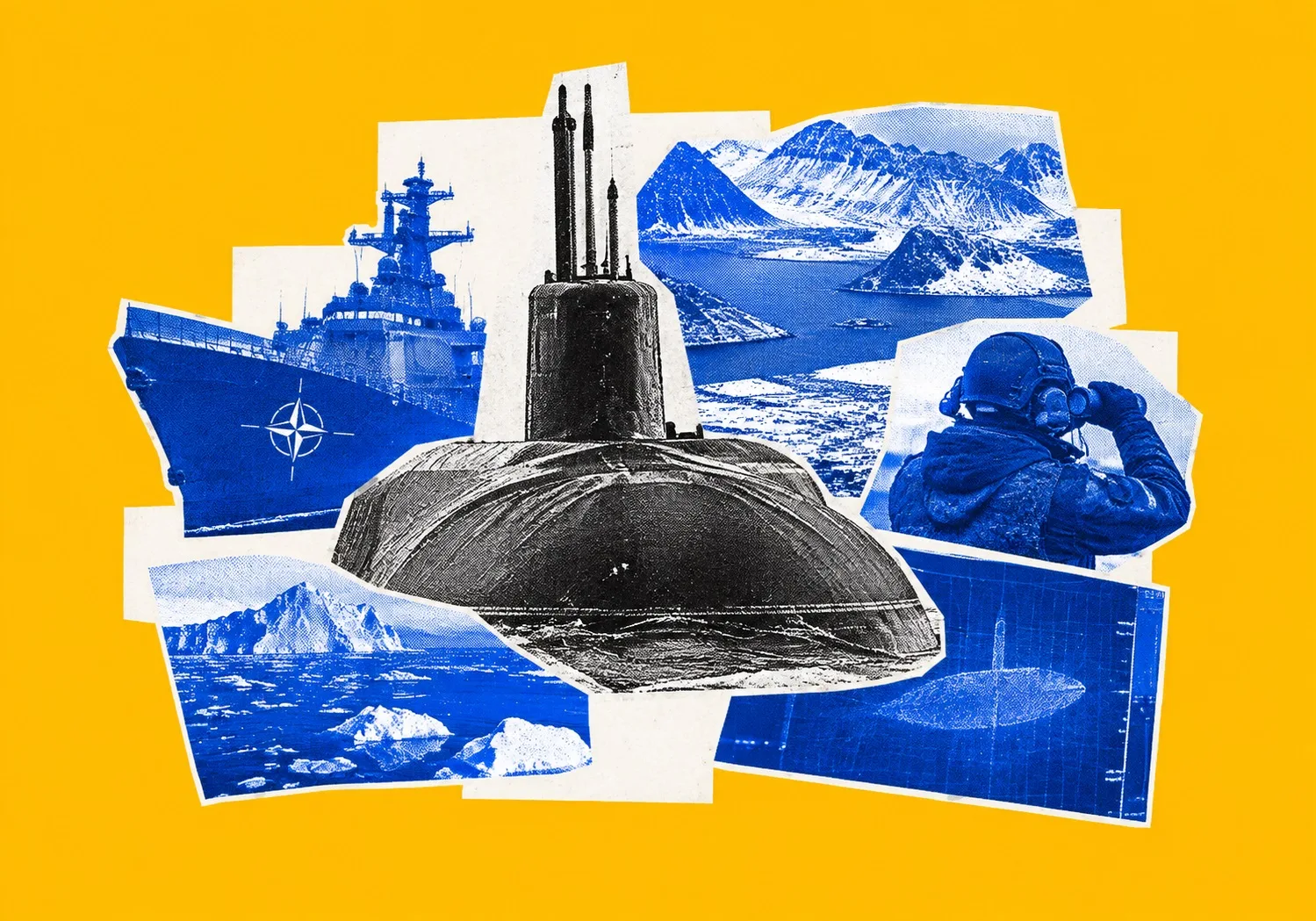
A secret operation by US, British, and Norwegian forces intercepted Russian GUGI submersibles near Svalbard before they could test new technology designed to disable subsea cables without attribution. The Arctic confrontation reveals a decisive shift in European security: NATO is moving from monitoring seabed sabotage to actively confronting Russia's grey-zone threats in international waters.
The location was not incidental. Two 1,400km fibre-optic cables run between Svalbard and mainland Norway, reaching depths of up to 2,700 metres. They carry the enormous flow of satellite data collected at SvalSat, the ground station near Longyearbyen. The cables sit in a maritime corridor that is also central to Russia’s access from its Kola Peninsula submarine bases towards the North Atlantic.
The significance of the encounter lies less in the fact that a Russian operation was stopped than in what the confrontation says about the changing character of European security. The seabed is no longer simply infrastructure to be protected after something goes wrong. It is becoming an operational environment in which Russia and Nato are testing surveillance, attribution and deterrence without crossing the threshold of open conflict.
From cutting cables to disabling them without a clear culprit
There is an important difference between dragging an anchor through a cable and developing a means of disabling it at depth without an obvious physical signature.
Anchor dragging is crude, comparatively cheap and potentially deniable. A vessel can appear to be navigating normally, slowly drifting or manoeuvring in the vicinity of infrastructure. If a cable is subsequently damaged, establishing whether the incident was deliberate can become a legal and intelligence problem.

The technology tested by GUGI points towards a different model. The purpose of the exercise was to simulate the deployment of a system capable of disabling underwater infrastructure while leaving less evidence that could immediately identify the perpetrator.
That changes the problem for European governments. Physical damage can often be investigated after the event. A capability designed around low attribution is intended to make even the first stage of that investigation uncertain.
The broader pattern is already visible in shallower waters. Maritime risk data recorded 13,079 instances of vessels drifting over sensitive subsea infrastructure in the North Sea in 2024, a 52 per cent increase from the previous year. In the Baltic, at least 11 subsea cables were damaged or severed between October 2023 and late 2025.
Those incidents do not all establish Russian responsibility, and the distinction matters. But they illustrate the operating environment in which deliberate sabotage can be concealed among commercial traffic, accidents and ambiguous maritime behaviour.
Russia appears to be developing capabilities for both ends of that spectrum: relatively inexpensive activity involving commercial vessels and more specialised military operations conducted at extreme depth.
Why Svalbard matters
The geography around Svalbard makes the area unusually valuable for both surveillance and military planning.
The Bear Gap, a roughly 400-mile maritime corridor between mainland Norway and Svalbard, is the passage through which Russia's Northern Fleet nuclear submarines must move when leaving their bases on the Kola Peninsula for the North Atlantic. Monitoring activity around the corridor therefore serves two purposes at once: protecting critical civilian infrastructure and observing one of the most important routes in Russia's strategic naval posture.
The cables themselves add another layer of sensitivity.

SvalSat sits at 78 degrees north and can receive data from polar-orbiting satellites on every orbit because of its location. It serves satellite data users including NASA's Near Space Network, meteorological agencies and global navigation systems. The two subsea cables provide the high-capacity connection carrying that information to mainland Norway.
That makes the cables more than telecommunications infrastructure. Their physical vulnerability connects commercial data flows with space infrastructure and military surveillance.
A disruption would not necessarily resemble a conventional military attack. It could begin as a technical failure somewhere on the ocean floor, with the consequences emerging later through degraded communications or delayed data transmission. That ambiguity is part of the strategic attraction of subsea operations.
Detection is becoming part of deterrence
The most consequential element of the Svalbard operation was therefore the allied response.
US, British and Norwegian naval and intelligence forces tracked the Russian vessels, made contact and prevented the exercise from being completed. The Russian ships withdrew without damaging the cables. British and Norwegian officials subsequently presented their intelligence to Moscow privately, making clear that the operation had been detected and that the technology involved was known to the allies.
Norway's Defence Minister Tore Sandvik confirmed the joint operation and said attempts to target critical infrastructure would be detected and met with consequences.
That sequence represents a departure from a purely defensive model. Surveillance is being used not simply to identify damage, but to demonstrate that covert activity itself can be observed and interrupted.
For GUGI, whose value depends heavily on secrecy, that distinction matters. The organisation operates specialised deep-sea submersibles, intelligence vessels and oceanographic research ships capable of working on the ocean floor. Both London and Washington have sanctioned it.
The Svalbard encounter suggests that the High North is developing its own form of grey-zone deterrence: detect the operation, confront it before damage occurs, then reveal enough knowledge to make the other side understand that repetition may not remain covert.
That does not remove the underlying vulnerability. It changes the calculation around exploiting it.
The Article 5 problem beneath the water
Subsea infrastructure presents Nato with a particularly difficult threshold question.
An attack on a military installation is recognisable as an attack. A severed cable is different. Even when the economic and strategic consequences are substantial, the immediate physical event may be hundreds or thousands of metres below the surface, outside territorial waters, involving a commercial vessel whose intentions are difficult to establish.
The September 2026 prosecution in Helsinki illustrates the problem. The crew of the Saint Vincent and the Grenadines-flagged cargo vessel Fitburg is being tried after the ship dragged its anchor for 130km across the seabed on December 31, 2025. Two Finland-Estonia telecommunications cables were damaged, while the vessel crossed eight other critical energy and data lines.

The case is also testing how far a coastal state can exercise jurisdiction over a foreign vessel accused of damaging infrastructure in an Exclusive Economic Zone.
The legal question is only part of the difficulty. Establishing intent can be harder than establishing damage. An anchor leaves evidence of what happened to the seabed. It does not automatically establish why the vessel was there.
A military submersible presents the opposite problem. Its presence in a sensitive area may be strategically meaningful, but the absence of visible damage makes the legal threshold for treating the activity as an attack more complicated.
This is precisely the space in which grey-zone operations can be useful. They can impose costs, gather intelligence and probe an alliance's response without necessarily creating the circumstances for an immediate armed confrontation.
Europe is rebuilding a capability it allowed to atrophy
The response is already moving beyond individual patrols.
Nato's Baltic Sentry, established in January 2025, combines naval frigates, mine-countermeasure groups, maritime patrol aircraft and underwater drones to protect critical infrastructure. The UK-led Nordic Warden initiative coordinates naval patrols across northern European waters.
Norway is also planning a redundant fibre-optic connection between Svalbard, Jan Mayen and the mainland, scheduled for 2028. Redundancy cannot prevent an attack, but it reduces the strategic value of any single cable and gives operators greater room to repair or reroute services.
The deeper change is technological. Protecting the seabed requires persistent surveillance rather than occasional inspection: autonomous and unmanned underwater vehicles, deep-water sonar, detailed seabed mapping, satellite integration and specialised repair capacity.
For years, Europe's dependence on subsea networks expanded while the military capacity devoted to monitoring and defending the ocean floor contracted. The result is an infrastructure system that is economically indispensable but physically difficult to defend across thousands of kilometres of seabed.
That imbalance is now being corrected, but the correction itself creates a new security architecture.

The challenge is not simply to place more ships around cables. European governments have to determine what constitutes suspicious activity, who has authority to intervene, what evidence is sufficient to establish deliberate action, and when damage to civilian infrastructure becomes a collective security issue.
The Svalbard operation offers one answer to the first part of that problem: detection can happen before the cable is cut. The harder question is what happens when the next operation is designed precisely to make detection less certain.
At 2,700 metres below the Arctic sea, the contest is no longer over who controls the surface. It is over who can see what is happening underneath it — and who can prove what they have seen before a grey-zone incident becomes something much harder to contain.
Sources: ACLED, Market Screener, TVP World, Caliber, Reuters