
Kyiv's Surprise Defence Shake-Up Has Caught Brussels Off Guard

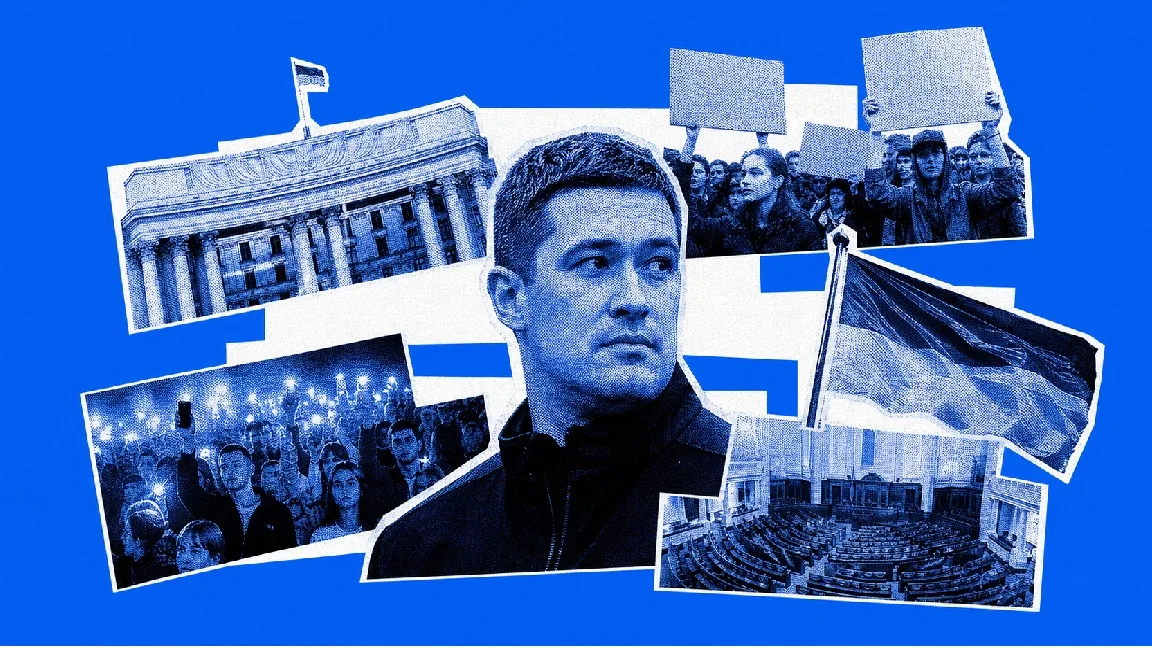
Mykhailo Fedorov's resignation has become more than a government reshuffle—it is a test of Ukraine's reform agenda and public trust. As protests demanding his reinstatement spread across the country, the departure of the architect behind Diia and defence modernisation is exposing growing tensions between wartime governance, institutional reform and political accountability. UPDATED
16:48 The President Has Decided on a Candidate for Minister of Defense
President Volodymyr Zelenskyy has announced that he will propose the parliament to appoint Yevhen Khmara,the acting head of the Security Service of Ukraine (SSU),as defence minister. Khmara has been tasked by the president with acting as Ukraine's defence minister in the interim.
"I have tasked Yevhen Khmara with serving as acting minister, continuing to reform the defence sector, and ensuring that Ukraine achieves all of the results we have discussed. Once the necessary legal procedures have been completed, I will request that MPs support Yevhen Khmara's nomination for the position of Minister of Defence of Ukraine.", Zelenskyy posted on X.
14:43 Two Ministries Without Ministers
Parliament Speaker Ruslan Stefanchuk announced a break in the Rada session: no applications for the ministers of defense and foreign affairs have been received from the President.
Currently, both ministries will be headed by first deputies.
In the Ministry of Defense, this is Oleksiy Vyskub, who in February 2026 transferred together with Fedorov from the Ministry of Digital Transformation from the position of First Deputy Minister.
14:00 The Ukrainian Parliament Appointed Cabinet of Ministers
Before that Parlament appoints Serhij Koretskyi , former CEO of state oil and gas company Naftogazas, a Prime Minister.
As many as 264 members of parliament out of 392 approved the Cabinet's appointment, while 15 voted against it, 19 abstained, and 20 lawmakers did not vote.
Although most ministers were approved, the intrigue over the fate of the defense and foreign ministers remains. Candidates for defense minister and foreign minister are expected to be submitted by President Volodymyr Zelensky later and then considered by parliament.
13:30 General Syrskyi Breaks Silence
Following hours of intense public scrutiny, Commander-in-Chief of the Armed Forces of Ukraine, General Oleksandr Syrskyi, released a brief official statement on social media.
Syrskyi thanked the outgoing minister for his service.
"I am proud that thanks to the Kyiv Defense Operation in 2022, we managed to defend our capital. And now in this very city, briefings can take place, visions can be shaped, and decisions can be made," Syrskyi wrote, in an apparent nod to the stability that allowed Fedorov to hold his press conference in Kyiv.
The General stressed that his primary focus remains on the strategic defense of the country.
"We must focus on the war and the implementation of an effective strategy that is already yielding concrete results," Syrskyi added.
13:15 President Zelenskyy : "The Battlefield is the Priority"
During a joint press briefing in Kyiv with visiting British Prime Minister Keir Starmer, Ukrainian President Volodymyr Zelenskyy actually confirmed what Fedorov said - there was a complex dialogue between the Ministry of Defense and the army leadership at different levels, but added that the issue is not about personalities.
The President believes that he should not choose in such a situation during the war and would like unity.
He does not absolve himself of responsibility, he respects both sides.
Zelensky is confident that Fedorov will remain in his team, but is not yet ready to say in what position.
Earlier this day the ex-defense minister said that he was offered the position of presidential advisor, which he refused.
10:38 Political Crisis Within the Ruling Party
Mykyta Poturaiev, a prominent Member of Parliament from the Presidential party "Servant of the People" ( Sluha Narodu) and Head of the Parliament Humanitarian Policy Committee, officially submitted his resignation to forfeit his parliamentary mandate.
Poturaiev explicitly stated that his decision was a direct response to the situation surrounding the Ministry of Defense.
"I believe that the reforms initiated by Mykhailo Fedorov must be continued at any cost. If there is a conflict between reforms and generals, then we must choose reforms, not generals.", Poturaiev told LB.ua.
Media reports that at least two other MPs are also considering submitting similar resignation letters.
08:30 The Rift at the Top: Dismissed Defense Minister Fedorov Blasts Commander-in-Chief Syrskyi for "Blocking Reforms"
On Thursday, following his abrupt removal on July 15, Fedorov held press briefing which was broadcast live by leading Ukrainian media.
Therefore, everyone could directly hear Fedorova's loud statements.
He detailed how the "old military system" stubbornly resisted modernization and laid the blame for his exit directly at the feet of the country's top general.
The roots of the conflict lie in Fedorov's rapid transition from Minister of Digital Transformation to Defense Minister in January 2026.
Known as an agile tech entrepreneur, the 35-year-old Fedorov treated the army as a tech ecosystem—scaling drone development, slashing military red tape, and digitalizing logistics.
However, his modernizing approach quickly ran into a brick wall of military bureaucracy. According to reports by The Economist, one of Fedorov's first acts was to order a massive audit of the Ministry of Defense and combat brigades.
The audit reportedly uncovered approximately 300 billion UAH ($6.6 billion) in excess and inefficient spending.
When Fedorov attempted to push sweeping reforms—such as shifting military procurement to competitive open tenders and introducing a new military contract system—the top brass pushed back. "We faced a total blocking of all our initiatives," Fedorov stated on July 16. "Instead of brainstorming how to defeat Russia asymmetrically, he \[Syrskyi\] came up with a way to divide the country".
According to Fedorov, General Syrskyi refused to discuss critical front-line issues face-to-face, opting instead to "weave political intrigues" and ultimately issuing a Minister dismissal ultimatum to President Zelenskyy.
While acknowledging Syrskyi's historic role in saving the country during the defensive operations in Kyiv and Kharkiv at the beginning of the full-scale Russian invasion in 2022, Fedorov emphasized that warfare has evolved since then.
07:50 Resignation in Protest
The rift has also triggered fracturing within the military hierarchy itself. On July 16, Colonel Pavlo Yelizarov, the Deputy Commander of Ukraine's Air Force (whom Fedorov appointed to lead air defense reforms), announced his immediate resignation. "I believe that the removal of Fedorov is a great evil for the country's defense capability," Yelizarov wrote on Facebook.
For much of the past seven years, Mykhailo Fedorov has represented a particular vision of Ukraine: digitally driven, reform-oriented and determined to move faster than its institutions. His resignation as Minister of Defence, confirmed as part of President Volodymyr Zelenskyy's government reshuffle, is therefore more than a change of personnel. It has become a test of how resilient Ukraine's reform movement remains without one of its most recognisable architects.
Officially, Fedorov says he will continue working on defence innovation outside government. In his farewell statement, he argued that his mission to strengthen Ukraine through technology would continue beyond ministerial office.
The public reaction suggests many Ukrainians are not ready to let him go.
07:00 Street Protests in Kyiv and Beyond
In central Kyiv, hundreds of young citizens, activists, and volunteers gathered to protest the decision. Protesters chanted Fedorov's name and carried signs reading "Why?", "Reforms must continue," and "Drones should fight, not people." Similar rallies were reported in Kharkiv, Dnipro, Odesa, and Lviv.
The Face of Digital Transformation
Few politicians have left a deeper mark on Ukraine's public administration than Mykhailo Fedorov.

As the country's first Minister of Digital Transformation, appointed in 2019, he oversaw the creation of Diia, accelerated the digitisation of public services and helped turn Ukraine into one of the world's leading examples of digital government.
Following Russia's full-scale invasion, his portfolio expanded far beyond public services. He coordinated partnerships with global technology companies, helped launch Army of Drones, and became one of the driving forces behind Ukraine's defence innovation ecosystem.
Earlier this year, he was appointed Minister of Defence with a mandate to bring that same culture of speed, experimentation and technological modernisation into one of the country's most strategically important institutions.
Why His Departure Matters
The government has not publicly explained why Fedorov is leaving office. Ukrainian media have reported months of disagreements over the management of the Ministry of Defence, including tensions between the ministry, military leadership and the Office of the President regarding procurement, institutional reform and decision-making.
Whether or not those reports tell the full story, Fedorov's resignation marks the departure of one of the few ministers consistently associated with institutional reform rather than political management.
Reform and Public Trust
The resignation comes less than a year after Ukraine experienced its largest domestic protests since the beginning of Russia's full-scale invasion.

In 2025, thousands of people demonstrated after legislation weakened the independence of the country's anti-corruption institutions. Public pressure eventually forced the government to reverse course, reinforcing the idea that Ukrainian society remains willing to mobilise when it believes key reforms are under threat.
That atmosphere has resurfaced following Fedorov's resignation.
Since the announcement, demonstrators have gathered in Kyiv calling for his return to government, arguing that his departure risks slowing the reform momentum that has defined much of Ukraine's state modernisation over the past several years. Social media campaigns supporting Fedorov have spread rapidly, with many portraying him as one of the few officials capable of combining technological innovation with effective public administration.
Regardless of whether those calls succeed, they reveal something larger than support for a single minister. They reflect growing public concern over the future direction of Ukraine's reform agenda at a moment when institutional credibility remains as strategically important as military resilience.
More Than One Minister
Fedorov's resignation is ultimately about more than one political career.
The systems he helped build—from digital public services to defence innovation—were designed to outlast individual officeholders. The coming months will show whether Ukraine's reform programme has matured into durable institutions or whether it still depends on the leadership of the figures who created it.
The public response suggests many Ukrainians already see the answer to that question as one worth fighting for.
Sources: Associated Press, The Kyiv Independent, Ukrainska Pravda, hromadske