
Moldova Declares 60-Day Energy and Water Emergency

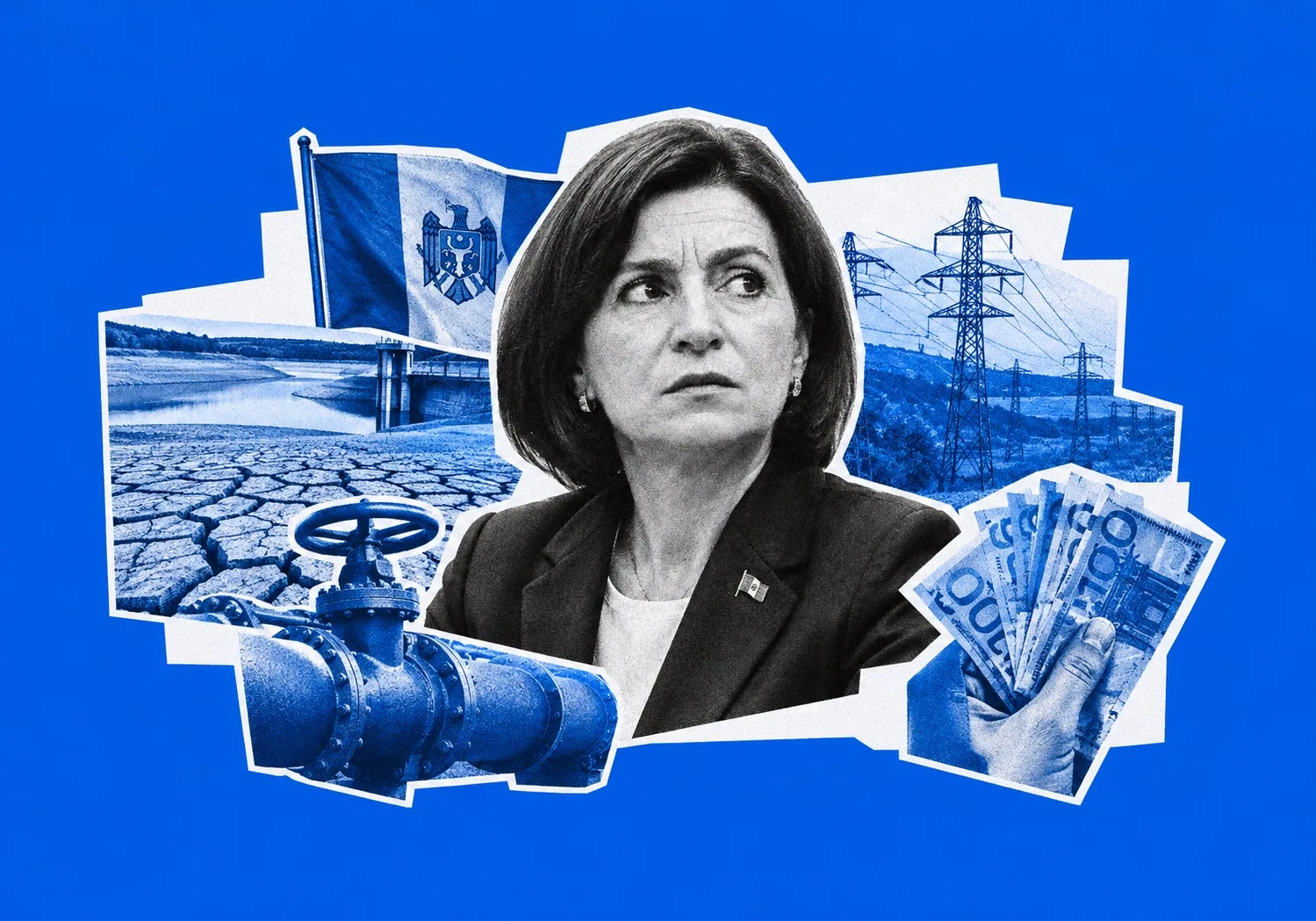
Moldova’s parliament has voted 54–20 to declare a national 60-day state of emergency across its energy and water sectors, effective September 26. Although the country faces no immediate shortages of gas or electricity, Chisinau is taking preemptive legal powers to navigate a severe hydrological deficit on the Dniester River alongside surging European gas prices ahead of winter.
That distinction matters. Moldova is not responding to a single supply failure. It is preparing for several vulnerabilities to hit at once.
The immediate trigger is the Dniester. Inflow into Ukraine’s upstream Novodnistrovsk reservoir has fallen to about 22 cubic metres per second, compared with an operational and environmental baseline of 60 cubic metres per second. The river supplies more than 70% of Moldova’s municipal water needs, including those of Chisinau, while reduced water availability also constrains hydropower generation.
Then there is the energy market. European gas prices have moved above €83/MWh, raising procurement costs for Moldova’s state energy trader, Energocom. The country expects to cover about 59% of its electricity needs through imports this winter, with peak demand estimated at 400–450 MW.
Neither problem alone necessarily requires emergency government. Together, they expose how little room a small, import-dependent economy has when environmental and geopolitical shocks arrive simultaneously.
The emergency is about time, not empty pipelines
The most revealing feature of the measure is what it does not mean.
Moldova’s government has explicitly said that there is no immediate shortage of gas, diesel, electricity or municipal water. Gas storage is around 75% of the country’s winter target, while separate strategic reserves amount to roughly 10 days of peak winter consumption.
Those reserves are being kept back rather than used to suppress prices.
That choice is significant. The government is treating physical supply security and affordability as two different problems. Drawing down emergency stocks to make market prices temporarily cheaper could leave Moldova with less protection if a genuine physical shortage emerges during a cold spell.
The emergency regime therefore gives Chisinau something more valuable than an immediate injection of fuel: time.
The executive will be able to accelerate energy purchases, bypass standard procurement and regulatory timelines, manage fuel imports and adjust electricity and heating allocations. Authorities can prioritise supplies to households, hospitals, schools and other critical infrastructure. If water levels deteriorate further, restrictions on non-essential consumption can also be imposed.
In normal conditions, these powers would sit behind administrative procedures designed to constrain government discretion. In an increasingly volatile energy system, those same procedures can become a source of delay when governments need to react quickly.
Moldova is effectively creating a legal mechanism for managing volatility before volatility becomes a shortage.
The Dniester has become an energy-security issue
The water crisis also changes the meaning of infrastructure on the Moldovan-Ukrainian border.
The Dniester is not simply a river shared by two countries. Its flow is connected to drinking water, hydropower and the operation of wider energy systems. A severe reduction in inflows therefore turns hydrology into an operational constraint on national resilience.
The figure of 22 cubic metres per second makes the problem unusually concrete. A system designed around a minimum flow of 60 is operating with substantially less water than expected.
For Moldova, the consequences extend beyond the availability of water from taps. Lower river flows reduce hydroelectric output and increase dependence on other sources of electricity at precisely the moment when imported power is already becoming more expensive.
This creates a feedback loop. Less water can mean less domestic generation. Less domestic generation means greater reliance on imports. More expensive imported energy then puts additional pressure on households and public finances.
The relationship with Ukraine is unavoidable. The Novodnistrovsk reservoir is upstream, while Moldova depends heavily on the Dniester downstream. The same regional environment is also being shaped by the war, which has already affected Moldova’s electricity security.
In March, Moldova imposed another 60-day energy emergency after attacks on Ukraine’s power infrastructure damaged the Vulcănești–Isaccea cross-border transmission line. That emergency expired in April. By July, deteriorating drought conditions had pushed energy and water management into a heightened-alert regime.
The September decision is different in character. The earlier emergency was tied to damage to critical infrastructure. The new one is designed around the interaction of infrastructure vulnerability, climate stress and market exposure.
That is a broader security problem.
Moldova has reduced one dependency - and exposed another
For years, Moldova’s energy security was closely associated with its dependence on Russian energy supplies. Chisinau’s efforts to move away from that model and procure gas through European markets have changed the structure of that dependency.
But market integration does not eliminate vulnerability. It changes where the vulnerability sits.
Moldova now has greater access to European wholesale markets, but it remains exposed to European prices. When those prices rise, a small economy with limited domestic generation and financial buffers cannot simply absorb the increase indefinitely.
The prospective pressure on households is already substantial. Heating costs could rise by as much as 96%, while Moldova has previously experienced a roughly 41% increase in residential gas tariffs, reaching about €1.01 per cubic metre.
The government therefore faces a difficult trade-off. It must prevent energy prices from becoming socially destabilising without consuming the reserves intended for a physical emergency. That points towards higher public expenditure, targeted consumer support and pressure on the state budget at the same time as procurement costs are rising.
The problem is not that European markets have failed to function. They are functioning as markets.
The problem is that a market price can be manageable for a large economy with deep fiscal capacity and much harder for a small candidate country facing several shocks simultaneously.
Emergency governance is becoming part of resilience
Moldova’s experience points to a broader change in the way energy security is being managed.
The old model concentrated on whether fuel and electricity could physically reach a country: pipelines, transmission lines, storage and bilateral supply agreements were the central questions.
Those questions remain important. But they are no longer sufficient.
A river basin can become an energy-security variable. A military strike on infrastructure in a neighbouring country can alter Moldova’s electricity position. A spike in European gas prices can become a domestic fiscal problem. A drought can increase electricity import requirements just as wholesale prices are rising.
The result is a form of compound vulnerability in which separate risks reinforce one another.
For Chisinau, emergency legislation is becoming a way to manage that overlap. The March emergency dealt with infrastructure disruption. The September measure brings water and energy under the same legal framework. What was once treated as exceptional administration is increasingly being used as a practical instrument for coping with recurring external shocks.
That does not make Moldova an isolated case. It makes the country an unusually clear one.
As an EU candidate, Moldova sits at the intersection of European energy markets, Ukraine’s wartime infrastructure and a regional river system under severe environmental pressure. Its exposure is particularly acute because it lacks the domestic production capacity and financial depth to absorb major shocks alone.
The question for Brussels is therefore not simply whether Moldova can get through one difficult winter.
It is how much resilience the European integration process can provide before a candidate country is forced to rely on emergency powers each time climate conditions, regional security and energy prices deteriorate together.
The emergency begins on September 26. The more consequential shift has already happened: in Moldova, the boundary between energy policy, water management and national security is becoming increasingly difficult to draw.