
Iran Threatens UK Air Base RAF Fairford as Armed Forces Enter High Alert

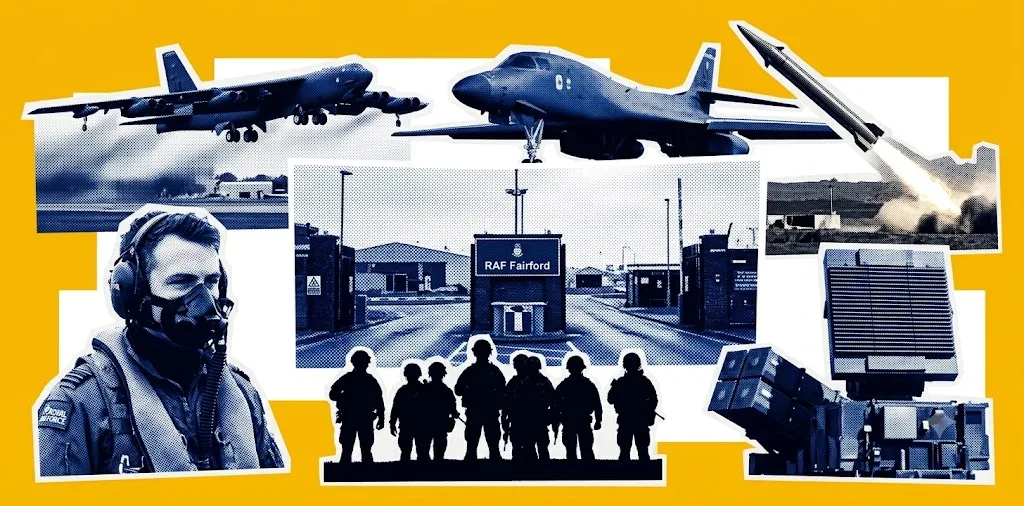
The United Kingdom has placed its armed forces on a 24/7 high-readiness footing after Iran’s Islamic Revolutionary Guard Corps (IRGC) designated the RAF Fairford airbase as a "legitimate target" over US bomber operations.
RAF Fairford is one of the most important American strategic aviation facilities in Europe. The Gloucestershire airbase has long served as a forward operating location for US B-1 and B-52 bombers, and has also hosted other long-range strategic aircraft.
Its value is straightforward: distance matters. A bomber operating from Britain can reach the Middle East more quickly and with less logistical friction than one flying from the continental United States. For Washington, Fairford is therefore an instrument of operational flexibility and strategic pressure.
For Tehran, that same geography makes the base a vulnerability.
The IRGC's decision to name Fairford publicly was not simply a warning against a military installation. It was a message to the British government that the distinction between American operations and British responsibility may not be accepted by Iran.
London may say that the United States is using British infrastructure only within a limited defensive framework. Tehran can respond that American aircraft are still taking off from British territory.
That is the strategic problem.
London is trying to separate legal participation from physical exposure
The British position has been carefully constructed around limits. The United States can use British facilities for defensive operations and for strikes intended to reduce Iranian capabilities threatening international shipping. Britain is not, according to the policy outlined in the briefing, joining the broader US offensive campaign.
The arrangement is designed to preserve alliance obligations without making Britain a full participant in the conflict.
Yet military geography has a habit of undermining legal distinctions.
A bomber sortie launched from RAF Fairford does not become less visible to an adversary because London defines its purpose narrowly. The base remains British sovereign territory. Any missile, drone, cyberattack or proxy operation directed against it would create an immediate security problem for the United Kingdom, regardless of who planned the mission.
This is the friction at the centre of the crisis. Washington wants maximum freedom to use a strategically valuable European platform. London wants to preserve the alliance while retaining control over the threshold at which Britain becomes an active belligerent.
The United States gains a forward staging point. Britain inherits a greater share of the risk.
Why Fairford, and why now?
Iran has several reasons to make the threat explicit at this moment.
The United States has conducted a 13th consecutive night of strikes against Iranian targets after the collapse of a temporary ceasefire. Tehran has responded with attacks on US bases in neighbouring Arab states. The conflict is therefore already moving through a familiar cycle: American force projection, Iranian retaliation, and the expansion of the geographic space in which allied infrastructure becomes relevant.
Fairford offers Iran something that distant American territory does not: a pressure point inside a European NATO country.
The threat also fits a broader Iranian strategy of raising the cost of coalition support without necessarily seeking a direct conventional confrontation with the United Kingdom. A threat against a British base can force London to spend more on air and missile defence, increase security around military infrastructure and confront politically sensitive questions about how far it is prepared to support American operations.
That is asymmetric deterrence.
Iran does not necessarily need to destroy RAF Fairford to create a strategic effect. The possibility of an attack can itself complicate the use of the base.
The same logic applies to hybrid operations. British security services have attributed more than 20 potentially lethal plots in the country over the past year to Iranian state intelligence or Iranian-backed networks, targeting dissidents, opponents, Farsi-language journalists and Jewish sites. This month, two Romanian nationals were sentenced to prison over a stabbing attack against a Farsi-language media journalist in London that was carried out on behalf of Iran, according to the material provided.
Britain has responded with new legal powers banning support for the IRGC, which London links to the direction of proxy networks and criminal gangs inside the country. Tehran rejects the allegations as politically motivated.
The argument over attribution does not remove the security challenge.
The Cyprus decision reveals the limits of British support
The exclusion of RAF Akrotiri in Cyprus from the current defensive staging arrangement is one of the clearest signs that London is not offering Washington unlimited access.
The base was struck by an Iranian-type Shahed drone on March 2, causing minor damage. Iran also allegedly launched two ballistic missiles towards the joint US-UK facility on Diego Garcia in the Indian Ocean, although both missed.
These incidents have changed the political calculation around British military facilities.
Akrotiri is geographically closer to the Middle Eastern theatre than Fairford. Its use could offer obvious operational advantages to the United States, but the March drone attack showed how quickly the conflict could reach a British base in a region already exposed to retaliation.
London's decision to exclude the facility therefore reflects more than a technical disagreement over military planning. It establishes a principle: British infrastructure is not automatically available simply because it is useful to an ally.
The same principle is now being tested at Fairford.
Britain’s defence posture is becoming part of the conflict
The government has confirmed layered air and missile defence readiness in coordination with NATO allies, while the armed forces operate on a 24/7 high-readiness basis.
That posture is designed to address the most immediate concern: a direct strike against British military infrastructure. But the security problem is wider than the ability to intercept missiles.
A conflict involving strategic bombers and long-range missiles creates a broad target set. Military bases are obvious. So are transport links, communications systems, energy infrastructure and the networks that support the movement of military personnel and equipment.
The UK therefore faces a two-track threat.
The first is conventional: drones or missiles aimed at bases such as Fairford. The second is asymmetric: cyberattacks, sabotage, criminal networks or violence directed at Iranian opponents and vulnerable communities in Britain.
The British state has already been dealing with the second category. The direct threat to Fairford connects it to the first.
That is why the political and military consequences of the IRGC warning extend beyond the runway at Gloucestershire.
The alliance is strong, but its risk is no longer distributed evenly
The United States has the greatest operational benefit from the current arrangement. Its strategic bombers can use a forward European location while Washington maintains pressure on Iran.
Iran also gains something from the confrontation. By naming a British base, it can attempt to widen the political distance between Washington and its European partners. The more danger Britain faces because of US operations, the more difficult it becomes for London to present those operations as someone else's war.
The British government is left managing the least comfortable part of the equation.
It has limited control over the broader American campaign but carries responsibility for the security of its own territory. It must protect bases that may be used for operations it does not fully endorse. It must respond to Iranian threats without allowing retaliation against British infrastructure to turn into a wider war. And it must decide what happens if the next attack is not a missile, but a cyber operation or an act of violence carried out through a proxy network.
This is where the traditional idea of an allied military base begins to look outdated.
For decades, host nations could treat overseas military facilities as instruments of alliance policy while assuming that the main risks would remain concentrated in the distant theatre where operations were taking place. That assumption is becoming harder to sustain.
A base is no longer simply a platform from which power is projected. It is also a point at which retaliation can arrive.
The new liability of hosting American power
Britain's predicament is likely to be familiar to other NATO allies.
The more valuable a European base is to American global operations, the more strategically important it becomes to an adversary. That value can make the host country a target even when its government tries to draw a legal line between support and participation.
The issue is not whether London can describe its role as defensive. It can.
The harder question is whether an adversary will respect that description.
Britain has chosen to keep the American strategic relationship intact while placing limits on how its bases are used. That may be the only politically sustainable position available. But the IRGC threat to RAF Fairford shows the cost of the arrangement: London can restrict the mission without being able to control the consequences.
The British government may still decide when a base can be used. It cannot decide where the war ends.
Sources: Reuters.