
High Energy Costs Are Splitting Europe Into a Three-Speed Industrial Economy

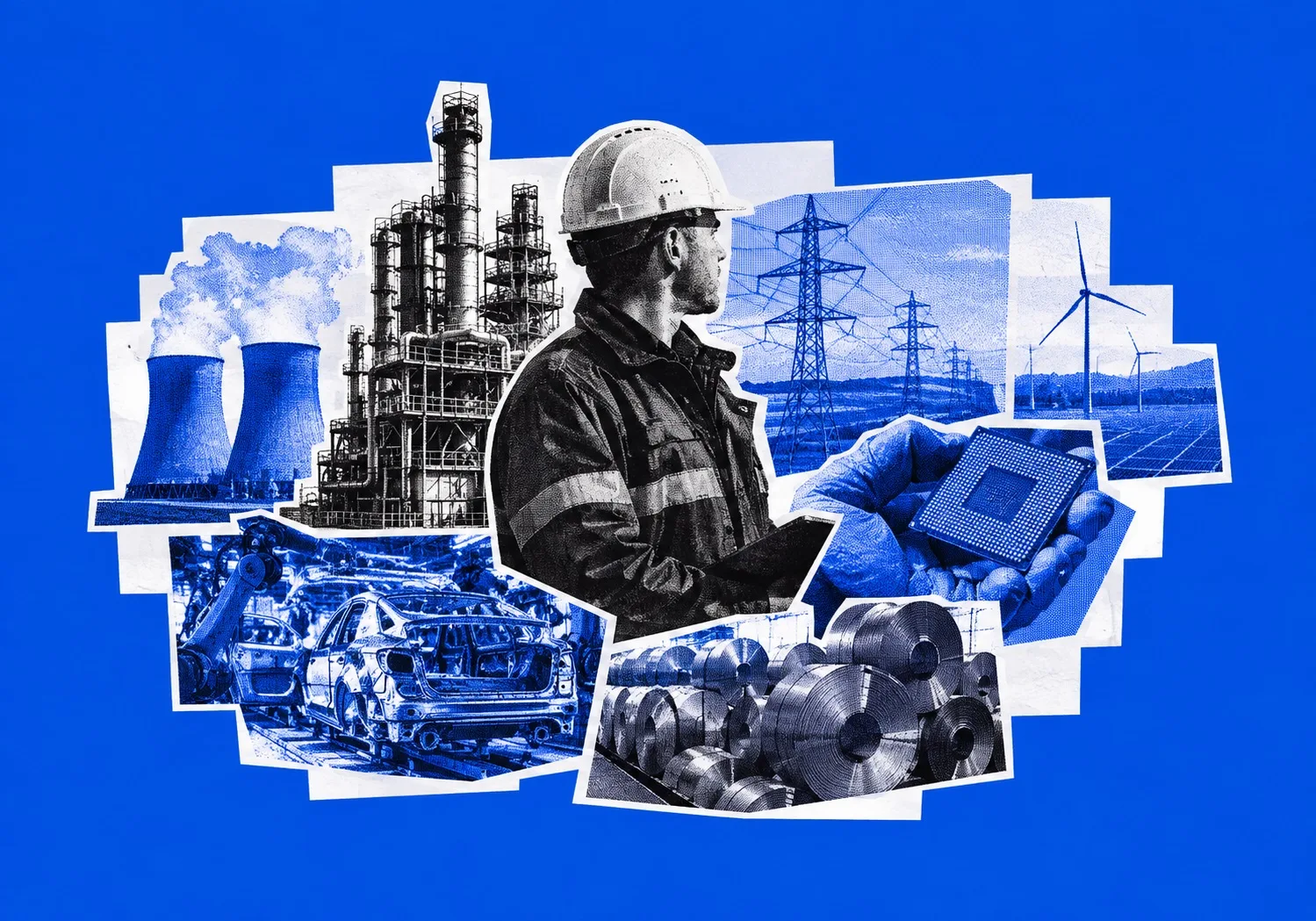
Driven by high electricity prices and LNG import costs, Europe’s industrial base is diverging into a three-speed economy. While state-backed defence, AI infrastructure, and semiconductors attract massive investment, foundational steel and chemical manufacturers - like INEOS and ArcelorMittal - are shutting down production under structural cost pressure.
This shift is already visible across the continent. In Britain, INEOS is mothballing all three major acetyl plants at its Saltend site in Hull, putting roughly 4,000 supply-chain jobs at risk. Across Germany, Spain and France, ArcelorMittal has idled blast furnaces as weak demand, energy costs and carbon prices squeeze steel margins. In Finland, meanwhile, Google is committing at least €13 billion to data centres and related grid infrastructure, backed by a 22-year agreement for up to half the output of the Loviisa nuclear plant.
The divergence matters because the sectors losing ground are not peripheral to the European economy. They supply the materials on which much of the rest of it depends.
From energy shock to structural disadvantage
Four years after Russia’s invasion of Ukraine disrupted Europe’s gas model, the industrial consequences are still working through corporate balance sheets.
The immediate shock was the loss of cheap pipeline gas and the rapid shift towards seaborne LNG. Europe moved from a relatively localised energy system towards one in which it competes with Asian buyers for globally traded supplies. The result has been a structurally higher energy baseline.
In 2025, large energy-intensive industrial consumers in the EU paid an average of about $107 per megawatt-hour for electricity, more than twice US levels and roughly 57 per cent above Chinese rates. Between 2019 and 2024, electricity prices for energy-intensive industries rose by about 53%, while their power consumption fell by 14.5% between 2019 and 2023.
The chemical industry provides one of the clearest examples. INEOS has said energy costs at Saltend can reach 12 times those of its US operations. UK front-month natural gas was cited at $23.51 per MMBtu, against $2.84 at the US Henry Hub. Reuters estimates European chemical output has fallen 19% since the beginning of the energy crisis.
For industries in which gas is both an energy source and a feedstock, there is little room to compensate through efficiency alone. A plant can become more productive, but it cannot redesign the underlying economics of its raw materials without fundamentally changing the production process.
That is why the current closures look different from a conventional downturn.
The power market is spreading the LNG premium
Europe’s electricity market adds another layer to the problem.
Under the marginal pricing model, the most expensive power plant required to meet demand can determine the clearing price for the wider market. When gas-fired generation is setting that price, the cost of imported gas can influence electricity prices even for power produced from lower-cost sources such as nuclear and renewables.
The consequence is particularly significant for manufacturers that lack the bargaining power to secure dedicated energy supplies.
A hyperscaler can negotiate a long-term power purchase agreement. A defence contractor can operate under long-term public procurement arrangements that provide greater visibility over costs and demand. A basic chemicals producer has fewer such protections.
Google’s Finnish investment illustrates the new model. Its planned €13 billion expansion includes new data centres, grid upgrades and a 22-year PPA with Fortum covering up to 50% of Loviisa nuclear power plant output.
That is not simply a technology investment. It is an energy strategy.
The ability to secure predictable electricity over decades is becoming an industrial asset in its own right. Companies with the capital and political importance to negotiate such arrangements can partly detach themselves from the volatility experienced by less protected manufacturers.
The resulting competition is no longer simply between companies. It is increasingly between different forms of access to the European energy system.
Strategic sectors are being insulated
Defence is perhaps the clearest example of this shift.
European defence spending reached about €418 billion, or 2.2% of GDP, in 2025 and is projected to rise to €454 billion, or 2.4% of GDP, this year. Long-term government contracts give defence manufacturers a degree of protection from higher energy overheads that is unavailable to many civilian producers.
Semiconductors occupy a different position but benefit from a similar strategic logic. The European semiconductor market is projected to grow from $66.35 billion in 2025 to $68.72 billion in 2026 and $90.71 billion by 2031, supported by demand from industrial automation, defence and automotive electronics.
Public policy is deliberately concentrating resources in these areas because governments increasingly treat them as matters of economic security rather than ordinary commercial activity.
That is already changing the geography of capital.
The European Commission is proposing more than €100 billion through its Clean Industrial Deal, while the draft European Competitiveness Fund envisages roughly €409 billion for strategic technologies, digitalisation, defence and critical infrastructure in the post-2027 financial framework. Mario Draghi’s assessment of Europe’s competitiveness gap put the required annual investment at between €750 billion and €1.2 trillion.
The direction is clear even if the final policy instruments are not.
Europe is moving towards an industrial model in which strategic importance can determine who receives protection from the continent’s underlying cost disadvantage.
Steel exposes the contradiction
Steel is where the strategic tension becomes harder to ignore.
European crude steel production fell to a historic low of 125.8 million tonnes in 2025, while imports reached a record 29% share of EU consumption. On September 2, ArcelorMittal idled three blast furnaces in Bremen, Gijón and Dunkirk.
The EU responded on September 18 with provisional import quotas and minimum price floors for electrical steel and downstream products, seeking to shield domestic producers from cheaper Asian imports.
Trade protection can slow the loss of production. It cannot, by itself, eliminate the energy differential behind it.
The problem becomes sharper when Europe’s industrial policy is considered alongside its decarbonisation strategy. Green steel requires large volumes of clean electricity, with about 90 TWh needed for the hydrogen inputs alone in the production model outlined in the briefing.
Europe therefore faces an uncomfortable industrial equation: it wants to retain steelmaking, make it substantially cleaner and reduce dependence on foreign supply, while the electricity required to achieve those goals remains expensive.
Protecting the factory is one problem. Making the factory economically viable under a new energy system is another.
The supply chains behind strategic autonomy
This raises a question that reaches beyond individual industries.
Europe is spending more on defence and attempting to build greater sovereignty in semiconductors and digital infrastructure. Yet the same industrial system is losing capacity in steel, chemicals and other foundational sectors that feed into manufacturing.
That matters for defence itself. Steel, chemicals, polymers and other industrial inputs do not become strategically irrelevant because their end users are considered strategic. If their production migrates abroad, European manufacturers become more dependent on imported materials.
Ukraine illustrates the pressure from another direction. ArcelorMittal Kryvyi Rih has begun consolidating units and reducing staff by up to 3,400 positions amid elevated electricity costs following Russian strikes on Ukraine’s energy infrastructure, compounded by European environmental compliance costs.
For Ukrainian defence procurement, higher costs for basic materials and components are not an abstract industrial-policy issue. They feed into the cost of maintaining and replacing equipment in a war economy already operating under severe infrastructure constraints.
The same logic applies across Europe. When steel, chemicals, aluminium, glass, batteries and polymers become more expensive, the effect does not stop at the factory gate. Automotive manufacturers are already being squeezed between weak consumer demand, Chinese EV competition, higher borrowing costs and rising input prices.
A new industrial bargain
Europe’s policy response is increasingly built around accepting that markets alone will not preserve the industrial base policymakers consider strategically necessary.
The danger is that this produces two parallel economies rather than a coherent industrial strategy: one in which governments and large technology companies can secure capital and energy on favourable terms, and another in which manufacturers remain exposed to the full cost of imported LNG, electricity and carbon compliance.
The divide is visible in employment as well as investment. A data centre can represent billions of euros in capital expenditure while a chemical complex supports thousands of jobs through a much wider supply chain. Once a basic chemical plant or blast furnace disappears, rebuilding the associated industrial ecosystem is not simply a matter of restarting a production line.
The European economy can therefore grow in headline strategic sectors while becoming thinner underneath.
Eurozone GDP is forecast to grow by just 0.9% in 2026, compared with global growth of 2.5%. Corporate revenues in Europe have risen by 11.2%, but the gains have been heavily concentrated in energy, defence and semiconductors. Global hyperscaler AI infrastructure spending is expected to reach $725 billion this year and exceed $1 trillion in 2027.
The capital is arriving. The question is where it is landing.
If access to affordable power increasingly determines which industries can survive, Europe’s industrial policy is no longer simply deciding what technologies it wants to develop. It is also deciding which parts of the existing industrial economy can afford to remain on European soil.
Sources: Globe Newswire, Allianz, Debug Lies News, Reuters, CheMmanager