
Greek Elections 2027: Why Mitsotakis is Using Turkey Invasion Scare to Save His Government

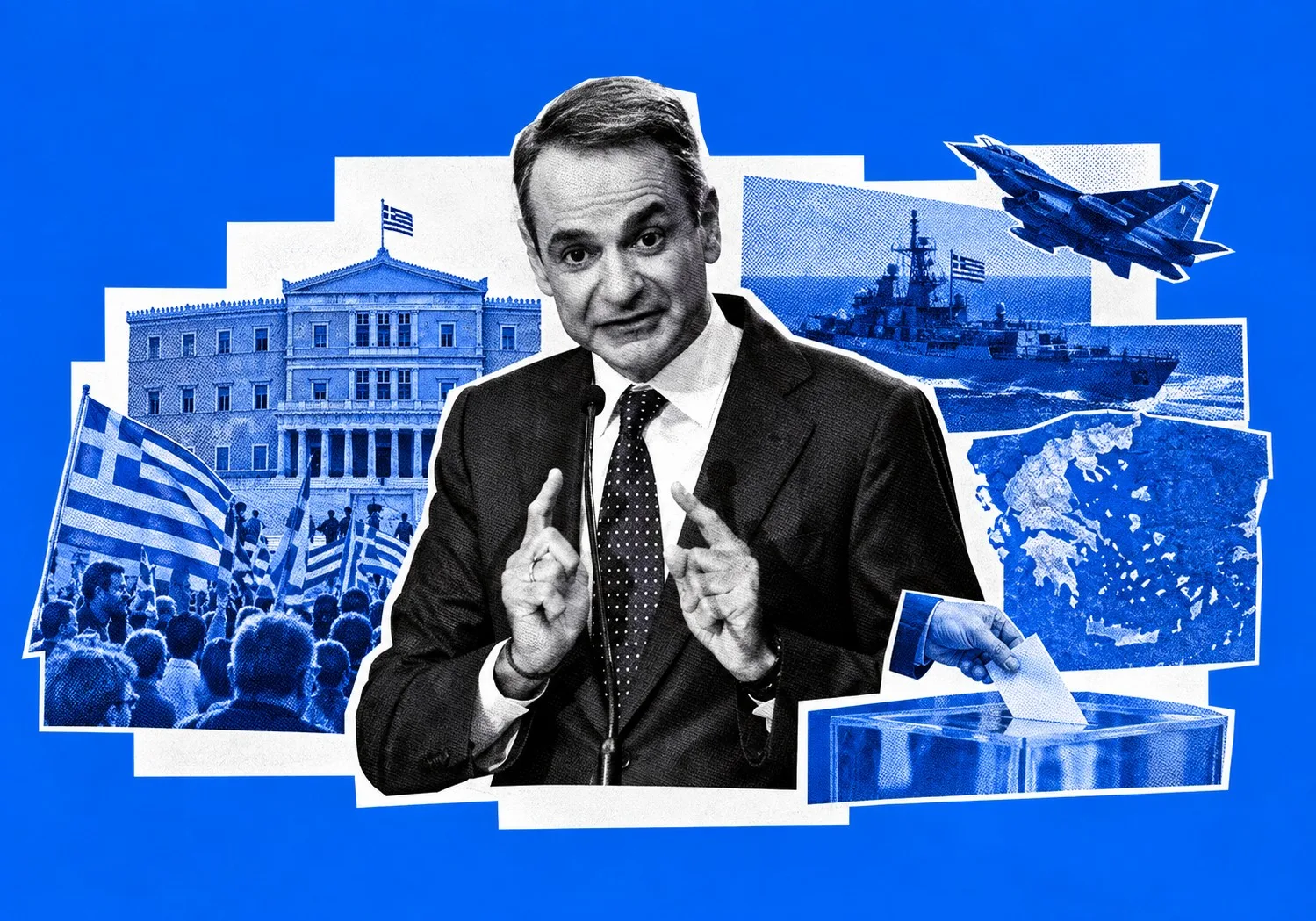
Facing mounting corruption scandals and shrinking poll numbers ahead of Greece's 2027 general election, Prime Minister Kyriakos Mitsotakis is weaponising foreign policy. After his justice minister warned that a Turkish invasion is "inevitable" without a single-party government, opposition parties accuse New Democracy of using national security fears to engineer electoral survival.
Athens is fast approaching an uncomfortable reckoning ahead of the spring 2027 general election. Mitsotakis built his entire political identity on a promise of modernising technocracy, executive competence, and steady economic recovery after a decade of bailouts. Yet that polished exterior has buckled under the weight of mounting legal scandals, European regulatory scrutiny, and a persistent drop in the polls that makes an outright parliamentary majority almost impossible to achieve under current voting laws.
Instead of adapting to the realities of coalition politics, the governing New Democracy party is falling back on a familiar mechanism: weaponising external security threats to force risk-averse voters into line.

The Math of Political Isolation
The arithmetic facing the Maximos Mansion is brutally simple. Recent polling across Greece consistently places New Democracy in the lead, but well short of the thresholds required to govern alone. Under normal parliamentary conditions, a leading party would begin quietly sounding out potential coalition partners. Mitsotakis, however, has spent four years systematically burning every political bridge available to him.
The most damaging blow to his coalition prospects remains the long-running wiretapping affair, where state intelligence services were caught spying on opposition politicians, journalists, and senior military figures. The fallout permanently poisoned relations with Nikos Androulakis, leader of the centre-left PASOK party, who was himself a target of the surveillance. On the left, former Prime Minister Alexis Tsipras has launched a new political vehicle, Elas, which has rapidly climbed to second place in national polls by capturing a growing wave of anti-incumbent anger.
Financial propriety has proved equally problematic for the government. The European Public Prosecutor’s Office is currently investigating how Greece allocated its €36 billion share of the EU Recovery and Resilience Facility, following detailed allegations that lucrative contracts were systematically routed toward a narrow clique of around 30 favoured corporate entities. Add to that the upcoming autumn court trials of four New Democracy MPs implicated in a massive EU agricultural subsidy fraud, and the government's narrative of clean executive governance falls apart completely.
This leaves Mitsotakis isolated. Every major opposition leader has publicly declared that they will not sit in a cabinet that keeps him in the prime minister's chair.
At the same time, the prime minister is being squeezed from the right. Former Prime Minister Antonis Samaras, an uncompromising foreign policy hardliner with significant influence over the party’s traditional base, has openly signalled his readiness to launch a rival nationalist party. That threat directly targets New Democracy’s conservative flank, leaving Mitsotakis with almost no room to manoeuvre without risking a fatal split in his own voting base.
Thessaloniki and the Rhetorical Shift
Recognising the danger, Mitsotakis attempted to reset the political narrative at the annual Thessaloniki International Fair earlier this month. He rolled out an aggressive economic package heavy on tax cuts and public sector wage increases, while flatly ruling out early elections before 2027. He insisted that single-party stability was essential, pointing out that Greece is scheduled to assume the rotating Presidency of the Council of the EU in July 2027.
The economic sweeteners, however, failed to shift the headline numbers. When PASOK's Androulakis pointed out that the government had panicked, shifting its core slogan from "Mitsotakis or chaos" to "Mitsotakis or Erdoğan," the prime minister responded by demanding that foreign policy be kept out of domestic partisan fights.
Yet Mitsotakis notably refused to pull back his own justice minister, Giorgos Floridis. The minister’s invasion comments were left standing uncorrected on the public record, serving as an unacknowledged but central plank of the government's new survival strategy.
The View Across the Aegean
Exploiting cross-border tension is a two-way street, and the timing suits Ankara just as well.
Turkish President Recep Tayyip Erdoğan faces his own constitutional deadline. Under Turkish law, he cannot run for a third presidential term when his current mandate ends in 2028 unless parliament calls an early election. Erdoğan has already dropped public hints that a snap vote is on the horizon, a move that requires a cooperative external foil to rally his own nationalist base.
When Greek pro-government media outlets began running heavy coverage of Turkey’s alleged "encirclement" by deepening military ties between Athens and Israel—highlighting joint defence ventures like the "Achilles Shield" project—Ankara seized the opening. Turkish Foreign Minister Hakan Fidan publicly warned Athens against letting itself be used as a proxy for regional destabilisation.
This pattern is deeply familiar to diplomats in the region. As former Turkish EU Affairs Minister Egemen Bağış recently noted, rhetoric across the Aegean routinely spikes whenever either capital approaches an election, only to subside once the polls close.
The hazard in this cycle is that performative anger can easily slip into genuine crisis. Repeating claims of an imminent foreign invasion lowers the threshold for military miscalculation in a crowded, heavily armed maritime environment where Greek and Turkish assets operate in close proximity daily.
The Real Cost for Brussels
The decision to convert national security into a domestic fear campaign carries immediate institutional risks for the rest of Europe.
Greece's upcoming EU Council presidency in July 2027 is meant to showcase the country's institutional recovery. If Athens is instead locked in a prolonged post-election deadlock—characterised by fractured parliaments, failed coalition talks, and repeated election re-runs—the administrative capacity of the Greek state will be entirely consumed by internal political survival.
European partners who spent years working to stabilise Greece's position in the eurozone now face the prospect of a government that uses national defence assets as leverage in domestic electoral math.
The strategy also destroys Greece’s long-standing diplomatic argument in Western capitals. For decades, Greek diplomats worked to frame disputes in the Aegean as matters of international law and territorial integrity threatened by Turkish revisionism. By explicitly telling the public that a Turkish invasion depends on whether a specific party wins a domestic majority, ministers in Athens are validating Ankara's argument that Greek security concerns are manufactured for political consumption.
Who Gains from the Deadlock
The main beneficiaries of this rhetoric are not the moderate voters Mitsotakis hopes to frighten back into the fold.
On the right, Antonis Samaras and his nationalist faction gain immense leverage. By shifting the public debate toward existential defence threats, the government validates Samaras’s hardline world view, making it easier for him to siphon off conservative voters who view Mitsotakis as soft on Ankara.
On the left, Alexis Tsipras and his new Elas movement gain a clear, uncomplicated target. They can frame the government’s security warnings as the transparent panic of an administration trying to distract from European corruption inquiries and the fallout from the wiretapping scandal.
In Ankara, Erdoğan receives the exact external validation he needs to set up a snap election and clear his own constitutional path to remaining in power.
The losers in this equation are the institutional checks and balances designed to hold Greek executives accountable. By forcing a binary choice between single-party rule and foreign invasion, the governing party is attempting to make normal democratic rotation look like treason.
End of the Single-Party Era
Greece is reaching the limit of the political model that defined its post-1974 democratic history. The system of alternating, highly disciplined single-party governments commanding absolute parliamentary majorities is no longer supported by the electorate. Party loyalty has fractured, and voters are increasingly spreading their support across newer, less conventional political formations.
In most European democracies, this shift forces politicians to master the art of compromise, negotiation, and power-sharing. In Athens, where coalition governance is still viewed by party leaderships as an admission of weakness, the political class is choosing escalation instead.
By attempting to preserve single-party hegemony through the projection of external threats, the government is setting a precedent that will corrupt Greek foreign policy long after the 2027 ballots are counted. The ultimate danger for Mitsotakis is not just that voters might see through the scare tactics, but that by treating national defence as a disposable campaign tool, he leaves the country far more vulnerable to the real crises ahead.