
Germany Restricts Flights Around Airports, Government Buildings and Critical Infrastructure

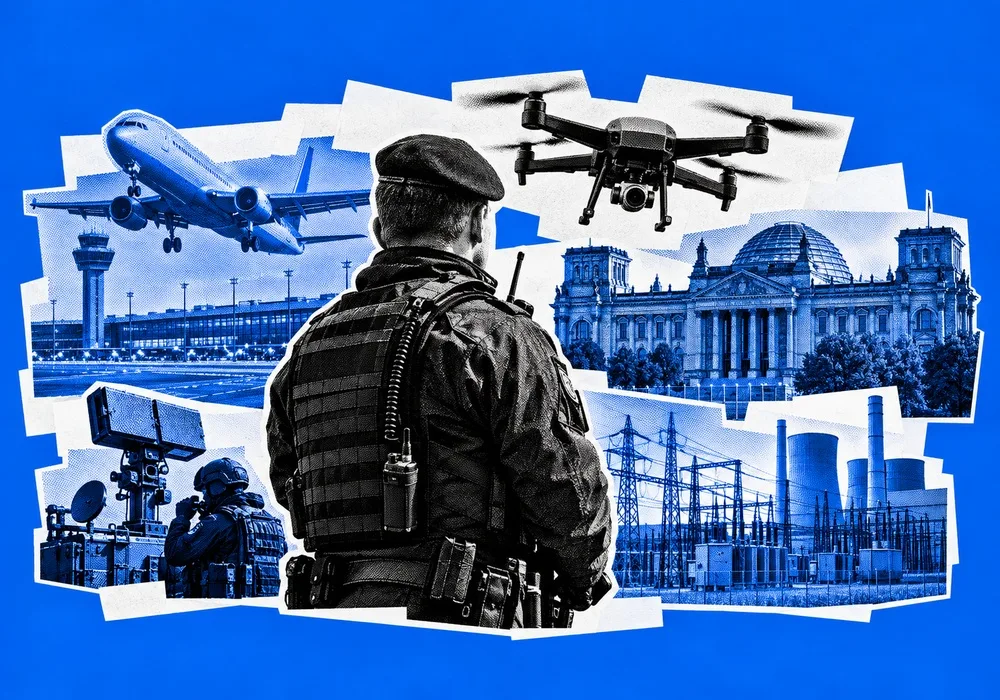
Germany has introduced a complex system of restricted airspace covering government institutions, airports, military installations, energy facilities and protected natural areas. The rules governing drones have taken on greater significance as authorities respond to concerns about espionage, sabotage and the vulnerability of critical infrastructure, while seeking to balance security requirements with civilian aviation and commercial activity.
Germany's airspace is governed by national aviation legislation, European Union regulations and geographically defined restrictions that determine where aircraft can operate. Some zones are permanently restricted, while others are activated temporarily for military exercises, security operations or specific events. Requirements also differ depending on whether a flight involves a conventional aircraft, a helicopter or an unmanned aerial vehicle.
The system extends far beyond airports and military bases. Government buildings, police facilities, energy installations, research centres, transport infrastructure and environmentally sensitive landscapes can all be subject to special rules. For drone operators, this means that a flight permitted in one location may require additional authorisation or be prohibited altogether just a short distance away.
Germany's approach reflects the different risks associated with low-altitude aviation. Small drones are widely accessible and can be operated close to buildings and infrastructure that would be difficult to approach using conventional aircraft. Their size and flexibility make them useful for legitimate activities, including photography, industrial inspections, surveying and emergency response. The same characteristics, however, create challenges for authorities responsible for protecting sensitive sites.
Berlin's Government District Under Strict Flight Controls
One of the most prominent restricted areas is the airspace surrounding Germany's parliament in Berlin. The designated ED-R 146 zone extends approximately 5.6 kilometres around the Reichstag building. Restrictions are particularly stringent within the innermost zone, extending roughly 1.85 kilometres from the parliament.
Unauthorised entry into this restricted airspace can constitute a criminal offence. Drone operations are possible only under specific conditions, and the applicable procedures depend on the location, purpose of the flight and relevant authorisations. Commercial operators may qualify for permission under established arrangements, but this does not give them unrestricted access to the entire zone.
The restrictions protect the Bundestag and other institutions central to Germany's political system. They also reduce opportunities for unauthorised surveillance of government buildings, security arrangements and official movements.
The capital's airspace can be subject to further restrictions during state visits and other events involving heightened security requirements. Authorities can establish additional temporary zones when circumstances demand them, meaning that even experienced operators must check current aviation information rather than rely solely on a permanent map of prohibited areas.
Airports and the Risks of Unauthorised Drone Flights
Airports are among the most sensitive locations in Germany's airspace system because even a small unmanned aircraft can create serious operational problems when it enters an area used by passenger aircraft. A drone sighting can lead to suspended departures and arrivals, flight diversions and delays affecting thousands of passengers.
German regulations establish different requirements around airports and smaller airfields. Drone flights within designated airport safety zones are subject to strict conditions, and additional authorisation may be required depending on the location and type of operation. Around certain aerodromes, a lateral distance of 1.5 kilometres is particularly important, although the precise requirements depend on the applicable rules and permissions.
These rules should not be interpreted as a single universal exclusion radius for every aircraft. Conventional aviation follows its own airspace requirements, while drone operators must account for both general operating rules and designated geographical restrictions.
The risks extend beyond direct collisions. An unauthorised drone can force air traffic controllers to halt movements while the situation is assessed, creating disruption even when no physical damage occurs. Repeated incidents can also affect airport security procedures, staffing and operational planning.
Germany's air navigation service provider, Deutsche Flugsicherung, advises drone operators to check the applicable control zones and obtain air traffic control clearance where required. Operators must also consult the relevant aviation authorities before conducting flights in areas subject to special restrictions.
Critical Infrastructure Becomes a Security Priority
Germany's restrictions are increasingly relevant to the protection of critical infrastructure, including energy installations, industrial facilities, military sites and transport networks. Authorities have expressed concern about unauthorised drone activity around sensitive locations, particularly where flights could be used to gather information or prepare sabotage.
In February 2026, the German federal government outlined changes intended to strengthen the country's capacity to counter drone threats. The measures included expanding the circumstances in which the armed forces could support police operations against drones and simplifying procedures for deploying that assistance. The government linked the reforms to an increase in illegal drone flights over critical infrastructure since Russia launched its full-scale invasion of Ukraine, while noting suspicions that some incidents could involve foreign state actors.
These suspicions do not mean that every unauthorised flight is evidence of espionage or that responsibility for individual incidents has been established. Nevertheless, the possibility that drones could be used for hostile surveillance has increased pressure on authorities to improve detection, coordination and response capabilities.
The distinction between an ordinary aviation violation and a potential security incident is important. A recreational drone flight in a prohibited area may breach aviation rules without being part of a deliberate hostile operation. However, repeated flights near military facilities, energy installations or other sensitive locations can prompt authorities to investigate whether the activity is accidental, commercially motivated or intended to collect intelligence.
Germany's aviation regulations restrict drone operations around several categories of protected facilities. These include military installations, certain industrial sites, energy generation and distribution facilities, government institutions and police premises. The rules impose conditions on operations near specified sites, with consent or other applicable authorisation required in circumstances defined by law.
This framework creates a legal basis for restricting access while allowing exceptions for approved activities. Industrial operators, for example, may have legitimate reasons to use drones for inspections, but these operations must comply with the relevant safety and authorisation requirements.
Military Training Areas and Research Facilities
Military exercises create another layer of restrictions. Certain areas of German airspace are reserved for defence activities, while temporary restrictions can be introduced or activated according to operational requirements. Civilian pilots must distinguish between permanently prohibited zones, areas subject to conditional access and temporary restrictions that apply only during specified periods.
The Berlin-Brandenburg region illustrates how these controls can overlap with the protection of research facilities. In addition to the restricted zone around the Reichstag, the area includes a restricted zone around the Helmholtz Centre in Berlin-Wannsee, a research institution focused on materials and energy.
Germany's aviation authorities publish information on arrangements governing restricted areas, including provisions intended to protect energy, decommissioning and research facilities. These arrangements establish conditions under which certain operations may be permitted, but operators who do not meet those conditions must obtain the relevant authorisation. Temporary restrictions can also be introduced during state visits or when the security situation requires additional controls.
Research activities can therefore affect the availability of airspace even when a site is not a conventional military base. Such restrictions may support safety and security requirements around specialised installations, although the existence of a restriction alone does not establish that a facility is involved in a particular defence programme.
Peenemünde and the Long-Term Control of Airspace
Another example highlighted in recent reporting is Peenemünde, on the island of Usedom in northeastern Germany. Published aviation information identifies a restriction period running from 8 January 2026 to 31 December 2028.
Peenemünde occupies a distinctive place in German technological history. During the Second World War, the site was a major centre for the development and testing of military rockets. It is now associated with historical preservation and technical exhibitions, as well as aviation-related activities in the surrounding area.
The duration of a restriction does not, by itself, establish its precise operational purpose. To determine which activities are covered, pilots must consult the relevant aviation notices and the exact geographical designation. The broader significance is that airspace restrictions can remain in place for years where particular activities or facilities require predictable operating conditions and controlled access.
Long-term restrictions also demonstrate why a simple list of places where drones cannot fly is insufficient for planning. Operators need to understand the boundaries, applicable exceptions, authorisation procedures and dates on which a measure takes effect.
National Parks and the Environmental Dimension
Not all restrictions are motivated by national security. Germany also limits drone operations in protected natural areas, where noise and the presence of aircraft can disturb wildlife. Birds and other sensitive species may be particularly vulnerable during breeding periods or in habitats already under pressure from tourism and human activity.
The country's rules cover national parks, nature reserves and other protected landscapes, including areas in the Bavarian Forest, Berchtesgaden, Saxon Switzerland and the Harz. The precise requirements vary according to the legal designation of each site and the applicable regional regulations.
Under Section 21h of Germany's Air Traffic Regulations, drone operations in designated protected areas are subject to specific conditions and exceptions. Authorisation from the competent conservation authority may be required, and additional restrictions can apply under state-level legislation. The rules also distinguish between recreational flights and operations carried out for other purposes, including cases where an overflight is necessary to perform a legitimate task.
The legal framework does not mean that every protected landscape is subject to an identical ban. Some restrictions permit particular operations under defined conditions, while others are more stringent. Conventional aircraft are also governed by a different set of rules, and restrictions applying to drones should not automatically be treated as prohibitions on all aviation.
This distinction reflects a wider regulatory challenge: authorities must protect sensitive environments without imposing restrictions beyond their legal competence. For commercial drone operators, the practical result is that environmental regulations must be checked alongside aviation rules.
Hospitals, Police Facilities and Emergency Operations
Hospitals and police facilities are subject to additional safeguards because unauthorised drone flights can interfere with emergency services or compromise the security of sensitive operations. German regulations generally require specific consent for drone flights above or within 100 metres of hospital boundaries, as well as around certain police and security-service premises.
Restrictions also apply around accident scenes and emergency operations. A drone that enters an area where rescue helicopters are operating can introduce an additional hazard at a time when emergency services are already working under pressure. Authorities may therefore impose restrictions that take effect for the duration of an incident.
These measures are particularly relevant as drones become more common among recreational users, journalists and commercial operators. A flight that is lawful in ordinary circumstances may become prohibited when it interferes with an emergency response or enters a temporarily restricted area.
Tourist attractions and historic sites can also be subject to specific drone restrictions. Neuschwanstein Castle, Linderhof Palace and Nymphenburg Palace are examples cited in coverage of Germany's restrictions. However, the applicable rules depend on the particular location and designation; a drone prohibition near a landmark does not necessarily mean that every type of aircraft is banned from the surrounding airspace.
Enforcement, Penalties and the Need for Up-to-Date Information
Germany's restrictions are backed by enforcement powers, and unauthorised flights can have consequences beyond a warning to the operator. Depending on the circumstances, violations may result in administrative penalties or criminal proceedings. Some infringements involving protected areas can carry fines of up to €50,000, although the maximum penalty is not applicable to every type of violation.
The consequences are particularly serious when a flight breaches a designated security zone. Unauthorised drone entry into the restricted area around the Reichstag can constitute a criminal offence. Operators cannot assume that a flight is lawful simply because the aircraft is small, the operation is brief or the intended purpose is photography.
To help operators identify the rules that apply to a planned flight, Germany provides the Digital Platform for Unmanned Aviation, known as DIPUL. Its map displays geographical zones and restrictions relevant to drone operations. Deutsche Flugsicherung and the competent state aviation authorities also publish guidance on controlled airspace, permissions and operational requirements.
Checking these sources is essential because permanent restrictions are only part of the picture. Temporary security zones, changes to operating conditions and local requirements can affect whether a flight is permitted on a particular day. Operators must also distinguish between the permissions required for drone flights and those governing conventional aircraft.
Germany's system ultimately combines aviation safety, environmental protection and national security within a layered regulatory framework. The expansion of drone use has made this framework more consequential: aircraft that once required specialised equipment and training are now widely available, while the sites they can approach include infrastructure essential to the functioning of the state and the economy. The challenge for German authorities is to preserve the legitimate benefits of civilian drone operations while ensuring that access to sensitive airspace remains controlled, enforceable and proportionate to the risks.
Sources: Euronews, Deutsche Flugsicherung