
Fuel Shock Exposes Europe’s Uneven Energy Vulnerability

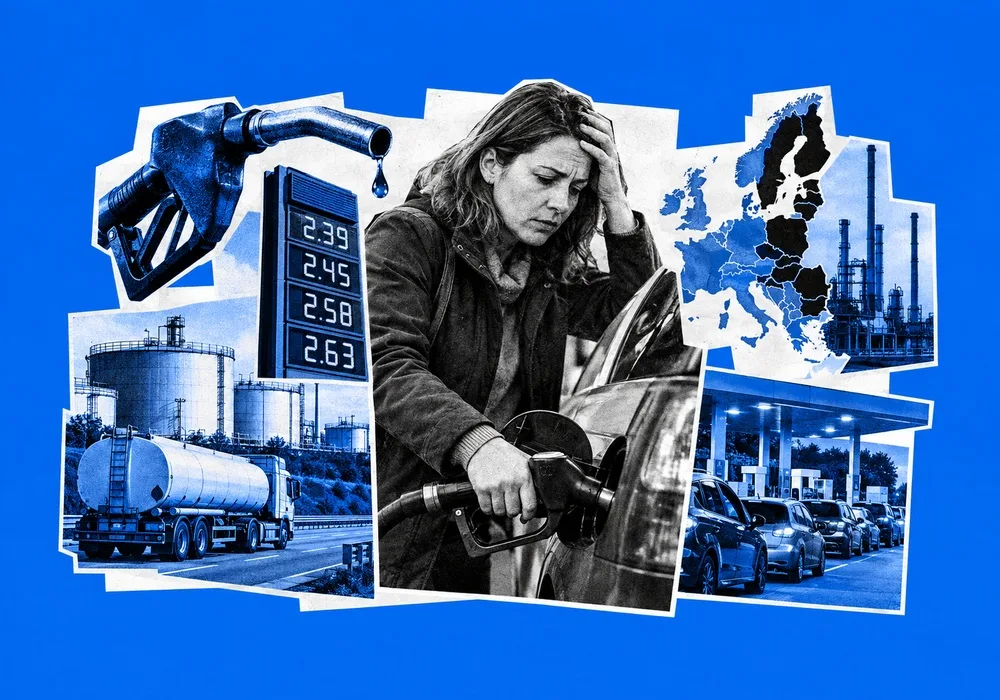
Europe’s latest fuel shock is exposing sharp differences in how the continent absorbs global energy disruptions. While the Netherlands, Denmark and Finland have some of the highest nominal petrol prices, purchasing-power-adjusted costs show a heavier burden in the Balkans, with Greece the most exposed EU member state.
Europe is facing another sharp increase in transport fuel costs as disruptions to major oil shipping routes continue to squeeze global supplies. Petrol prices have climbed above €2 per litre across much of the continent, while diesel has reached even higher levels, adding pressure on households, transport companies and energy-intensive businesses.
The disruption has been described by the Centre for Economic Policy Research as the largest physical supply disruption in the history of global energy markets. The immediate trigger is the reduced flow of oil and refined products through the Strait of Hormuz, compounded by disruption around the Bab el-Mandeb Strait. Fewer than 20 vessels a day were reportedly passing through Hormuz during the latest escalation, sharply limiting one of the world's most important energy routes.
Fuel prices diverge across Europe
The impact is not evenly distributed. As of 22 September, the Netherlands had Europe's highest average petrol price at €2.43 per litre, followed by Denmark at €2.35 and Finland at €2.32. France and Greece were also above €2.20 per litre.
Diesel prices were higher still. Denmark reached €2.52 per litre, while France stood at €2.40 and Italy at €2.36. By comparison, diesel cost around €1.70 in North Macedonia and €1.72 in Andorra, illustrating the wide differences in the immediate consumer impact of the crisis.
Headline prices, however, do not fully capture the economic pressure facing consumers. Once fuel costs are adjusted for differences in purchasing power, the picture shifts towards lower-income European economies. A 50-litre tank represents a substantially larger share of purchasing power in parts of the Balkans than in wealthier Western European markets.
Bosnia and Herzegovina has the highest relative burden in the Europe-wide comparison, while Greece is the most exposed EU member state on this measure for both petrol and diesel. The distinction is important because identical prices at the pump can have very different consequences for households depending on income levels and overall price structures.
The problem is moving from crude oil to refining
The current shock is not only a story about the price of crude. Europe is also facing tighter supplies of refined products, particularly diesel and jet fuel.
The International Energy Agency has reported that global refinery production in July was almost five million barrels per day below the level recorded a year earlier. Gulf supply disruptions are forcing refiners to search for alternative crude grades and supply routes, but different types of crude cannot always be substituted easily. Replacing established sources therefore increases both logistical and refining costs.
The pressure is being amplified by attacks and outages affecting refineries in Saudi Arabia, Kuwait and Bahrain. At the same time, disruption to Russian refining capacity is creating another shock to the global diesel market. The significance for Europe is indirect as well as direct: reduced Russian refinery output pushes other major buyers, including Turkey and Brazil, towards alternative supplies, tightening the international market for diesel.
This helps explain why diesel has become particularly expensive. European Central Bank experts told Euronews that diesel refining margins are expected to peak in October, while petrol margins appear to have peaked in August. Even if crude prices stabilise, pressure on refined products could therefore persist.
Europe still has supply buffers, but they are being tested
The immediate issue for the EU is therefore not a continent-wide physical fuel shortage. The European Commission's Oil Coordination Group said on 8 September that there was no immediate security-of-supply problem in the EU. European demand for diesel and jet fuel was still being met through higher refinery output and alternative supplies, while commercial and emergency stocks remained at sufficient levels.
The risk lies in how long those buffers can absorb the disruption. The IEA says more than 1.3 billion barrels of cumulative oil supply have been lost from Middle Eastern producers since the beginning of the shock, while flows through Hormuz fell from around 20 million barrels per day before the conflict to an average of 2.7 million barrels per day in March-May. Alternative suppliers, rerouting and stock drawdowns have so far prevented a much deeper physical shortage.
For Europe, prolonged disruption would make the cost of replacing Gulf supplies increasingly important. Refiners would have to compete for alternative crude, while transport companies and other fuel-intensive sectors would face higher operating costs. The effect could feed through into freight, agriculture, construction and consumer prices well beyond the petrol station.
A new test for Europe's energy resilience
The latest shock exposes a structural vulnerability in Europe's energy system: even after years of efforts to diversify suppliers and reduce dependence on individual sources, European consumers remain exposed to disruptions at global maritime chokepoints.
The Strait of Hormuz normally carries around one-fifth of global oil and LNG flows, while a significant share of international energy trade passes through maritime chokepoints. The current crisis is therefore testing not only Europe's fuel reserves but also the resilience of its refining, transport and supply networks.
The distributional effects are particularly important. Northern and Western European countries can record some of the continent's highest nominal pump prices, while lower-income economies in the Balkans can experience a heavier burden relative to purchasing power. This creates different political and economic pressures within the single market even when countries face the same global oil shock.
Governments are already responding with targeted measures. France, for example, has expanded fuel-related assistance for lower-income and high-mileage commuters and sectors including fishing, farming and construction, adding €450 million to its support package. The measures illustrate the growing tension between cushioning households and businesses from the shock and maintaining already strained public finances.
For the EU, the central challenge is no longer simply whether it can secure enough oil in the short term. It is whether alternative supply routes, refinery capacity and emergency stocks can absorb a prolonged disruption without turning an external energy shock into a broader inflationary and competitiveness problem.
Sources: Euronews, European Commission, IEA, CEPR/VoxEU