
Frontex expansion tests the limits of Europe’s externalised migration policy

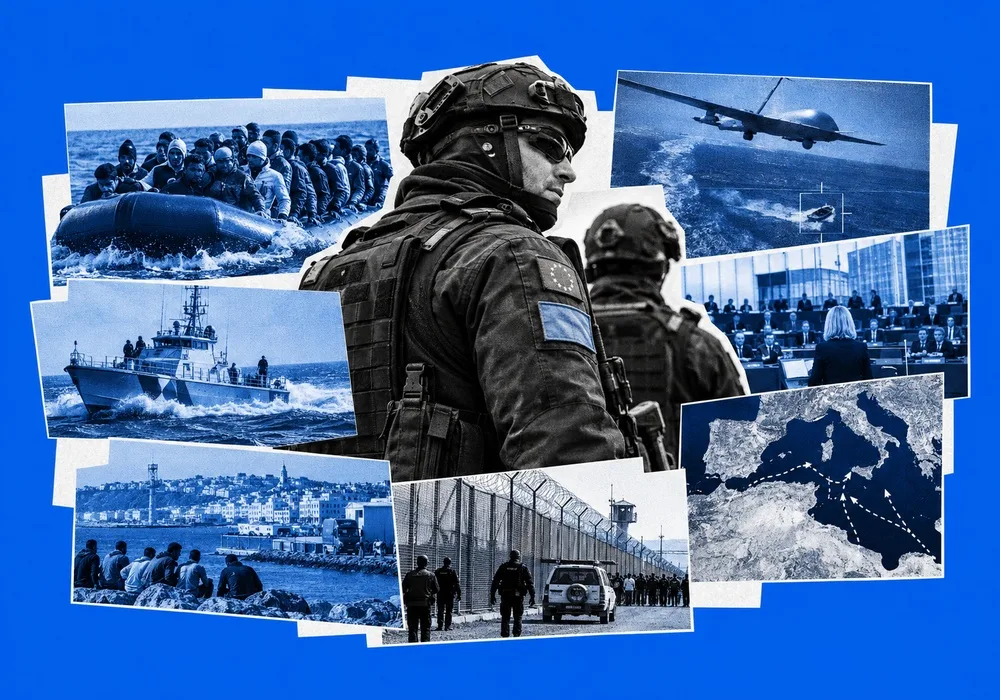
The EU is expanding Frontex and increasingly shifting migration control beyond its territory through surveillance and cooperation with third countries. A legal dispute over the agency's activities around Libya is testing the accountability of a European border system that increasingly operates outside the bloc's physical borders.
The European Union is entering a new phase of migration management in which the border is increasingly being controlled before migrants reach Europe. Member states are strengthening Frontex, expanding surveillance capabilities and relying more heavily on cooperation with countries along the main migration routes. The objective is not simply to manage arrivals more efficiently, but to prevent as many journeys as possible from reaching EU territory in the first place. This is gradually turning external migration control into a permanent part of the European security and border-management system.
The model is particularly visible in the central Mediterranean, where European surveillance and cooperation with North African countries have become central to efforts to reduce irregular arrivals. Libya is one of the most important partners in this system because a large proportion of migrants attempting to reach Italy travel from its shores. Yet the closer European migration policy becomes tied to Libyan authorities, the more difficult it becomes to separate the EU's border-control objectives from the conditions in which intercepted migrants are subsequently held.
Frontex is becoming a pillar of EU migration policy
Frontex was created to support national authorities in managing the EU's external borders. Its role has since expanded considerably, reflecting a broader European shift towards centralised border management and greater use of surveillance technology. Aircraft, drones, maritime monitoring systems and shared information allow European authorities to identify migration movements over increasingly large areas and coordinate responses before boats approach EU territory. The agency is consequently becoming an important part of the infrastructure through which Europe attempts to manage migration flows rather than simply respond to arrivals.
This expansion is taking place as governments across the EU face continued pressure to demonstrate greater control over irregular migration. The political debate is increasingly focused on preventing departures, disrupting smuggling networks and making returns more effective. That creates strong incentives to move intervention further away from European territory, because stopping a journey before it reaches an EU border avoids the subsequent pressure on reception centres, asylum systems and national authorities. Frontex therefore sits at the intersection of border management, migration policy and a broader European effort to shift control upstream.
Libya exposes the limits of the externalisation strategy
The central Mediterranean demonstrates why this approach is both attractive and difficult for the EU. Cooperation with Libyan authorities can help European governments reduce the number of migrant boats reaching Italy and Malta, while European surveillance makes it possible to identify vessels before they arrive. But the effectiveness of this system depends on a partner whose treatment of migrants has repeatedly attracted international criticism. UN bodies and human rights organisations have documented allegations of arbitrary detention, torture, trafficking and other abuses involving migrants in Libya.
This creates a structural problem for European policymakers. The EU can influence what happens on migration routes outside its territory through funding, equipment, surveillance and information-sharing, but it cannot exercise the same degree of institutional control over third-country authorities that it exercises over its own agencies and member states. As a result, the European migration system increasingly depends on actors operating under different legal and political conditions. The more important these partnerships become, the more difficult it becomes for the EU to treat their consequences as entirely external to European policy.
A legal challenge puts Frontex under scrutiny
That question is at the centre of a case before the EU courts involving a Sudanese asylum seeker who is in Libya. The claimant argues that Frontex surveillance contributed to the identification of migrant boats and to their subsequent interception and return to Libya. Human rights organisations supporting the case have argued that information collected through European surveillance was used in a way that contributed to preventing migrants from reaching European territory.
Frontex disputes the interpretation of its role. The agency has maintained that its aerial surveillance is primarily intended to identify vessels and support maritime safety, while rejecting the claim that it directly provides information to the Libyan coast guard for the purpose of returning migrants. The dispute therefore goes beyond the question of whether a particular piece of information was transmitted. It raises a broader issue about whether an EU institution can bear legal responsibility for consequences that occur when its surveillance and information are incorporated into operations conducted by a third-country authority.
The real issue is the chain of responsibility
This distinction is becoming increasingly important as European migration policy moves further outside the EU. A surveillance aircraft can identify a vessel, an information centre can relay its location, a third-country authority can intercept it and migrants can subsequently be taken to detention facilities. Each stage may involve a different institution, but the overall process can still form a single operational chain.
That makes accountability much harder to establish. European authorities can point to the fact that they did not physically carry out an interception, while critics can argue that European surveillance and coordination helped make the interception possible. The legal significance of the Frontex case lies precisely in testing where responsibility lies within that chain. A ruling that expands the obligations of EU agencies could affect how similar operations are organised in the future.
Europe is building a border beyond its territory
The dispute also highlights the scale of the transformation taking place in European migration policy. The EU increasingly seeks to manage migration through agreements and operational cooperation with countries of origin and transit, rather than relying only on controls at its geographical borders. Financial assistance, training, surveillance, information-sharing and cooperation on returns are becoming interconnected elements of a single system.
This approach effectively creates a European border that extends beyond the physical territory of the Union. Migration can be monitored in international waters, departures can be discouraged in North Africa and people can be prevented from reaching Europe before they have the opportunity to request protection on EU territory. For European governments, this offers a way to reduce pressure on domestic asylum and reception systems. For European institutions, however, it creates a much more complicated question of how EU law and fundamental-rights obligations apply when European capabilities are deployed beyond EU jurisdiction.
The return system makes external partnerships even more important
The issue is becoming more significant as the EU also seeks to increase the effectiveness of its return policy. European governments want rejected asylum seekers and people without a legal right to remain to leave the bloc more quickly, while the EU is seeking stronger cooperation from countries of origin and transit. The success of these policies depends heavily on the willingness and capacity of governments outside the EU to accept returned nationals and cooperate with European authorities.
This creates a migration system in which prevention and returns are increasingly connected. If irregular journeys can be disrupted before departure or during the crossing, fewer people reach the EU's asylum system. If those who do arrive can be returned more efficiently, governments gain another mechanism for controlling migration numbers. Both elements, however, depend on relationships with countries where European standards and institutional safeguards may not always be applied in the same way.
Frontex faces a new kind of accountability
The expansion of Frontex therefore creates an institutional challenge that goes beyond the agency's traditional role at the EU's external borders. As its surveillance and operational capabilities grow, its activities can have consequences far beyond the locations where Frontex personnel are physically present. That makes questions about information-sharing, cooperation with third countries and oversight increasingly important.
The legal dispute involving Libya could become relevant to that broader debate. If EU courts establish that agencies can face responsibility for certain consequences resulting from their surveillance or cooperation with third-country authorities, future operations could require stronger safeguards and clearer documentation. Such a development would not necessarily prevent cooperation with countries outside the EU, but it could make the legal conditions under which that cooperation takes place considerably more demanding.
Migration policy is becoming part of Europe’s security architecture
There is also a wider strategic dimension to this transformation. Migration control is increasingly being integrated with maritime surveillance, border security, intelligence-sharing and efforts to disrupt organised smuggling networks. This is changing the institutional character of migration policy: it is no longer confined to asylum authorities and border guards but increasingly involves the same surveillance and security infrastructure used to monitor other cross-border threats.
For European governments, that integration offers greater capacity to anticipate movements rather than simply react to them. But it also raises questions about proportionality, oversight and transparency because the systems involved can operate far from the public institutions and courts that traditionally scrutinise migration policy. The more technologically advanced and geographically dispersed the system becomes, the more important it is to establish clear rules governing how information is collected, shared and acted upon.
The next test for Europe’s externalised border
The Frontex-Libya dispute is therefore significant not because it concerns one surveillance operation, but because it reflects a much larger change in the way the EU approaches migration. Europe is developing a system designed to intervene earlier, operate across borders and rely more heavily on third-country partners. That strategy can reduce the number of people reaching EU territory, but it also creates a more complex network of responsibility stretching across multiple jurisdictions.
The central question for the coming years will be how far this model can expand while maintaining effective legal oversight. If Europe increasingly exercises border-control functions outside its own territory, the distinction between European action and the actions of its partners will become less straightforward. The future of EU migration policy will therefore depend not only on how much control Europe can exercise over migration routes, but also on how clearly it defines responsibility for the consequences of that control.
The debate surrounding Frontex is ultimately part of this larger transition. Europe is moving from a model focused primarily on managing migration at its borders towards one that seeks to shape migration movements well before they reach them. That makes external partnerships indispensable to the strategy — and makes the legal and political accountability of those partnerships one of the defining challenges for the EU's next phase of migration policy.
Sources: Front-LEX, Associated Press