
France Strengthens Infrastructure Protection Amid Rising Hybrid Threats

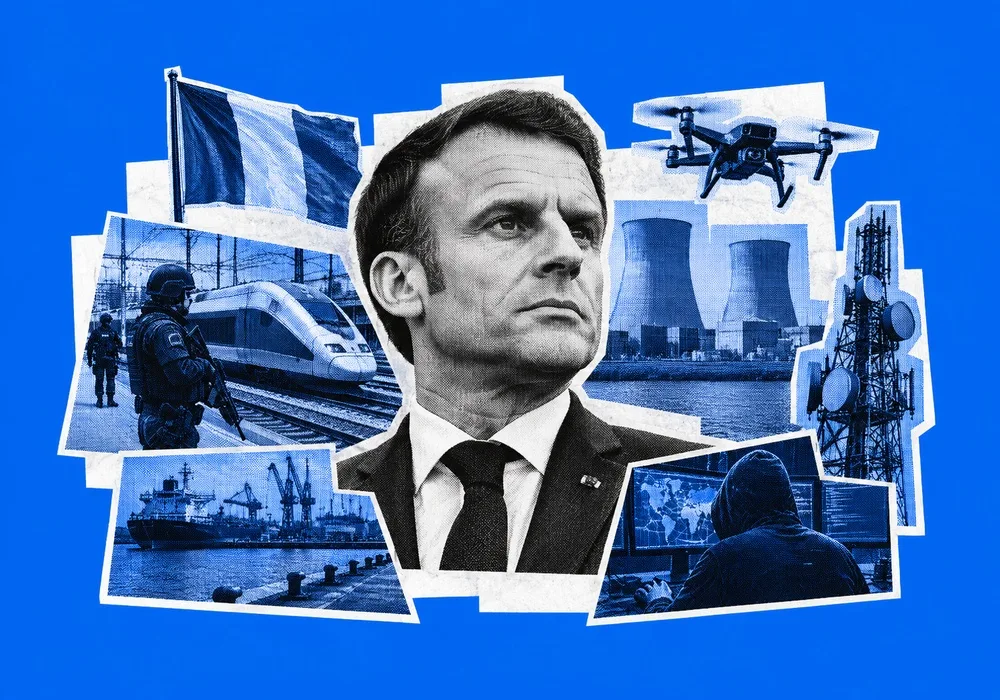
France will prepare a national plan to protect critical infrastructure and sensitive defence-industrial sites from drone and cyber threats as President Emmanuel Macron warns of intensifying Russian hybrid activity. Paris is also preparing a G7 meeting on energy security as rising oil and gas prices increase pressure on European economies.
French President Emmanuel Macron has ordered the government to prepare a national plan to protect critical infrastructure and the most sensitive sites in the country’s defence and technology industries from drone and cyberattacks. The decision follows what Macron described as an intensification of the Russian hybrid threat to France and other European countries, with recent incidents raising concerns over the vulnerability of infrastructure beyond conventional military targets.
The announcement came after a meeting at the Élysée Palace on 18 September with leaders of political parties represented in the French parliament and candidates for the 2027 presidential election. French intelligence and security officials briefed the participants on developments in Ukraine and the Middle East, as well as the wider security implications for France. Macron used the meeting to outline both immediate protective measures and a broader response to the changing security environment.
France expands protection of critical infrastructure
Macron instructed the government to draw up measures covering critical infrastructure and sensitive facilities belonging to France’s defence-industrial and technological base. The plan is expected to address the risks posed by drones and cyberattacks, alongside existing efforts to counter foreign interference and disinformation.
The move reflects a widening definition of infrastructure security in France. Protection is increasingly extending beyond traditional targets such as energy networks, airports and transport systems to facilities that support defence production and advanced technologies. Such sites have become more strategically important as European countries increase military spending and expand their defence-industrial capacity.
France has already established mechanisms to monitor and respond to foreign interference. The government’s VIGINUM service, created to detect and counter foreign digital interference, is part of this system, while French authorities have also worked with European partners facing similar threats. Macron said France would continue strengthening these capabilities as hostile activity becomes more diverse.
Drone and cyber threats move higher on the agenda
Macron referred to a series of incidents across Europe as evidence of the changing security environment. Among them was an incident at Leipzig-Halle airport in Germany involving a drone that German authorities said was connected to Russian activity. Other European countries have also reported unexplained drone sightings, disruptions and suspected interference affecting sensitive sites and infrastructure.
The French president said such operations were intended to create uncertainty and pressure European societies supporting Ukraine. At the same time, he stressed that France should avoid a direct confrontation with Russia and continue supporting Ukraine through its existing political, economic and military commitments.
This distinction is central to the French approach. Paris is seeking to increase the cost and difficulty of hostile operations while keeping its response below the threshold of direct military confrontation. Strengthening infrastructure protection is therefore being presented as a resilience measure rather than as a move towards a new military posture against Russia.
Defence industry becomes part of the security perimeter
The decision to include sensitive defence-industrial facilities in the new plan comes as France and other European countries seek to expand weapons production. European governments are investing in additional manufacturing capacity, ammunition production and supply chains after years of limited defence spending and the demands created by Russia’s full-scale invasion of Ukraine.
The expansion of defence production also creates new vulnerabilities. Manufacturing plants, research facilities, technology companies and logistics networks can be targeted through physical attacks, cyber operations, espionage or sabotage. Protecting these sites is therefore becoming an increasingly important component of European defence planning.
For France, the issue extends beyond individual factories. The resilience of the defence-industrial base depends on electricity, transport, telecommunications, digital infrastructure and specialised suppliers. A disruption at any point in that chain can affect the wider ability to produce and deliver military equipment.
Energy security becomes a parallel concern
The same Élysée meeting also focused on the economic effects of the war in the Middle East and the resulting disruption to energy markets. Macron said rising prices for oil, refined products and gas were creating additional pressure on French households and businesses, with diesel, aviation fuel and natural gas among the government’s main concerns.
The pressure comes as European energy markets remain exposed to developments outside the continent. Disruptions around major transport routes can quickly affect crude oil and gas prices even when European countries have sufficient physical supplies. For governments, this makes energy security increasingly dependent not only on storage levels but also on access to alternative suppliers and transport infrastructure.
France is in a relatively stronger position on electricity because of its large nuclear fleet, but this does not shield the country from global oil and gas price movements. Higher fuel prices affect transport and logistics, while gas prices can feed into industrial production and broader inflation across the European economy.
Paris seeks alternative energy supplies
Macron said France was already discussing additional energy supplies with Saudi Arabia, Iraq, Qatar, the United Arab Emirates and Nigeria. The discussions cover crude oil, refined products and gas, with Paris looking to diversify supply routes and reduce exposure to disruptions affecting existing corridors.
France is also examining longer-term infrastructure options involving the Middle East and the Mediterranean. Macron referred to possible routes connecting Iraqi energy production with Mediterranean markets and cooperation involving countries in the region. The objective is to create additional channels for energy imports rather than relying excessively on a limited number of vulnerable routes.
Paris is also looking towards Canada. Macron said he planned to discuss oil and liquefied natural gas supplies with Canadian Prime Minister Mark Carney, adding another dimension to France’s effort to diversify its energy relationships.
G7 to coordinate response to energy shock
France, which currently holds the G7 presidency, will convene a meeting of the group dedicated to energy security in the coming weeks. The talks are expected to address supply coordination, strategic reserves and measures to limit the economic effects of disruptions in global energy markets.
Macron said the G7 could examine the possibility of releasing or otherwise making greater use of strategic reserves. Earlier coordinated releases by major economies demonstrated the role such reserves can play in responding to sudden disruptions, although their use also reduces the buffer available for future emergencies.
For Europe, coordination among the G7 is particularly relevant because oil markets are global while European countries have different levels of exposure to imported energy. A coordinated response can therefore address supply risks at a broader level than individual national measures.
France pushes for EU-level measures
Paris is also seeking a stronger European response. Macron said he would raise energy security with European Commission President Ursula von der Leyen, with France pushing for faster work on gas storage, more flexible energy markets and measures to preserve import and refining capacity.
The French government is also examining ways to increase refining capacity and make greater use of available infrastructure. Macron said France was looking at measures involving biofuels and other alternatives that could reduce pressure on conventional fuel supplies.
The emphasis on refining is important because access to crude oil does not automatically guarantee sufficient supplies of finished fuels. Refinery capacity, shipping routes, storage facilities and distribution networks all determine how quickly imported energy can reach consumers and industry.
Macron rejects broad fuel subsidies
The government is also facing pressure over the domestic impact of higher energy prices. Macron rejected a broad return to fuel subsidies, warning that such measures could increase France’s budget deficit or require higher taxes. Instead, the government plans to review existing support mechanisms and consider targeted assistance for sectors and households most affected by the price increases.
The approach reflects France’s wider fiscal constraints. Large-scale compensation could soften the immediate impact on consumers but would also add pressure to public finances at a time when Paris is attempting to reduce its deficit.
The government is therefore looking at a combination of targeted support and measures intended to reduce the underlying cost of energy. These include securing additional supplies, improving infrastructure and increasing the flexibility of the European energy system.
Security and energy policy increasingly overlap
The two sets of measures announced by Macron are formally separate, but they reflect a broader shift in how European governments approach resilience. Critical infrastructure, defence production, energy supplies and transport networks are increasingly treated as interconnected elements of national security.
A cyberattack against an industrial facility, a drone incident near an airport or disruption to an energy route can have consequences extending well beyond the immediate target. The resulting economic costs can affect defence production, public finances and political decision-making at the same time.
For France, the immediate response is therefore focused on strengthening physical and digital protection while maintaining access to energy supplies. At European level, the same approach is increasingly visible in efforts to protect defence-industrial capacity, diversify energy imports and reduce vulnerabilities in strategic infrastructure.
Macron’s latest measures place these issues within the same broader security framework: protecting the infrastructure needed to sustain France’s economy and defence capabilities while limiting the effects of external geopolitical shocks.
Sources: Euractiv