
France Pushes to Lift EU Sanctions on Usmanov Amid Azerbaijan Pressure

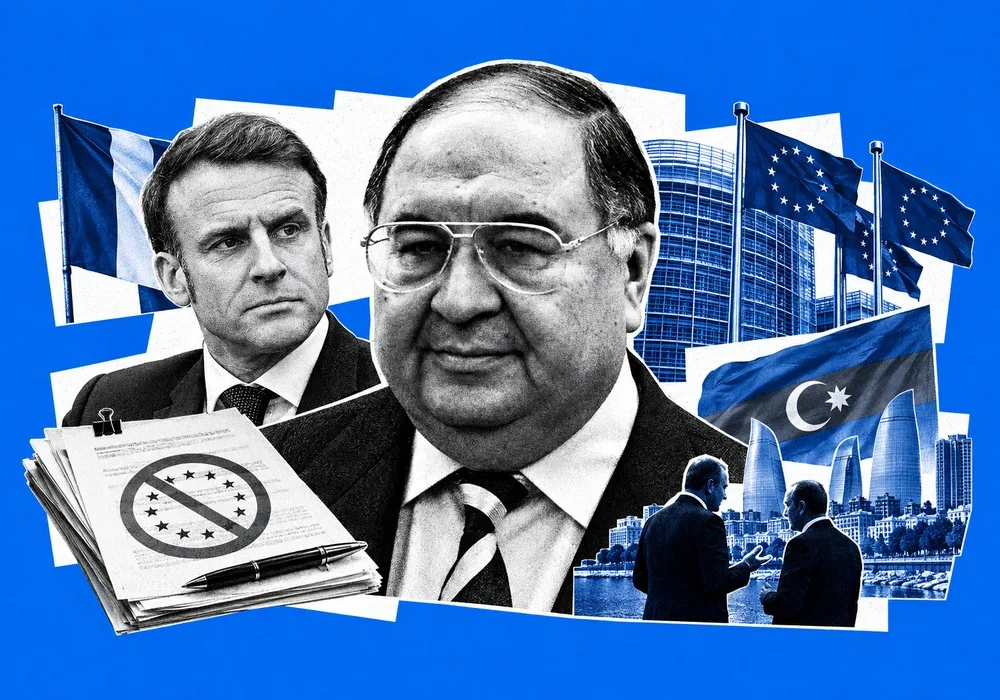
France is pushing to remove Russian-Uzbek billionaire Alisher Usmanov from the EU sanctions list, delaying the renewal of sanctions against nearly 3,000 individuals and entities. European diplomats link Paris’s position to pressure from Azerbaijan over French nationals detained there, raising wider questions about the EU’s ability to maintain a unified sanctions policy.
France is pushing for the European Union to remove Russian-Uzbek billionaire Alisher Usmanov from its sanctions list, in a move that has delayed the renewal of the bloc’s broader sanctions regime against Russia. European diplomats say the French position is linked to pressure from Azerbaijan over two French nationals detained in the country, while Paris has publicly framed its stance as a matter of national security.
The dispute has forced the EU to postpone a decision that normally passes with little difficulty. The bloc’s sanctions listings, covering almost 3,000 individuals and entities, require unanimous approval from all 27 member states for renewal. After France joined Slovakia in opposing the continued listing of Usmanov, EU ambassadors extended the deadline until September 22, giving governments another week to resolve the disagreement.
A dispute over one name holding up a wider sanctions renewal
Usmanov has been under EU sanctions since Russia’s full-scale invasion of Ukraine in 2022. The billionaire, whose wealth was built through mining and telecommunications, has challenged the measures in European courts and disputed media statements that were used in the justification for his listing. His legal campaign has continued alongside repeated political efforts by several countries to have him removed from the sanctions regime.

Until recently, Slovakia had been the principal obstacle to the renewal of sanctions against Usmanov. France’s decision to join Bratislava has changed the arithmetic inside the EU and created a much broader political problem: a measure designed to maintain collective pressure on Russia can be held up by disputes that are not directly related to the sanctions themselves.
The issue is particularly sensitive because the EU sanctions list is renewed as a package. A disagreement over individual names can therefore delay the continuation of restrictions covering thousands of people and companies. The September 22 deadline now gives member states only a limited window to find a compromise before the measures expire.
The Azerbaijan connection
European diplomats told Reuters that Paris privately linked the Usmanov case to Azerbaijan’s detention of two French nationals. One of them, French businessman Martin Ryan, is serving a 10-year prison sentence in Azerbaijan on espionage charges that he denies. France has described his detention as arbitrary and called for his immediate release. Another French national, Anass Derraz, was sentenced to 12 years in Azerbaijan in a separate case.
Diplomats said Azerbaijan was using Usmanov’s position on the EU sanctions list as leverage in its dealings with France. Reuters reported that France believes Baku’s position has received backing from Qatar and Kazakhstan, although the governments involved did not immediately respond to requests for comment. The French Foreign Ministry declined to comment specifically on the alleged Azerbaijan connection.
Paris has instead described its position in broader national-security terms, saying it wants to respond positively to approaches from international partners concerning Usmanov. French officials have not publicly confirmed that the lifting of sanctions is being negotiated in exchange for the release of French citizens.
The uncertainty around the alleged linkage is important. The reported connection between the detainees in Azerbaijan and Usmanov’s sanctions status comes from European diplomats and was also reported by the Financial Times and Le Monde; there has been no public confirmation from Paris or Baku of a formal bargain.
France and Azerbaijan already have a difficult relationship
The dispute comes against a backdrop of deteriorating relations between Paris and Baku. Tensions intensified after Azerbaijan regained control of Nagorno-Karabakh in 2023, prompting the exodus of around 120,000 ethnic Armenians from the region. France subsequently expanded its military and political support for Armenia, angering Azerbaijan.
Paris has also accused Azerbaijan-linked groups of conducting disinformation campaigns in France and attempting to inflame tensions around unrest and independence demands in New Caledonia. Baku has rejected the broader French approach to the South Caucasus and has previously criticised Paris for its support for Armenia.
Azerbaijan’s interest in Usmanov is not entirely new. According to Reuters, President Ilham Aliyev has previously lobbied for the billionaire to be removed from the EU sanctions list, while other regional leaders, including Turkish President Recep Tayyip Erdogan, have also called for Usmanov’s delisting.
A wider test for EU sanctions policy
The immediate dispute concerns one individual, but its implications extend to how the EU manages sanctions as a collective foreign-policy instrument. Because renewal requires unanimity, any member state can delay the process, creating space for bilateral disputes and national interests to enter decisions formally designed to respond to Russia’s war against Ukraine.
This is not the first time an individual sanctions case has become entangled with wider political negotiations. Hungary and Slovakia have previously challenged parts of the EU sanctions regime, while in March 2025 the two countries secured the removal of Usmanov’s sister, Gulbakhor Ismailova, from the sanctions list.
The difference now is that France is one of the EU’s principal supporters of Ukraine and has traditionally backed a strong European response to Russia. French officials have stressed that Paris remains committed to increasing pressure on the Russian war machine. The disagreement therefore creates tension between France’s stated strategic position on Ukraine and its current demand concerning one of the individuals targeted by EU sanctions.
For Brussels, the central issue is not only whether Usmanov remains sanctioned. It is also whether the EU can maintain a predictable sanctions policy when national governments face separate diplomatic or security pressures. If an individual’s removal can become part of negotiations over detained European citizens, other governments could face similar demands in future disputes.
The next decision is expected on September 18, ahead of the September 22 deadline. Until then, EU governments will have to determine whether a compromise can preserve the wider sanctions package while addressing France’s objections over Usmanov.
Sources: Financial Times, Le Monde