
Europe’s Winter 2026 Gas Crisis: Low Storage and Shipping Disruption Threaten Prices

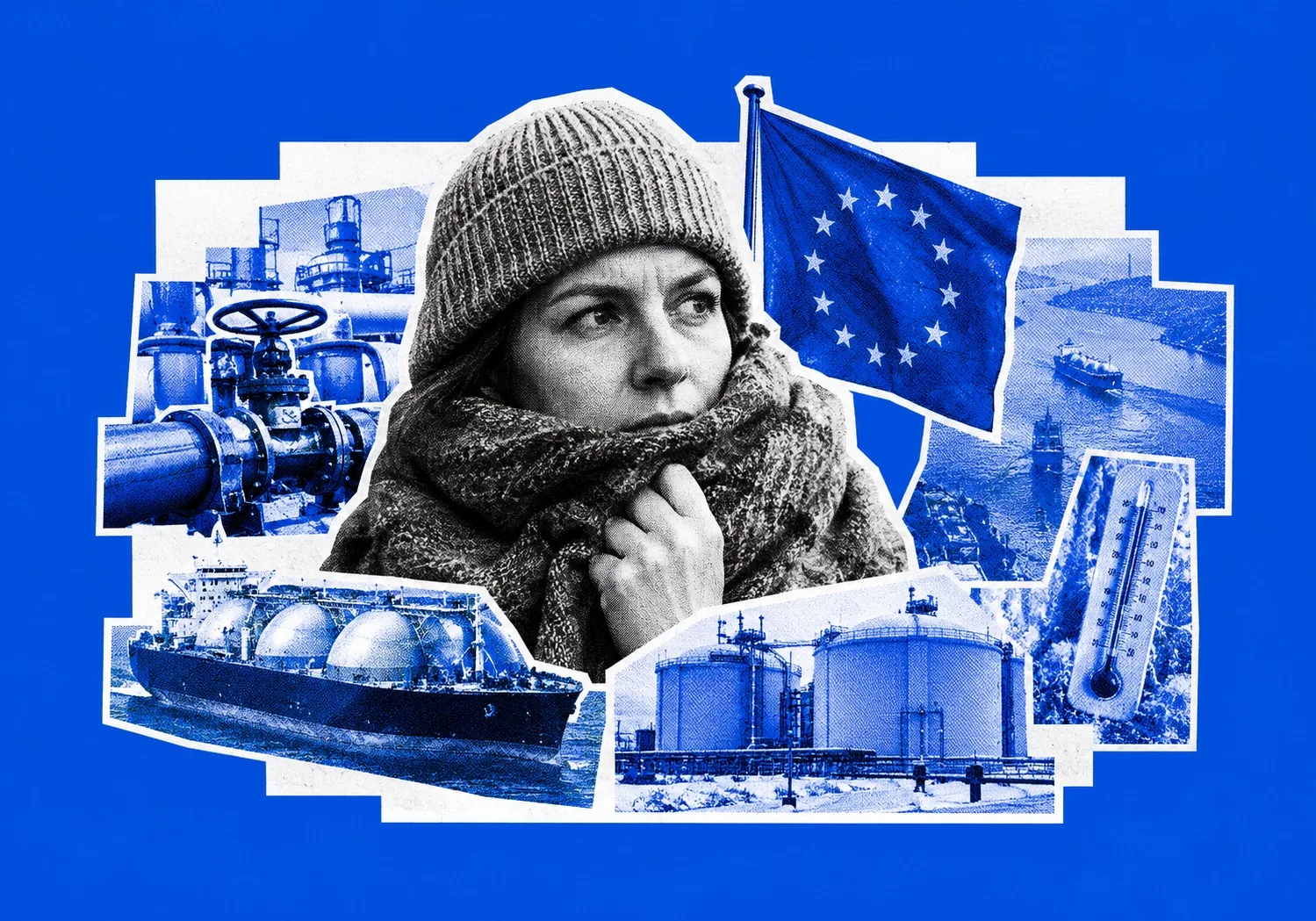
Europe enters the winter of 2026 with underground gas storage at just 70% - its lowest seasonal level since 2011. Combined with Middle East shipping bottlenecks disrupting global LNG flows and an upcoming EU ban on Russian gas, the continent faces severe price volatility. While blackouts remain unlikely, high market competition for limited fuel could drive up energy bills for European households and factories this season.
Gas is available on global markets, but availability is not the same as security. Europe must now compete for cargoes, pay prices set by international demand, and hope that commercial incentives align with the need to fill storage before winter.
This year, they did not.
When the market stops preparing for winter
European storage facilities were supposed to provide a buffer against precisely the sort of uncertainty now facing the continent. Gas bought during the warmer months could be held underground and withdrawn when heating demand increased. The arrangement did not eliminate price volatility, but it gave suppliers and governments some room to absorb seasonal fluctuations.
In 2026, that mechanism ran into an uncomfortable commercial reality. Summer gas prices were higher than winter forward prices, making it more attractive for traders to sell gas immediately than to buy additional volumes and store them for later. Filling storage became a financial proposition that private operators had little incentive to pursue.
The result is a clash between two different definitions of security. For a trader, a storage facility is an asset whose value depends on the relationship between purchase prices, future prices and operating costs. For a government, it is insurance against a cold winter, disrupted shipping or a sudden shortage. The social value of that insurance does not necessarily appear on a commercial balance sheet.
Europe's difficulty is not simply that traders made individual decisions that proved inconvenient. It is that the market increasingly responsible for securing the continent's energy supply does not automatically reward the accumulation of reserves needed to protect it.
With storage only just above 70% in early October, the margin for error is considerably narrower than usual. A cold spell would accelerate withdrawals precisely when replenishing supplies could become more expensive and more difficult.
The distinction matters because Europe cannot manufacture additional gas on demand. Its ability to respond depends on storage, available imports, and consumers' willingness or capacity to reduce consumption.
A distant conflict reaches European heating bills
The problem extends well beyond Europe's storage facilities. The ongoing US-Israeli war in the Middle East has disrupted shipping through the Strait of Hormuz, a strategic maritime corridor handling roughly a fifth of global liquefied natural gas trade, including Qatari supplies.
Europe's imports of Qatari gas fell by 5.1 billion cubic metres between January and August 2026 compared with the same period a year earlier. For a continent increasingly dependent on LNG, the disruption removes flexibility from an already constrained market.
The effect is not limited to cargoes that would otherwise have arrived directly in Europe. LNG is traded internationally. When supplies from one exporting region become harder to move, buyers elsewhere compete more aggressively for alternative shipments. European importers may have to offer higher prices to secure cargoes that can be delivered from the United States or other producers outside the affected region.
Asian buyers are part of the same contest. If their demand rises during a cold spell, European purchasers cannot assume that available LNG will automatically head towards European terminals. The cargoes go where commercial conditions are most attractive, subject to contractual and logistical constraints.
That is how a conflict thousands of kilometres away can reach a household's heating bill without any direct interruption to the infrastructure supplying that home. The geopolitical shock changes the price of the fuel available to European utilities, which then face pressure to pass higher costs through to customers.
The European Commission maintains that the bloc's infrastructure is flexible enough to avoid blackouts. Expanded LNG import capacity and the ability to obtain supplies from different directions offer genuine protection. But infrastructure cannot guarantee that sufficient gas will be available at an affordable price.
Europe may be able to buy its way through a shortage. The question is how much consumers and industry will have to pay.
Fourteen billion cubic metres at stake
The potential gap is substantial. If the coming winter is as cold as the previous one, analysts estimate that Europe's gas supply shortfall could reach 14 billion cubic metres, equivalent to around 7% of total EU demand or the annual energy consumption of 10 million to 12 million households.
ENTSO-G's winter outlook points to a more severe possibility. If cold weather coincides with restricted LNG inflows, underground storage could fall to just 11% by the end of the season. Such a level would breach safe strategic reserve baselines and leave the bloc with a weakened starting position for replenishing supplies ahead of the next winter.
Maintaining storage at a safer 30% threshold would require Europe to reduce demand by about 7% or withhold an equivalent volume from consumers under the scenario described in the outlook.
That is the uncomfortable arithmetic behind assurances that the system can remain operational. A country can avoid blackouts and still experience an energy crisis in the form of unaffordable bills, reduced industrial output or restrictions on consumption. Physical continuity of supply is a lower bar than economic security.
The consequences would not be distributed evenly. France, the Netherlands and Portugal, among the main European entry points for Russian LNG, face particular adjustment pressures as alternative supplies must replace volumes affected by the forthcoming EU restrictions. Their exposure to Russian LNG does not mean that the entire burden will fall on those countries, since gas markets and infrastructure connect national systems. It does, however, leave them with a more immediate challenge in reorganising supply.
Heavy industry would face difficult choices if prices rose sharply or authorities required consumption cuts. Energy-intensive businesses cannot always reduce gas use without affecting production. Households, meanwhile, have less scope to respond to higher bills, particularly during a prolonged cold spell when heating is not an optional expense.
The Russian gas decision adds another constraint
On 1 January 2027, an EU-wide ban on long-term Russian LNG supply contracts is scheduled to take effect, removing an estimated 7 billion cubic metres of supply from the European market.
The policy continues Europe's effort to end its reliance on Russian energy following the invasion of Ukraine. Yet its timing creates a difficult practical question: how much replacement supply can Europe secure, and at what price, while storage remains under pressure and global shipping is disrupted?
The additional volume is not necessarily impossible to replace. The problem is that replacement depends on a market whose capacity to deliver is constrained by export availability, transport routes and competition from other buyers. The more urgently Europe needs alternative cargoes, the less comfortable its bargaining position becomes.
The cost estimate is significant. Replacing potential shortfalls with alternative seaborne LNG, predominantly from the United States, could add €3 billion to Europe's bill, around 12% more than in the previous year. That premium would feed into an economy already vulnerable to higher energy costs and renewed inflationary pressure.
American LNG exporters stand to gain from Europe's continued shift away from Russian supplies. Global energy traders may also benefit from greater volatility and stronger competition for cargoes. European buyers, by contrast, must absorb the financial consequences of a transition that improves geopolitical independence while exposing them more directly to global price movements.
The choice is not simply between Russian gas and American gas. It is between different forms of dependence. Pipeline contracts once offered a degree of predictability in volumes and delivery, even when the political relationship behind them was deeply problematic. LNG offers greater geographical flexibility, but that flexibility has a price: Europe must compete with the rest of the world every time supplies tighten.
The crisis has changed its character
The current predicament differs from the acute supply shock that followed Russia's full-scale invasion of Ukraine in 2022. Europe has since reorganised its imports, reduced its reliance on Russian pipeline gas and adapted to a more international market. Its energy system is not starting from the same position as it was then.
But the adjustment has created a different vulnerability. Europe now depends more heavily on a combination of commercial storage decisions and seaborne LNG purchases, exposing it to maritime chokepoints and the purchasing power of competing economies.
The briefing also points to a lasting reduction in industrial gas demand of about 20% following earlier conflicts and market disruptions. Lower consumption can ease supply pressure, but a decline driven by industrial contraction is not the same as an improvement in energy efficiency. If production has been curtailed because energy has become too expensive, the adjustment carries an economic cost of its own.
There is no simple return to the old system. Russian LNG restrictions are approaching, while Europe's dependence on international cargoes is becoming more entrenched. The commercial incentives that determine whether storage is filled will continue to matter, particularly if seasonal price differences fail to compensate traders for holding gas.
Governments can seek to coordinate purchases, encourage conservation and prepare measures to reduce demand in an emergency. Yet those interventions would be operating against a market that increasingly allocates scarce supplies through price. During a severe cold snap, the adjustment may therefore arrive not through a sudden physical collapse but through higher bills, industrial cutbacks and pressure on governments to decide which consumers should bear the cost.
Europe has spent years rebuilding its energy security around diversification. The coming winter will test whether diversification alone is enough when the fuel itself remains scarce, storage is commercially unattractive, and the next cargo can be diverted by events beyond the continent's control.
Sources: Politico, IEEFA, European Commission, Euronews