
Europe Is Deciding What Its Next Common Symbol Will Look Like

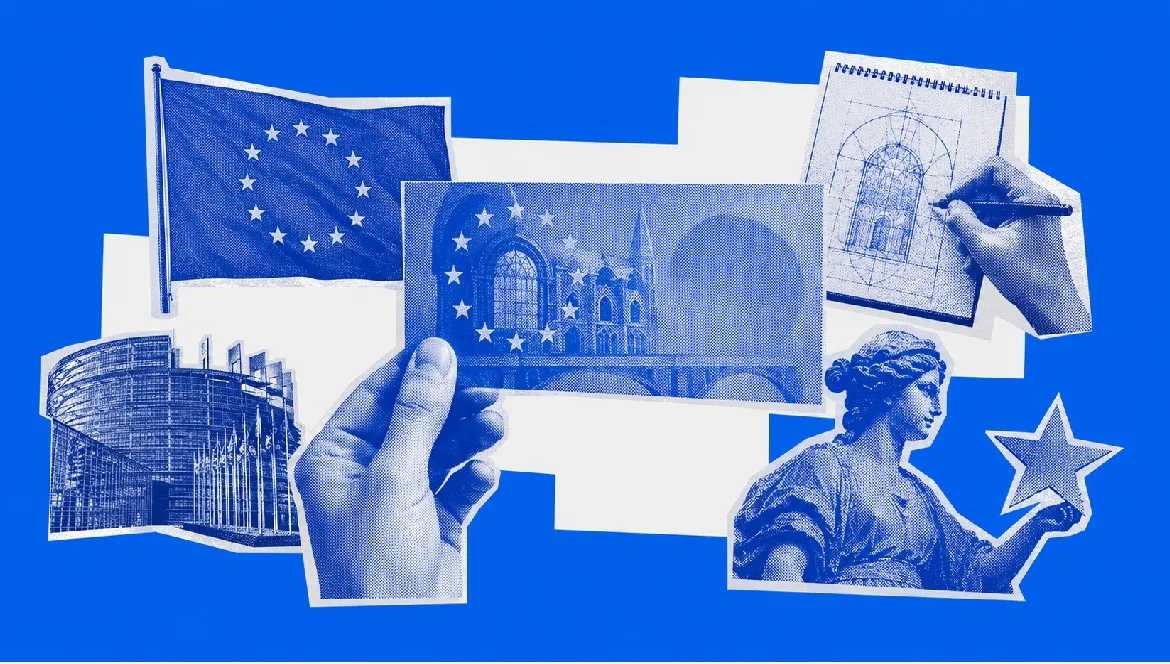
Europe is redesigning its euro banknotes for the first time in more than two decades. Ten final concepts are competing to define the image of a common Europe that millions of people will carry in their hands.
Europe is voting on the future of the euro banknotes. At first glance, this is a story about colours, portraits and birds. In reality, the European Central Bank is trying to answer a much more difficult question: what can represent Europe today, when the continent is increasingly defined by the absence of a single shared cultural canon?
The ECB has unveiled ten shortlisted design concepts for the next generation of euro banknotes and opened a public survey that will run until 21 September. Five proposals are built around the theme ‘European culture’, while another five focus on ‘Rivers and birds’. The ECB’s Governing Council is expected to select the final theme by the end of 2026.
This will be the first complete redesign of the euro banknotes since the currency was introduced. The first notes entered circulation in 2002, while the second series began to appear in 2013. The new banknotes will not replace them immediately. Their development, testing and production will take several years, and existing notes will remain legal tender.
From Ancient Arches to a Europe That Has Yet to Be Defined
The first euro series avoided depicting specific national heroes or recognisable landmarks. Instead, it featured fictional windows, gateways and bridges inspired by different periods of European architecture, but not tied to any particular country. That was a deliberate compromise for a currency intended to unite states with very different histories and national memories.
More than two decades later, that approach no longer seems quite as obvious. The euro has become one of the most visible physical symbols of European integration, yet the banknotes themselves say remarkably little about the people who make that integration possible. The new process effectively reopens a question that the original designs tried to avoid: should Europe represent itself through specific people, through the natural world, or through an abstract idea of shared life?

The concepts built around European culture include figures such as Marie Skłodowska-Curie, Ludwig van Beethoven and Leonardo da Vinci — personalities whose significance extends beyond the borders of any single modern state. The reverse sides feature schools, libraries, cultural spaces, stages and other places where culture is not simply preserved, but created.
It is a significant shift in emphasis. European culture is presented not as a museum of the past, but as an ongoing process of exchange between generations, languages, cities and communities. That distinction matters for a political project that has always struggled with the question of how to create a common identity without erasing the identities that already exist.
Nature Offers a Less Contentious European Symbol
The second theme, ‘Rivers and birds’, offers a different route. Instead of focusing on major historical figures, it centres on natural systems that do not recognise national borders. Rivers cross countries, birds migrate across continents and ecosystems exist independently of political boundaries. In that sense, nature may be one of the clearest symbols of European interdependence.
The theme brings together two separate ideas — rivers as the ‘lifeblood of Europe’ and birds as symbols of freedom, resilience and diversity. The decision to combine them followed earlier consultations in which Europeans showed strong support for cultural and environmental themes.
The choice between the two approaches is, in effect, a choice between two ways of imagining Europe. One says that Europe is a shared history, an intellectual inheritance and a cultural tradition. The other responds that Europe is a common space in which people, water, animals and ecosystems constantly cross borders.
The second vision may be particularly suited to a Union that is increasingly forced to think in terms of interdependence. Climate change, energy networks, migration routes and supply chains have all made the idea of borders more complicated. A river or a migrating bird may therefore communicate something about Europe that a historical figure cannot: the fact that the continent is connected whether its governments want it to be or not.

The Euro Banknote Can No Longer Be Merely Neutral
The ECB presents the redesign not only as an aesthetic exercise. The new banknotes are also intended to be more secure, accessible, inclusive and environmentally sustainable. But behind the technical update lies a broader political problem — even if a central bank would be unlikely to describe it in those terms.
The euro must remain meaningful to people who were born after its introduction. For many younger Europeans, banknotes are already becoming less important in everyday life as cards, phones and digital payments gradually push cash into the background. In that environment, physical money has to do more than simply function as a means of payment.
It becomes one of the few everyday objects that literally moves between people in different European countries. That makes the design of banknotes more significant than it might initially appear. Flags belong to states. Passports belong to citizens. Euro banknotes are among the few everyday objects that can belong simultaneously to dozens of countries.
The question, therefore, is not simply whether the next banknote will feature Beethoven or a kingfisher. The question is what kind of community Europe wants people to carry in their wallets every day.
The Hardest Choice Will Not Be Between Ten Designs
The ECB has not simply handed the task to graphic designers. The process began with public consultations, after which two themes were selected from seven possible options. An expert group then proposed specific motifs, while 25 designers were invited to develop their own concepts. An independent jury selected the ten finalists — five for each theme.
This means the future banknotes are being created not simply as works of graphic design. They are the product of a process attempting to reconcile history, identity politics, accessibility, security and public expectations.
And that is where the central difficulty lies. Europe has no single obvious national myth. It cannot simply choose one founder, one revolution or one victory. Its political model is built around the coexistence of a shared identity with national, regional and cultural differences.
The new euro banknotes are therefore unlikely to create a European equivalent of the pantheon found on US dollars. Instead, they may present Europe as a network of connections — between people, knowledge, cultures and natural systems.
It is a less dramatic image, but it may also be a more accurate one. The European Union has never been held together by one national story. Its strength, and often its weakness, lies in its attempt to make different stories coexist within a single political space.
The new banknotes will not appear until years of development and testing have been completed. By then, Europeans will have already had the opportunity to decide which of the ten proposed visions they find most convincing.
In the end, Europe will not simply be voting on the design of its money. It will be voting on what should remain visible when a common European identity is shaped less by the symbols of the past than by the continuing search for what can hold people together in the future.
Sources: European Central Bank, Reuters