
EU Expands Naval Mission to Intercept Russia’s Shadow Fleet and Protect Undersea Infrastructure

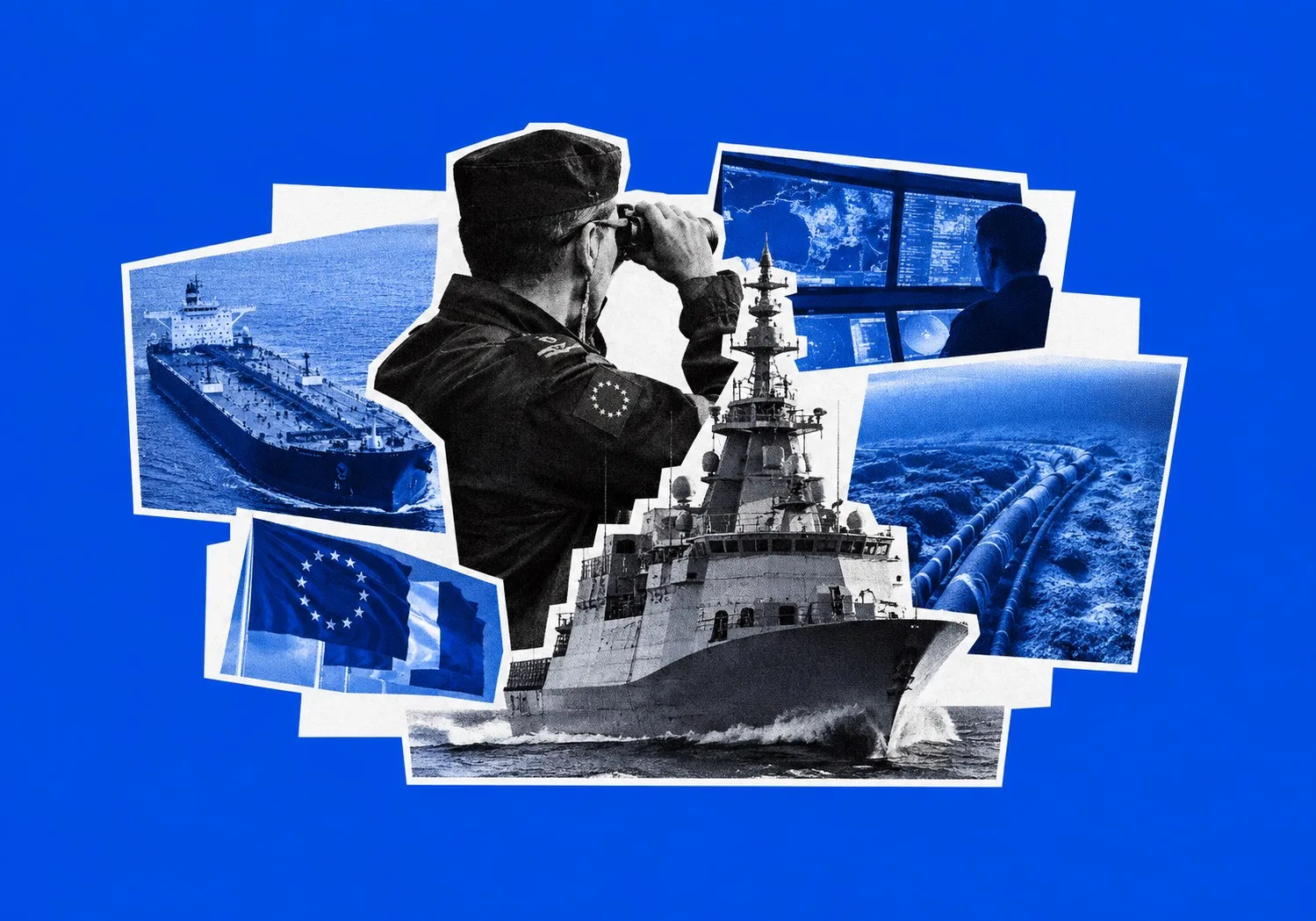
EU ambassadors have agreed to expand EUNAVFOR MED IRINI into a broader Mediterranean security operation, giving warships new powers to challenge Russia’s shadow fleet, monitor critical subsea cables, and counter hybrid threats across the region.
The shift is more significant than the extension itself. IRINI is becoming a mechanism through which the EU can bring together sanctions enforcement, infrastructure protection, counter-smuggling and naval cooperation without creating a separate operation for each new security problem.
The draft decision would extend the mission until March 31, 2029, with a reference budget of €16.88 million for the two-year extension. Formal adoption is scheduled for October 9 at an ECOFIN meeting, followed by publication in the EU Official Journal.
What changes at sea is more important than the calendar.
From Libya to a wider security mission
IRINI was launched in March 2020 as the successor to Operation Sophia, with its central task focused on enforcing the UN arms embargo on Libya. Its existing responsibilities also include tackling illicit Libyan petroleum exports, disrupting human-smuggling networks and training Libyan maritime authorities.
The revised mandate retains those functions but adds a distinctly wider security role.
EU vessels will be tasked with monitoring suspected Russian shadow fleet vessels, carrying out flag-verification checks and contributing to action against ships that are unflagged, falsely flagged or operating with fraudulent documentation. The mission will also develop maritime awareness around critical infrastructure, including subsea telecommunications cables, electricity interconnectors and oil and gas pipelines.
That combination matters because the Mediterranean's security risks no longer fit neatly into separate categories. A tanker avoiding sanctions, a vessel behaving suspiciously near a subsea cable and a ship involved in smuggling may look like different problems to different parts of government. Operationally, they increasingly require the same assets: surveillance, intelligence, maritime patrols, vessel tracking and the ability to establish what a ship is doing at sea.
IRINI is being redesigned around that reality.
The legal power, and the limits
The most consequential tool is not a new European power to seize sanctioned ships. It is the more limited authority provided by Article 110 of the UN Convention on the Law of the Sea.
EU governments adapted IRINI's legal framework in March 2026 to permit flag-verification checks under the provision. Article 110 allows warships to board merchant vessels on the high seas where there are reasonable grounds to suspect that a ship is without nationality, is falsely flying a flag or refuses to show its flag.
That distinction is crucial.

Being listed under EU sanctions does not, by itself, give an EU warship an unlimited right to board and confiscate a tanker on the high seas. Article 110 provides a legal basis for establishing a vessel's status and investigating circumstances covered by the convention. Further action can require additional legal grounds or authorisation from the vessel's flag state.
The operational consequence is therefore less dramatic than the phrase "interdiction" might imply, but potentially more persistent.
A shadow fleet operator depends on anonymity, paperwork and predictable maritime logistics. Repeated flag checks, documentation challenges and inspections can interfere with those assumptions even when the ship is not permanently taken out of service.
IRINI conducted its first such check in May 2026 on a dark-fleet oil tanker suspected of using false documentation. Between May and August, the mission also carried out physical inspections and flag-verification visits involving vessels suspected of belonging to the Russian shadow fleet.
The mission's existing record illustrates the scale of surveillance on which the expanded mandate will build. Since 2020, IRINI has conducted more than 24,000 radio queries on merchant vessels, monitored more than 2,747 suspicious flight-tracking events and carried out 33 physical vessel boardings or inspections. It has also issued 107 recommendations to EU member states for port-level inspections and seized cargo in three cases involving violations of the Libyan embargo.
The numbers are not evidence of a mass boarding operation. They show something more useful: a surveillance architecture that can now be directed at a much broader set of maritime risks.
Sanctions become a problem of ships, not paperwork
The EU's expanding shadow fleet sanctions list makes that shift particularly relevant. The 20th sanctions package in April added 46 vessels, while the 21st package in July added another 41. The list now exceeds 670 vessels and has expanded beyond crude-oil tankers to include support vessels such as bunkering ships, tugboats and transshipment barges.
Sanctions traditionally work through restrictions on access to European ports, financial services, insurance and other commercial infrastructure. Their effectiveness therefore depends partly on whether targeted vessels can continue operating through alternative networks.
IRINI adds a physical layer.
A tanker operating in international waters does not automatically become subject to EU jurisdiction merely because it appears on a sanctions list. But if its flag status is questionable, its documentation is fraudulent or it refuses to establish its nationality, the legal circumstances change.
That creates friction in the business model of a shadow fleet. More checks can mean delays, additional scrutiny, documentation problems and greater uncertainty over where a vessel can operate and how easily it can be insured or serviced.
The May 2026 interception of the Cameroonian-flagged tanker Tagor provides a useful illustration of the limits as well as the potential of this approach. French naval forces, supported by UK aerial assets, intercepted the vessel off Brittany after it had departed Murmansk. A court in Brest later fined its owner €1 million for improper documentation and non-compliance. Once the penalty was paid, the ship was released.
The lesson for IRINI is not that European navies have acquired a general confiscation power. It is that maritime enforcement can convert regulatory violations into direct operational and financial consequences.
The seabed becomes part of the battlefield
The second major change is less visible but potentially broader in scope.
The Mediterranean seabed carries international fibre-optic cables, electricity interconnectors and strategic pipelines, including the Trans-Med and GreenStream systems. The revised IRINI mandate explicitly incorporates surveillance of these assets and the maritime activity around them.
In August, IRINI and the Italian Navy established a technical arrangement covering geographic mapping, secure data channels and joint surveillance procedures for maritime infrastructure.
That requires a different kind of naval capability from traditional ship inspection. Monitoring a subsea cable does not mean placing a warship directly over every kilometre of infrastructure. It means building a maritime picture capable of identifying unusual vessel behaviour and correlating it with the location of strategically important assets.
The revised mandate envisages satellite surveillance, aerial and surface autonomous systems and automated vessel-tracking algorithms as part of that effort. IRINI is also expected to develop integrated data-gathering systems covering illicit maritime activity that could affect European security and economic interests.
The mission is therefore moving towards persistent situational awareness rather than episodic patrols.
That is particularly relevant to the grey-zone environment, where an individual act may be ambiguous but a pattern of behaviour can become significant.
A naval platform for Europe's southern neighbourhood
The proposed mission also gives greater weight to cooperation with states around the Mediterranean. Egypt, Tunisia and Lebanon are specifically identified for joint exercises, capacity building and maritime data sharing.
For these partners, cooperation offers access to European naval expertise and information without requiring them to adopt an explicitly anti-Russian political position. For the EU, it extends the geographical reach of its maritime picture and creates channels through which information can move between European and regional authorities.
The result is a model that sits somewhere between a traditional military operation and a security network.
IRINI will still police the Libyan arms embargo and combat smuggling. But the same mission will now watch sanctioned vessels, monitor maritime approaches to critical infrastructure, test autonomous surveillance technologies and support regional naval cooperation.
That is a notable change in how Brussels is organising maritime security.
Rather than creating a new operation whenever a new vulnerability emerges, the EU is adapting an existing naval structure to absorb several of them. The Mediterranean is consequently becoming not just a theatre for enforcing individual policies, but a continuous operating environment in which sanctions, infrastructure security and maritime intelligence intersect.
The legal boundaries remain narrow. Article 110 does not turn every sanctioned tanker into a lawful target for seizure, and the Tagor case shows that enforcement can ultimately depend on documentation, flag-state jurisdiction and national legal proceedings.
But the strategic effect does not require unrestricted confiscation powers.
A European naval presence capable of identifying vessels, challenging their flags, collecting intelligence and passing evidence to national authorities changes the economics of operating in the grey zone. For Russia's shadow fleet, and for other maritime networks that depend on ambiguity, the Mediterranean is becoming a place where that ambiguity is increasingly expensive to maintain
Sources: Euro News, Evropean Union, Reuters. Kathimerini