
EU EES Delays: How the New Biometric Border System is Causing Chaos at European Airports

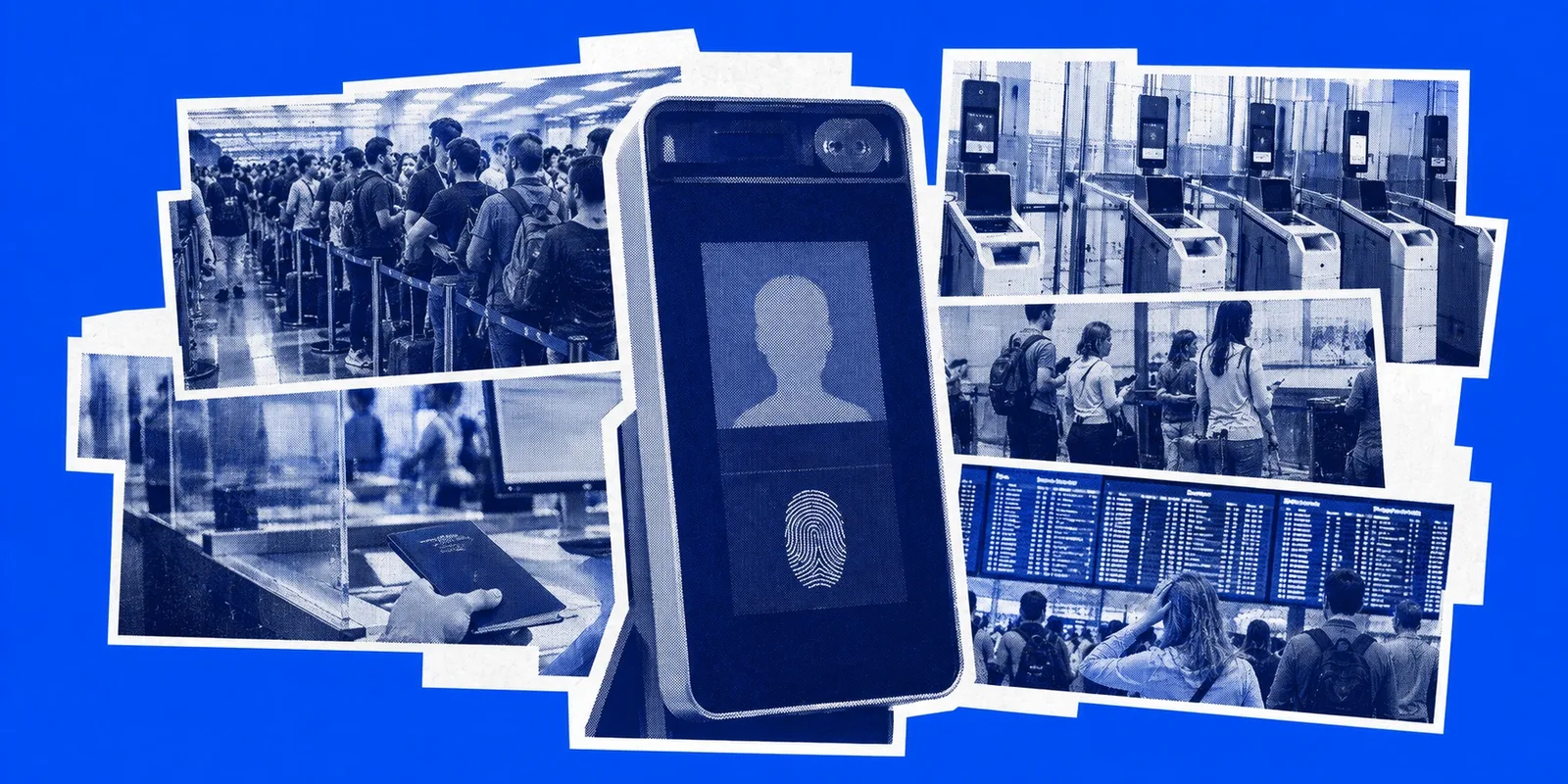
Massive queues, missed flights, and hours of waiting - the EU’s new Entry/Exit System (EES) is facing its first major test across Schengen airports. As processing times jump from 70 seconds to nearly six minutes per passenger, airlines and airports are struggling to cope with the new biometric border reality.
By April 15, major aviation hubs in France, Germany, Belgium, Italy, Spain and Greece were reporting queues of between two and five hours during peak periods. At Paris-Charles de Gaulle and Paris-Orly, waits regularly reached up to two hours. At tourist gateways including Nice and Lyon, delays exceeded three hours at their worst.
The disruption came just days after the EES became fully mandatory across all 29 Schengen countries.
The system itself, Brussels insists, is working normally.
That is precisely the problem.
A system that works on paper
The Entry/Exit System was designed to replace manual passport stamping for short-term visitors from outside the EU. Instead of relying primarily on a border officer checking a document and applying a stamp, the new infrastructure records a traveller’s facial image and four fingerprints alongside passport and travel data.
The policy is intended to create a more reliable digital record of who enters and leaves the Schengen area. It should make it easier to identify overstays and close gaps in the old system, where paper-based records could not provide the same centralised visibility.
The architecture is ambitious. Its deployment is permanent.
The operational assumptions behind it now look much less certain.
The European Commission says the system is functioning in standard mode and estimates that an individual can be processed in around 70 seconds. Airports Council International Europe, representing the continent’s airport operators, says the reality on the ground is closer to 350 seconds — five times longer.

That is not a marginal discrepancy. It is the difference between a system that can process a queue and one that creates one.
At an airport, five minutes is not simply five minutes. It is a multiplication of every passenger arriving at the same time, every aircraft unloading hundreds of people, every connection depending on a narrow window and every border officer required to deal with a biometric procedure that cannot be reduced to a passport stamp.
A small difference in the assumptions becomes a large physical problem.
The airport was never just an IT environment
The political language surrounding the EES has focused heavily on digitisation, security and interoperability. But passengers do not enter a database. They enter terminals.
That distinction has become central to the crisis.
A biometric system requires hardware, trained personnel, space for passengers to stop and complete the process, and enough capacity to handle the arrival patterns created by modern aviation. Those requirements are not interchangeable. A faster server cannot widen a corridor. A new software update cannot create more border officers during a morning wave of international arrivals.
The EES has exposed a familiar weakness in European policy implementation: the central institution can establish the legal architecture, while the consequences of that architecture are absorbed by infrastructure managed elsewhere.
Brussels sets the mandate. Member states supply the border personnel. Airport operators must accommodate the queues. Airlines bear the consequences when passengers miss departures.
The system may be European. The bottleneck is local.
That division of responsibility becomes particularly important when the central performance estimates and the measurements of the operators diverge so dramatically. If the Commission's 70-second benchmark is used to calculate capacity, an airport may prepare for one level of demand. If the real process takes roughly 350 seconds, the same physical infrastructure suddenly becomes inadequate.
The result is not a technical failure in the narrow sense. It is a planning failure across several layers of the system.
The first test of Europe’s digital border
The EES was gradually introduced from October 2025, with Czechia, Estonia and Luxembourg among the early participants. The legal deadline for universal implementation arrived on April 10, 2026.
That timetable mattered.
The EU was not launching a limited pilot at a handful of airports. It was moving to a common operating model across all 29 Schengen countries, covering the external border through which millions of non-EU travellers pass.
The system therefore faced its first full-scale test almost immediately.
The results have been uncomfortable. Aircraft have departed with large blocks of empty seats because passengers remained trapped in border queues. Airlines have had to rebook travellers. Connections have been missed. Airport operators have warned that the current arrangement could become unmanageable when passenger volumes rise during the summer season.
At Milan Linate, the image of an aircraft leaving with 122 empty seats is more than an unusual travel disruption. It shows what happens when a border-control process becomes the limiting factor in an aviation network designed around tightly coordinated movements.
The plane is ready. The crew is ready. The runway is available.
The passengers are still waiting for the border.
The cost of a rigid deadline
The aviation industry has responded with unusual force.
ACI Europe has warned that border processing times have risen sharply from previous levels and that the summer peak could bring the system close to collapse. Airlines for Europe has called for greater flexibility, including the possibility of temporarily suspending biometric collection during traffic surges. Ryanair chief executive Michael O’Leary has demanded a delay in the launch, describing the implementation as chaotic.
Paris airport operator ADP Group and border authorities have also sought a deferral of full enforcement until after the summer season, citing staffing and capacity concerns.

The demands are not simply about passenger inconvenience.
Airlines operate on schedules in which delays at one stage cascade through the entire day. A missed departure creates rebooking costs and customer-service obligations. A late aircraft disrupts its next rotation. Crew schedules can be affected. Airport gates and ground-handling operations become less predictable.
Yet carriers are being asked to absorb a problem they did not create.
The Milan incident illustrates the imbalance. An airline can rebook passengers, but it cannot control how long they spend at external border checks. It cannot add border officers. It cannot expand the terminal. It cannot decide whether the biometric process should be suspended during a surge.
The commercial carrier remains responsible for the passenger experience while lacking control over the part of the journey that caused the disruption.
That arrangement may prove increasingly difficult to sustain.
Security gains, mobility costs
There is a genuine strategic rationale behind the EES.
The old system of manual passport stamping created gaps in the tracking of short-term visitors. A centralised biometric record offers European border authorities a more comprehensive picture of who enters and exits the Schengen area. For the external security apparatus, including border-management institutions such as Frontex, the shift creates new capabilities for tracking movement and identifying overstays.
The problem is that security infrastructure is often evaluated according to the quality of the data it produces.
Transport infrastructure is judged by whether people can move.
Europe now has to make those two standards work together.
The EES is not a temporary experiment that can simply be abandoned because its first months have been difficult. The structural shift has already occurred. For non-EU nationals travelling for short stays, the border experience is being redesigned around biometric registration. That will affect how airports plan capacity, how airlines calculate connection times and how travellers approach international journeys.
The question is no longer whether Europe will have digital external borders. It is whether the physical system supporting them can be brought into alignment with the political ambition.
The hidden price of centralisation
The episode also exposes a broader institutional tension inside the EU.
European integration often works by creating common rules. The advantage is consistency: the same framework can apply across borders that millions of people cross every day. But common rules become more difficult when the infrastructure beneath them remains uneven.
A major international hub, a regional airport and a border crossing do not have identical space, staffing or passenger flows. A system designed around a single average processing time may look efficient in a central model while producing radically different results at individual locations.
That is why the dispute over 70 seconds versus 350 seconds matters so much.
It is a dispute about what counts as reality.
If the Commission's benchmark is accurate, the industry must explain why airports are experiencing such severe delays. If ACI Europe's figures are closer to the truth, the EU has built a mandatory border regime around assumptions that were never sufficiently tested under real-world conditions.
Neither possibility is comfortable.
The consequences extend beyond this summer. Airports may need to redesign terminals and expand biometric infrastructure. Governments may have to recruit and train more border personnel. Airlines and travel agencies will face pressure to revise recommended arrival and connection times for non-EU passengers.
The old assumption that a traveller can arrive at an airport, pass through a predictable border process and make a tightly timed connection is becoming less reliable.
That is a significant change to the economics of European aviation.
The flexibility Brussels now needs
The immediate political dispute is over whether the EES should be temporarily suspended during extreme traffic peaks. But the deeper issue is whether the system has enough flexibility to respond when its own assumptions fail.
A rigid mandate is easy to administer from the centre. It is much harder to operate in a terminal filled with thousands of people.
Europe's border architecture will need mechanisms that recognise this reality. Emergency procedures, adaptable staffing models and the ability to manage exceptional surges may become as important as the biometric database itself.
The EU's security ambitions are not inherently incompatible with efficient travel. But security systems that ignore physical capacity eventually turn infrastructure into the enforcement mechanism.
That is what has happened at Europe's airports.
The EES was supposed to make the border smarter. Its first full-scale test has shown that a border can be digitally advanced and physically overwhelmed at the same time.
The most consequential question facing Brussels is therefore not whether the technology works.
It is whether Europe is prepared to build the airports, staff the borders and create the operational flexibility required for the technology to work in the world outside the database.
Sources: Connexion, ACI-Europe.