
Dalí Bronze Theft in Issoire Exposes France’s Regional Museum Security Gap

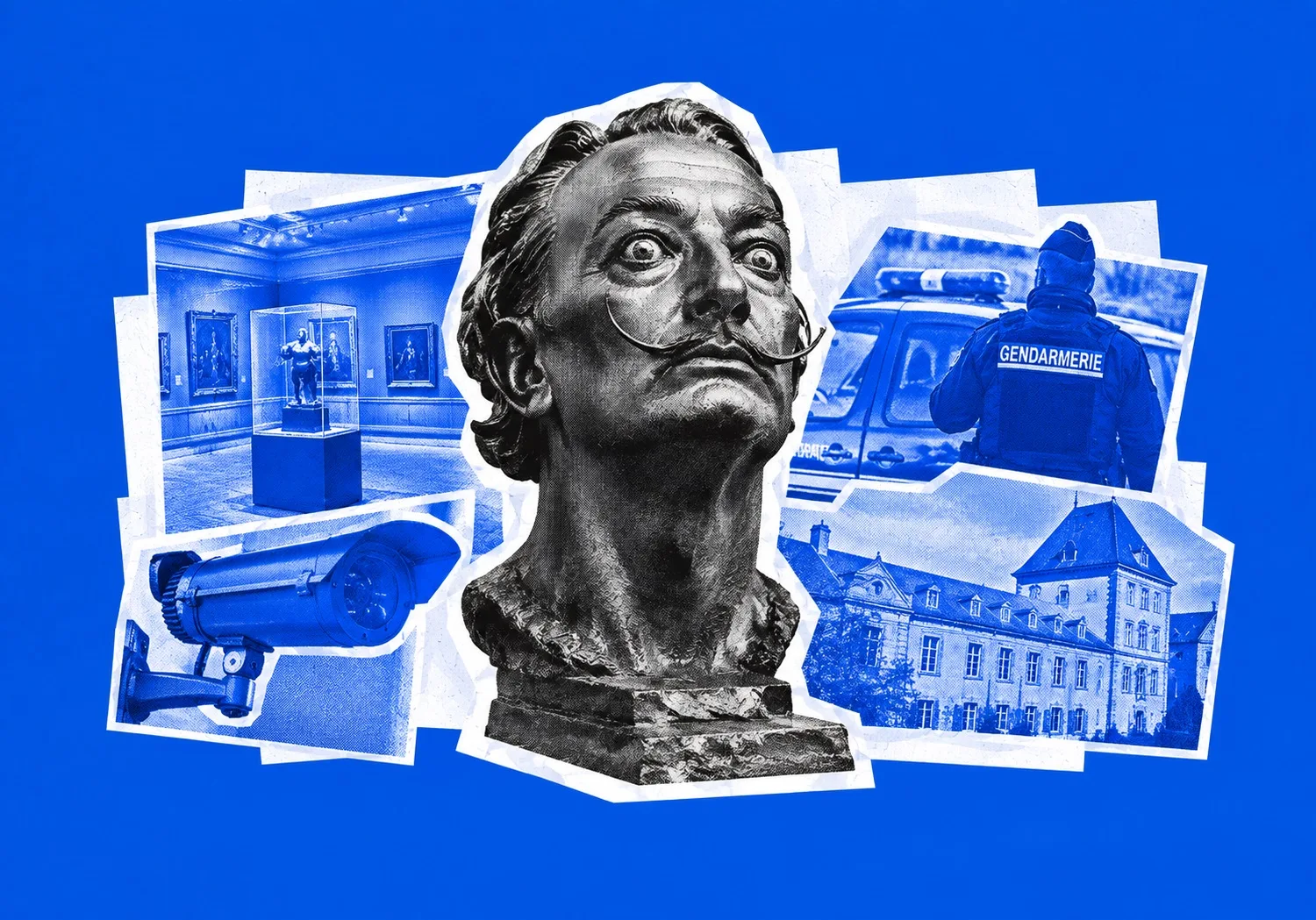
The overnight theft of Salvador Dalí’s 150kg bronze cover from the unique Apocalypse book object in Issoire, central France, has laid bare severe security vulnerabilities in private regional galleries holding multi-million-euro national heritage assets.
The case has been handed to the Section de Recherches of the Clermont-Ferrand Gendarmerie, with investigators examining the crime scene, possible entry points and local surveillance while coordinating with Interpol, Europol and France’s specialist art-theft authorities.
The striking fact is not simply that a famous Dalí has been stolen. It is that somebody managed to remove a half-tonne-class cultural object in a provincial industrial area without being stopped.
A masterpiece that could not simply be sold
L’Apocalypse de Saint-Jean was never an ordinary book. Forêt conceived it as an œuvre d’art totale, combining literature, painting, sculpture, bookbinding and metalwork into a single monumental object.
 The finished work contains 150 sheets of sheepskin parchment measuring 65 by 75 centimetres and weighs about 210 kilograms. Dalí's bronze outer casing accounts for 150 kilograms of that weight and was decorated with gold leaf, precious stones and seashells.
Its creation brought together some of the leading artistic and intellectual figures of the 20th century, including Dalí, Jean Cocteau, Bernard Buffet, Leonor Fini, Foujita, Ossip Zadkine, Georges Mathieu and Pierre Soulages, alongside writers and thinkers such as Jean Rostand, Émile Cioran and Ernst Jünger.
When completed in 1961, the object was valued at 100 million old French francs and acquired the international description of the world's most expensive book. Contemporary estimates put its value at between €1 million and several million euros.
That history makes the theft unusual for another reason: the object is almost impossible to dispose of openly.
A unique, highly recognisable Dalí bronze weighing 150 kilograms cannot simply enter the conventional art market. Any legitimate transaction would immediately expose its provenance. The more famous the work, the narrower the legal market becomes.
For the criminals, therefore, the value lies elsewhere.
The logistics are the real clue
The physical nature of the theft makes an opportunistic burglary difficult to imagine. The perpetrators did not walk out with a painting or slip a manuscript into a vehicle. They detached a massive bronze structure from a much larger object and transported it away.
That requires planning, equipment and a destination.
 The investigators will have to establish how the building was entered, how the cover was separated from the rest of the work, what means were used to move it and how it was transported from the site. Surveillance footage and forensic evidence may prove more important than conventional searches for a missing artwork.
The escalation to the Gendarmerie's Section de Recherches reflects the seriousness of the case. France has specialist structures for cultural-property crime precisely because the theft of exceptional works can extend well beyond the jurisdiction of a local police investigation.
The international dimension is equally important. Once an object leaves its original location, databases and cooperation involving Interpol, Europol and the OCBC become part of the effort to prevent its movement through established illicit channels.
But these mechanisms face an obvious problem. A 150-kilogram bronze object is difficult to conceal indefinitely, yet it is also difficult to identify once it has been physically altered.
That creates two very different criminal scenarios.
The black-market problem
One possibility is that the theft was commissioned for a private buyer or intermediary who understands the cultural value of the work and is prepared to operate outside the legitimate market.
The other is more destructive: the bronze could be dismantled for its materials.
The second scenario would destroy the very characteristic that makes the cover culturally important. Once melted down, the unique relationship between Dalí's sculpture and Forêt's monumental book would be gone. Gold and other valuable materials could survive, but the artwork would not.
 That distinction matters because the illicit art market has changed the risk profile of famous objects. A masterpiece that is too recognisable to sell openly may still have value as ransom, private black-market collateral or a source of valuable materials.
The theft therefore does not necessarily need to be explained by the prospect of a conventional resale.
What matters is that the perpetrators appear to have identified an asset whose cultural value was vastly greater than its practical usefulness, and nevertheless considered the operation worthwhile.
The regional security gap
The most consequential question for France may not be how the Dalí was stolen, but why such an object was being kept in a private cultural centre in an industrial zone in the first place.
Karoutzos acquired the complete work in Japan in 2003, when its owners were preparing to auction it piece by piece. His purchase preserved the integrity of an object that might otherwise have been dismantled.
For more than two decades, the work was therefore an example of private stewardship serving a public cultural purpose. A unique piece of French artistic heritage, rescued from fragmentation abroad, was brought back to France and made available for exhibition.
The irony is severe. The same decentralised model that saved L’Apocalypse from being broken up has now exposed it to a different form of destruction.
France's major national institutions operate under security conditions that private regional centres cannot necessarily replicate. A rare object held in a metropolitan museum can sit inside a dense network of surveillance, physical barriers and institutional security. A privately run centre in a provincial industrial area faces a fundamentally different risk environment.
That creates a structural dilemma.
If exceptional works can only be safely exhibited in institutions capable of providing state-level security, private collectors and regional museums may eventually have fewer reasons to display them publicly. Insurance costs can rise, security requirements can become prohibitive, and owners may decide that keeping major works away from public view is the safer option.
The result would be a paradoxical form of cultural centralisation: masterpieces that were brought to regional communities through private initiative could end up migrating back towards the country's largest and most heavily protected institutions.
What happens to the rest of the book?
The theft also leaves L’Apocalypse physically incomplete.
The 150 parchment leaves survived because the thieves took the bronze casing and left the interior pages on display. Yet the object was conceived as an integrated work. The cover was not an accessory that could simply be replaced without consequence.
For Karoutzos, preserving the remaining material now means safeguarding a cultural object whose defining physical relationship has been broken.
The 2003 acquisition is particularly relevant here. It was made precisely to prevent the work from being separated into individual components. Twenty-three years later, it has been separated anyway, this time by theft rather than auction.
That makes recovery more than a question of returning property to its owner. It is potentially the only way to restore the integrity of the work as it was conceived.
Until then, the parchment leaves remain a surviving fragment of a larger artistic construction, while the most physically distinctive component is somewhere outside the collection.
A warning for private museums
The case could have consequences well beyond Issoire.
Private art centres and collectors holding exceptional works face a difficult calculation between accessibility and protection. The more ambitious their collections, the more they may be exposed to criminal groups capable of planning transportation and exploiting weaknesses in facilities that were never designed to function like the Louvre or the Bibliothèque Nationale de France.
The Issoire burglary gives that problem a particularly stark physical dimension. This was not a theft made possible simply by slipping a small object into a coat. A 150-kilogram bronze cover had to be extracted from a building and moved away.
The investigation will determine how that was possible.
For the wider French cultural sector, however, the question is already clearer. If private institutions are expected to preserve and exhibit objects of national significance, the security burden cannot be treated as a private problem indefinitely. The alternative is to accept that some of France's most unusual and irreplaceable works can be publicly accessible only until someone decides they are worth stealing.
And in Issoire, someone apparently did.
Sources: Kazin Form, The Telegraph, ICI, Le Parisien