
Ceuta: Spanish Police Fire Warning Shots as Thousands Moved to Port Facility

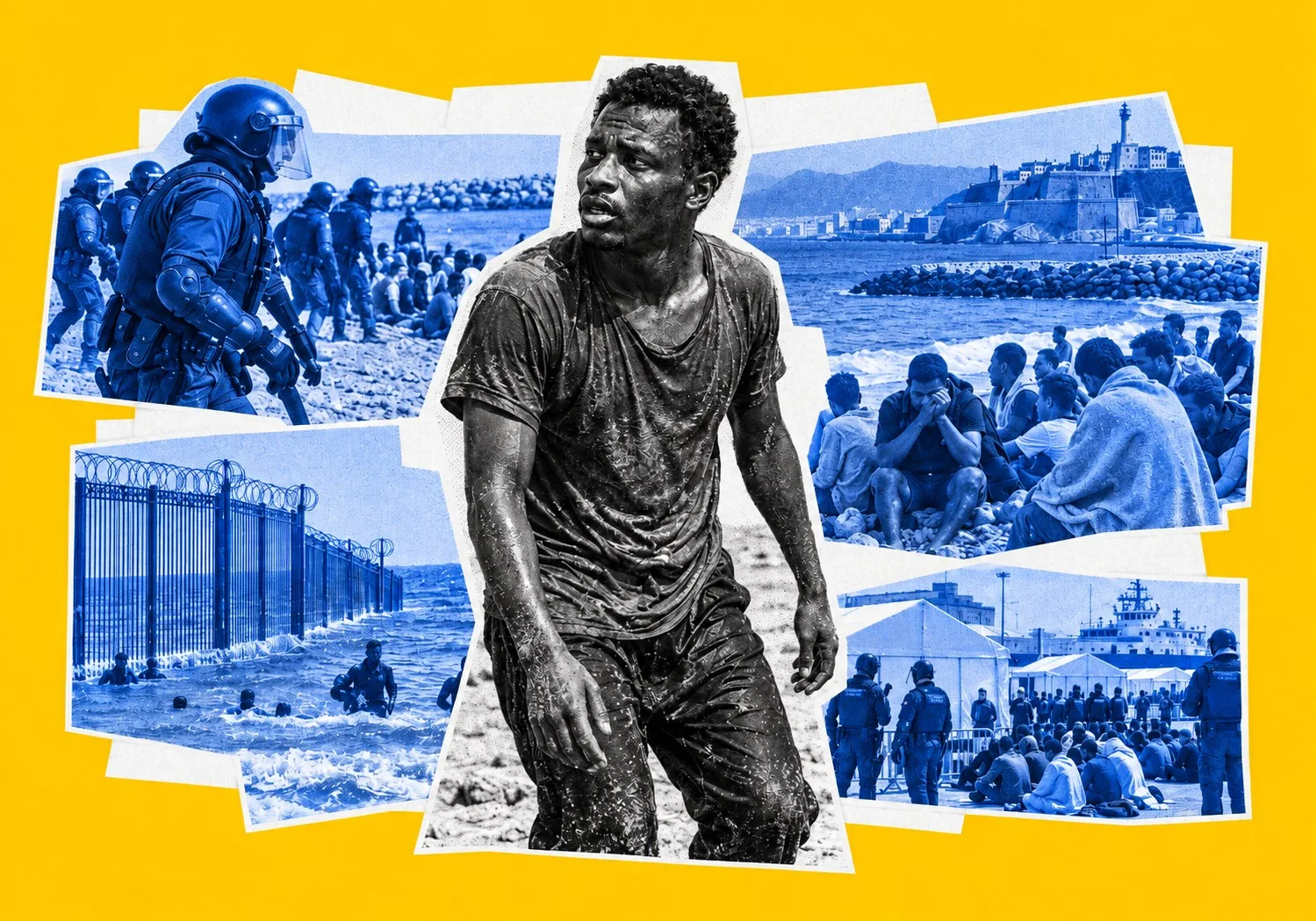
Spanish security forces fired warning shots and rubber bullets on Friday during an operation to clear thousands of stranded migrants from beaches in Ceuta. The clearance was authorized by Spain’s National Court. It marks the first operational test of the European Union’s newly implemented Migration Pact following July's mass border crossing.
Ceuta is a Spanish enclave of 83,000 people on the North African coast. It has become a critical operational choke point for European border management.
Six weeks ago, a sudden surge brought an estimated 80,000 people to its land and sea perimeters, leaving 141 dead at sea. Today, between 5,000 and 10,000 migrants remain trapped in the city.
Municipal shelters for minors are completely full. Roughly 4,000 adults have spent weeks sleeping on pavements and beaches.

The state's response has been limited. Officials erected a makeshift tent facility at the port, but it holds under half the remaining arrivals. The emergency measure demonstrates an administrative logistics system operating well past its breaking point.
Friday’s police action proved a stark reality. Neither local emergency teams nor existing statutory legal rules are equipped for high-volume entries over short timeframes.
The disruption points to a broader capacity failure across Southern Europe. Small border municipalities are routinely forced to manage emergency reception using modest local budgets.
For weeks, local officials in Ceuta requested military logistics, transport support, and immediate transfers to the mainland. Those requests stalled in ministerial committees. Government lawyers weighed the political risk of moving thousands of unregistered arrivals onto the Iberian peninsula.
While ministers in Madrid delayed decisions, municipal services collapsed under the volume. Frontline police were left to control tense public spaces with minimal operational backing.
Beach conditions worsened rapidly as summer temperatures rose. Medical teams reported spreading skin infections, waterborne illnesses, and growing frustration among families waiting for basic papers.
When armed police units moved in on Friday to clear the camps, the physical push triggered panic. Crowds feared they were being forcibly returned to Morocco rather than moved to port shelters.
A Court-Ordered Paralysis
To understand why thousands slept on public beaches inside EU territory for six weeks, one must examine court rulings in Madrid rather than perimeter fences in Africa.
For years, Spanish border units turned back people scaling land fences in Ceuta and Melilla through immediate summary returns. That option ended for sea arrivals following a landmark decision by Spain's Supreme Court.
Justices ruled that anyone reaching Spanish soil by water—including those swimming around coastal jetties—is covered by strict statutory procedural guarantees.
Under this ruling, the state must process each individual separately. Officers must register arrivals, complete medical checks, identify vulnerabilities, verify nationality, review individual asylum claims, and assign legal representation before issuing any deportation order.
The process functions when twenty people arrive on a wooden boat. It breaks down completely when thousands swim around breakwaters over forty-eight hours.
Smuggling networks adjusted to the ruling quickly. Traffickers used social media to distribute targeted advice. They informed clients that reaching Ceuta by sea blocked rapid deportation and opened a legal route to the Spanish mainland.
Spanish Prime Minister Pedro Sánchez stated publicly that criminal groups exploited the ruling. He warned that "networks operated with tactical precision to leverage judicial precedents."
Sánchez also pointed to foreign online accounts linked to Russia, Israel, and international far-right groups that amplified fake posts to fuel European political disputes. Moscow and Tel Aviv denied involvement. Spanish intelligence found no evidence that Moroccan authorities organized the push.
Regardless of who shared the material, the operational outcome was clear. Administrative systems built for individual legal cases were crushed by sheer volume.
The ruling left the government with limited options. Police could not legally perform summary returns at sea. Ceuta lacked the legal personnel needed to draft thousands of individual files.
The enclave became an administrative cul-de-sac.
Madrid could not legally deport arrivals en masse. Nor could ministers move them to the mainland without severe political pushback from regional governments. Constructing the port tent site—a facility built for 1,500 to 1,800 adult males while underfunded municipal shelters handle unaccompanied minors—is an admission that containment has replaced legal processing.
The administrative burden on local courts shows the gap between legal frameworks and frontline operations. Extra judges and clerks sent from Seville and Malaga were immediately buried under thousands of open files.
Under Spanish law, immigration judges face hard statutory deadlines to approve detention orders. That requirement proved physically impossible while reviewing hundreds of cases daily.
As legal deadlines expired without formal court orders, police had to release migrants back onto the streets. This fed the exact cycle of public encampments the state was trying to resolve.
This dynamic created sharp tension between police officers and local courts. Officers reported deep frustration at clearing public areas only to see the same people released hours later over missing paperwork.
One representative from a Spanish police union noted off the record that frontline officers were "acting as static gatekeepers for an administrative machine that has simply stopped turning."
The procedural delays left thousands living without shelter, clean water, or administrative clarity for over a month.
The Brussels Pivot
While police cleared the beach in Ceuta, political discussions in Brussels shifted rapidly.
The crisis in the enclave has accelerated an institutional move away from post-arrival distribution quotas. European strategy is pivoting toward external border security, fast returns, and emergency legal waivers.
In her State of the Union address, European Commission President Ursula von der Leyen introduced an Emergency Response Framework. Citing events in Ceuta, von der Leyen stated plainly: "Ceuta's border is a European border."
She proposed rules that grant member states procedural flexibility during mass entries organized or exploited by external actors. The framework allows national authorities to suspend standard processing timelines during declared emergencies. This signals a clear shift toward rapid containment over individual casework.
The European Parliament supported this direction the following day. Lawmakers passed a resolution by 339 votes to 225, with 16 abstentions.
The resolution described the events in Ceuta as an "unacceptable instrumentalization of vulnerable people" and a direct security threat. The text called for additional funding for physical barriers, border infrastructure, and immediate Frontex deployments.
Crucially, the vote contained a direct criticism of domestic policy choices in Madrid. European lawmakers warned against national regularisation programs. They argued that amnesties create pull factors that complicate border management across the Schengen zone.
The vote demonstrated that domestic regularisation initiatives have lost political backing among major European parties.
This policy shift is reshaping European diplomacy across North Africa. The Strasbourg resolution ties third-country trade access, market privileges, and bilateral aid directly to cooperation on border control and readmission treaties.
Both Sánchez and European Commission officials have acknowledged that managing border stability requires direct commercial arrangements with transit states like Morocco. Leaders in Rabat, who maintain territorial claims over Ceuta and Melilla, hold significant diplomatic leverage over European capitals as a result.
Rivalries between Madrid, Rabat, and Algiers add further operational complexity. Morocco's willingness to stop migrant departures or accept deported citizens fluctuates depending on broader regional disputes, including Western Sahara and energy pipelines.
By creating emergency rules that rely on external border policing, European governments are delegating border enforcement to neighboring states. The diplomatic goals of these neighboring governments do not always align with those of the bloc.
In several European capitals, the Commission's proposed rules have drawn warnings from legal analysts and human rights groups.
Experts note that allowing governments to trigger procedural waivers during periods of instrumentalization risks creating a permanent suspension of standard asylum procedures along Southern Europe. Lawyers point out that broad definitions of hybrid threats allow interior ministries to bypass statutory asylum screenings whenever arrival numbers rise.
Fences, Funds, and Frontline Costs
The focus on hard border enforcement creates distinct practical outcomes across the region.
Border agencies like Frontex gain larger operating budgets, expanded staff allocations, and broader legal mandates. Transit governments along the Mediterranean coast gain leverage over Brussels by acting as physical gatekeepers to the European market. Security-focused political parties have placed their primary policy demands at the center of EU legislation.
The immediate costs fall on border municipalities and the people stranded inside them.
Enclaves like Ceuta lack the land area, water infrastructure, and administrative staff to operate as long-term holding centers. The migrants themselves remain stuck in a cycle of physical danger, street homelessness, and administrative delays. They are increasingly exposed to human traffickers and police containment.
Concurrently, Spain's historic use of regularisation programs faces firm opposition from European institutions. This reduces Madrid's policy options within the Schengen area.
Domestic political pressure on Prime Minister Pedro Sánchez is mounting. Opposition leaders accuse the government of failing to secure the border while leaving local police forces under-resourced and exposed.
Economic losses across Ceuta are rising sharply. Local business groups, shipping firms, and transport operators warn that port closures and beach encampments have disrupted commercial activity.
A spokesperson for the regional port authority observed that turning freight facilities into temporary holding zones risks "permanently severing the commercial arteries connecting North African trade with mainland Spain."
Municipal leaders warn that converting industrial port space into long-term containment sites damages freight routes connecting North African trade channels with mainland Europe. A vital commercial port is being transformed into a militarized zone.
As police maintain their perimeter around the Port of Ceuta, the debate over European border policy faces clear operational limits.
Resorting to warning shots, riot control units, and temporary port camps to resolve an administrative backlog exposes a structural difficulty in the current European border regime: a legal model that promises individual statutory rights, but struggles to maintain them when thousands test those rights simultaneously at the border.
Sources: Euronews,Reuters, Helsinki Times