
Călin Georgescu Fraud Case Exposes the Dark Money Behind Europe’s Political Destabilisation

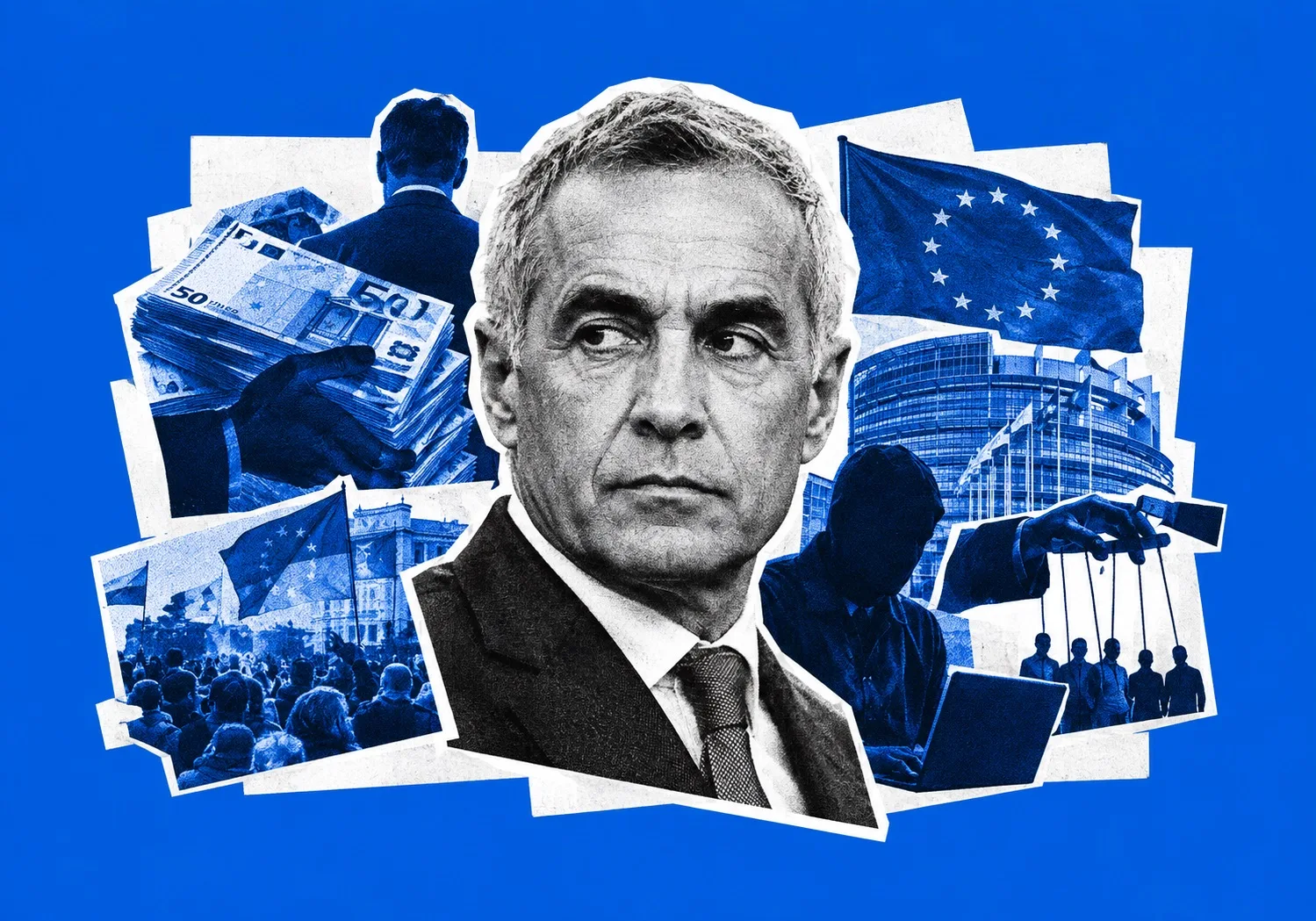
Romanian anti-terrorism prosecutors have detained far-right politician Călin Georgescu as part of a €1.1m organised fraud investigation, exposing how illicit financial networks are weaponised for political destabilisation. On Monday, DIICOT agents intercepted the former presidential candidate in Otopeni, searching his residence before bringing him in for questioning over allegations that proceeds from the scheme directly funded his annulled 2024 campaign.
The case is therefore putting a criminal-financial infrastructure beneath a political movement that had previously been viewed primarily through the lenses of electoral disruption, social media mobilisation and pro-Russian rhetoric.
From political outsider to criminal investigation
The alleged fraud dates back to September 2021, when Georgescu and two other people - a Romanian national and an Italian national - allegedly formed the core of the group now under investigation.
Their method was conventional in one respect. The group allegedly presented its associates as wealthy foreign businessmen with access to large overseas credit facilities, then offered financing in exchange for advance payments.
The target was Răzvan Leu, a Romanian businessman from Buzău County who filed the initial criminal complaint in 2024. He was allegedly promised €6mn in financing through an overseas banking institution. In late 2021, he transferred €1mn to a Swiss bank account belonging to an entity registered in the Commonwealth of Dominica, ostensibly as an investment in precious metals.
When Leu later sought his money back, the alleged scheme evolved rather than ended. He was told the funds would be returned through another Swiss entity and was subsequently persuaded to transfer a further €100,000 on the pretext that the loan package would be increased to €15mn.
That second payment is central to the political dimension of the investigation.
According to DIICOT, €100,000 of the money obtained through the scheme was intended to finance Georgescu’s electoral campaign. Messages from 2023 cited in the investigation show Georgescu assuring Leu that the money would be returned once donations for his presidential campaign arrived.
The alleged movement of the money creates a very different picture from a straightforward political donation. Campaign finance becomes one destination in a chain that prosecutors say began with an investment fraud and crossed several jurisdictions.
The money matters more than the slogans
Georgescu’s rise had already forced Romania to confront the vulnerability of its electoral system to unconventional forms of political mobilisation.
He unexpectedly won the first round of the November 2024 presidential election with 23 per cent of the vote, after an unprecedented TikTok campaign. On December 6, Romania’s Constitutional Court annulled the election following declassified intelligence reports concerning election-law violations, cyberattacks and a coordinated social media operation using bot networks and described as Russian-backed.
Georgescu was subsequently prevented from standing in the May 2025 re-run.
Until now, much of the political debate surrounding his movement has centred on ideology and influence: anti-NATO rhetoric, sovereignist politics, digital campaigning and alleged external interference. The DIICOT investigation moves the focus towards something more tangible — the financial channels capable of sustaining political activity.
That is an important change in the way such threats can be approached.
An electoral influence operation can be difficult to prosecute if its components remain dispersed across social media accounts, political messaging and foreign narratives. A financial transfer is different. It creates records, intermediaries, companies and bank accounts that can be investigated across jurisdictions.
The alleged €100,000 campaign payment is therefore more consequential than its size might suggest. It provides a potential link between organised financial crime and political financing.
A network that does not stop at Romania
The investigation is international by design. The financial trail includes Swiss banking structures and an entity registered in Dominica, while judicial material indicates connections to an organisation currently under investigation in the United States and linked financially to Russia.
DIICOT has submitted international requests for assistance to authorities in the UK, Switzerland, Italy and Latvia.
That geography matters because the network described by prosecutors does not correspond to the boundaries of a Romanian political organisation. The alleged activity depends on corporate entities, banking systems and intermediaries operating in several countries.
It also intersects with another strand of Georgescu’s political network.
His associate Ionel Rusen, a businessman from Constanța who was also targeted by Monday’s searches, was involved with Romanian Allied International Defense SRL, a company that sought to acquire Uzina Mecanică Drăgășani SA, a decommissioned Romanian munitions factory. In 2024, American investor Douglas Anderson, who presented himself as chief executive of Wall Street Capital Partners, acquired a majority stake in Rusen’s defence company and publicly released video messages supporting Georgescu.
Former US ambassador to Romania Adrian Zuckermann had also been listed as a business associate in ventures linked to Rusen.
None of these connections, on their own, establishes a single criminal purpose. Their significance lies in the overlap between political influence, financial networks and access to strategically sensitive industrial assets. That overlap is now being examined alongside the fraud investigation rather than in isolation.
The criminal cases are converging
Monday’s operation also arrives as Georgescu faces other serious proceedings.
In July 2025, the General Prosecutor’s Office indicted him over allegations that he publicly promoted fascist, legionary, racist and xenophobic ideologies and praised individuals convicted of genocide and war crimes.
In September 2025, prosecutors indicted Georgescu alongside former mercenary commander Horațiu Potra and more than 20 others over allegations of conspiracy against Romania’s constitutional order and spreading false information. Prosecutors allege the group sought to turn post-election protests in Bucharest into a violent attempt to overthrow the constitutional order. The trial formally opened on September 9, 2026.
The new fraud investigation does not replace those cases. It adds another layer.
The alleged financial relationship with the 2024 campaign is particularly significant because it connects an earlier criminal scheme to the political period that made Georgescu a national figure. What had appeared to be separate questions - electoral financing, organised fraud, foreign financial connections and efforts to challenge Romania’s constitutional order - are now being examined within an increasingly interconnected legal landscape.
The details seized on Monday add another unusual dimension. At Georgescu’s residence, investigators found a document purporting to show that he held the title of “Senator of Malta”, which authorities described as a false diplomatic document. They also found a signal-jamming device.
The investigation has not established from the material available what operational purpose the equipment or document was intended to serve. Their presence nevertheless broadens the questions surrounding the network from financial transactions to the use of equipment and credentials designed to create or protect privileged status.
Europe’s enforcement model is changing
The Romanian case points towards a broader evolution in how European states can respond to political interference.
Election interference has traditionally been treated as an electoral, intelligence or regulatory problem. Those mechanisms remain important, but they do not necessarily reach the financial infrastructure that makes an influence operation sustainable.
Financial crime enforcement can.
Tracing money through offshore companies and foreign banking systems is slower and less visible than confronting a political campaign. It can, however, expose relationships that are difficult to identify through political messaging alone. The involvement of Romanian authorities alongside counterparts and judicial channels in the UK, Switzerland, Italy and Latvia shows the extent to which such investigations depend on cross-border cooperation.
For European security institutions, that creates a different battlefield. The question is no longer simply whether foreign actors can influence voters. It is whether criminal proceeds can be converted into political capital before regulators, prosecutors and financial authorities can follow the trail.
Romania is an unusually consequential place for that question. It is both an EU and NATO member and a state on the alliance’s eastern flank. Its political turmoil therefore carries implications beyond domestic electoral politics.
The reaction to Monday’s operation has already crossed those borders. Dozens of Georgescu supporters gathered outside DIICOT headquarters, while Russian state-aligned media portrayed the action as evidence of “tyranny in Romania” and a “dictatorship in Europe”.
That response returns the case to politics. But the investigation itself is moving in the opposite direction - towards bank accounts, corporate structures, evidence and cross-border criminal procedure.
The most consequential question may now be whether Romania’s institutions can establish, through the courts, how much of Georgescu’s political machinery was sustained by money that began its journey as criminal proceeds - and how far that financial architecture extended beyond the people currently being questioned in Bucharest.