
Bulgaria’s Shift on Ukraine: How Rumen Radev Turned ‘Peace’ Into Executive Policy

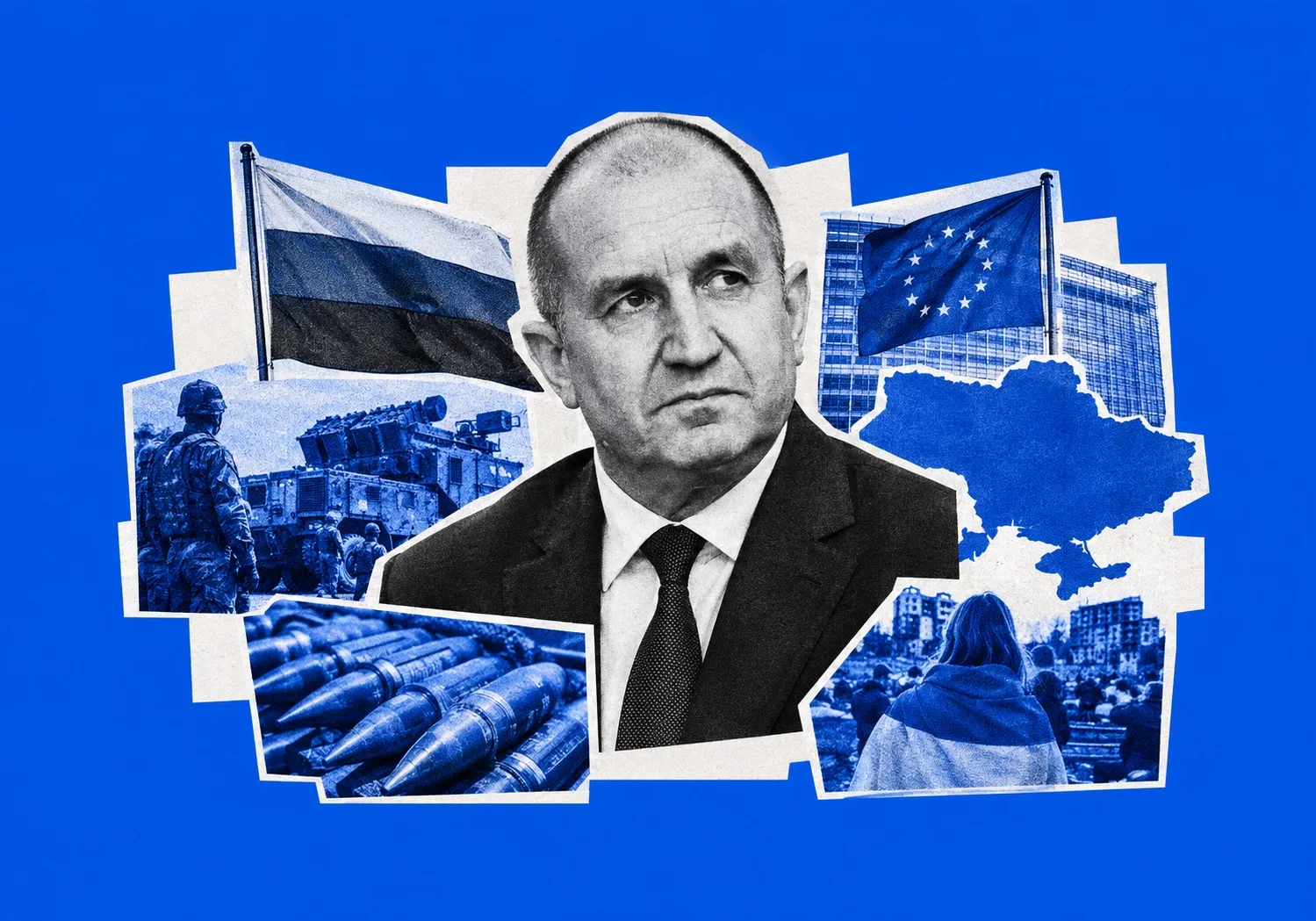
Speaking at the Euronews Defence and Space Summit in Brussels, Bulgarian Prime Minister Rumen Radev rejected accusations of holding a pro-Russian stance, arguing for an immediate diplomatic shift with Moscow. However, Sofia's position is no longer just debate: since taking office, Radev's government has officially halted state military aid to Kyiv and withdrawn from the European "Coalition of the Willing." This pivot transforms Bulgaria from a internal EU skeptic into a government actively opting out of collective security support while remaining inside NATO.
That turns Sofia from a sceptical voice inside the European debate into something more consequential: a government willing to opt out of collective initiatives while remaining firmly inside the EU and NATO.
From rhetoric to policy
Radev’s position is not new. As president, he repeatedly opposed sending weapons to Ukraine and argued for diplomatic engagement with Moscow. What changed in 2026 was his ability to turn that position into executive policy.
In June, he said Bulgaria had already given enough and described the conflict as a war of attrition that was imposing socio-economic costs on the country. The government subsequently ended further deliveries from army stocks.

There is an important distinction here. The end of state military transfers does not mean the disappearance of Bulgaria’s defence industry from the wider supply chain. Bulgarian manufacturers have remained significant producers of Soviet-standard ammunition, and the country’s industrial capacity has long been relevant to Ukraine’s access to compatible munitions. The political decision therefore affects not only a bilateral aid programme but the broader European ecosystem through which ammunition can reach Kyiv.
Radev’s government has also drawn a line around collective funding arrangements. In July, he said Bulgaria would not join the Coalition of the Willing because it was designed around continued financial and military assistance to Ukraine.
The significance lies in the sequence. Sofia did not simply declare neutrality. It withdrew from specific mechanisms through which European governments have tried to maintain support for Ukraine despite differences among member states.
That is a different form of dissent.
The Hungarian model, with Bulgarian constraints
The comparison with Hungary is inevitable, but Bulgaria is not simply reproducing Viktor Orban’s model.
The similarity is institutional. Both governments have sought to turn national political preferences into exceptions from a wider European security policy. The result is a more fragmented system in which governments that reject particular Ukraine policies can remain within the EU and NATO while declining to participate in selected initiatives.
The difference is that Radev’s position rests on a particular Bulgarian political equation. His governing coalition is supported by centre-right, populist and nationalist forces, including the overtly pro-Russian Revival party. His government therefore has domestic incentives to present disengagement from military support not as a break with Europe, but as a defence of Bulgaria’s own interests.
That distinction matters.
Radev is not arguing that Bulgaria should leave the Euro-Atlantic system. He is arguing that membership does not require Sofia to accept what he describes as a European strategic consensus on Ukraine.
At the Brussels summit, he attacked what he sees as an excessive emphasis on “weapons and money”, calling instead for a greater diplomatic component in Europe’s response. He also warned that continuing military support without negotiations could create an escalation path towards a nuclear confrontation.
The argument allows Radev to occupy political space between formal alliance membership and operational participation.
That space is becoming more important as the war continues.
The domestic market for disengagement
Radev’s argument would be harder to sustain if it had no domestic constituency. It does.
The Bulgarian public has shown a pronounced gap between sympathy for Ukrainians and support for military assistance to Ukraine. According to the briefing’s 2026 polling, around 60 per cent of Bulgarians express sympathy for the Ukrainian population, while only 30 per cent support arming Ukraine, compared with 70 per cent across the EU. Around 30 per cent expect Russia to win the war, the highest figure recorded in the EU, while 52.5 per cent support immediate negotiations based on Russian demands.
The numbers point to a political distinction that is easy to miss when European debates are framed simply as pro-Ukraine versus pro-Russia.
A voter can sympathise with Ukrainians while opposing weapons deliveries. A government can remain committed to EU and NATO membership while resisting military assistance to Kyiv. Radev’s political strategy is built around precisely that separation.
His nuclear argument fits the same domestic logic. At the Brussels summit, he repeatedly returned to the possibility of a worst-case scenario involving Russia’s nuclear arsenal. NATO Secretary General Mark Rutte, speaking at the same event, took a different line, saying the alliance did not face an imminent threat from Russia and calling on Moscow to stop nuclear threats.
Radev does not need to prove that nuclear escalation is imminent for the argument to have political force. It is enough to present military assistance as carrying an unacceptable risk that diplomacy might reduce.
For governments facing voters exhausted by a prolonged war, that is a powerful political frame.
Europe’s cohesion problem
The immediate consequence for Brussels is not necessarily that Bulgaria can stop European military support for Ukraine. Other governments can continue without Sofia.
Indeed, European and NATO support mechanisms are increasingly designed to allow groups of willing states to proceed when individual governments decline to participate. NATO says allies have committed to substantial military support for Ukraine in 2026 and 2027, while EU mechanisms continue to channel funding and assistance through participating governments.
The institutional problem is different.
Every time support has to be reconstructed through smaller coalitions, separate funding arrangements or voluntary participation, the distinction between collective policy and coalition policy becomes less clear.
The “Coalition of the Willing” is itself an expression of that shift. It allows governments that want to provide military assistance to move ahead without requiring every EU or NATO member to participate. But the same mechanism also makes non-participation easier to normalise.
The European security architecture therefore risks becoming multi-speed by default: some states provide weapons, others provide money, others concentrate on industrial production, and some explicitly refuse to take part.
That may be workable operationally. It is more difficult politically.
A new kind of veto point
Radev’s intervention at the summit matters because he is trying to redefine what dissent inside the Euro-Atlantic system means.
He does not present Bulgaria as hostile to Europe. He presents himself as the politician willing to question the prevailing strategy. He does not describe military aid as support for Russia. He describes it as an ineffective instrument that prolongs a war of attrition. He does not frame diplomacy as accommodation of Moscow. He frames it as risk management.
The distinction gives his government room to challenge collective policy without openly challenging the institutions themselves.
That is where the Bulgarian case becomes more significant than the personality of Radev.
For Ukraine, the practical effect is straightforward: one state has stopped using its military stocks for direct assistance and has withdrawn from a framework designed to sustain continued support. For the EU, the more difficult question is whether such decisions remain isolated national choices or become part of a broader model in which member states selectively participate in common security policy.
The European response so far has been restrained. As of October 2, neither the European Commission nor Ukraine’s Foreign Ministry had issued a formal public response directly addressing Radev’s summit remarks.
For Sofia, that silence leaves the central political proposition intact: a government can remain inside the Euro-Atlantic system while publicly contesting the security strategy that much of that system has adopted.
And once that distinction becomes politically viable, European solidarity no longer depends only on what governments agree to do. It also depends on how many different ways they can choose not to do it.
Sources: Evronews, The Guardian, Nova.bg, Novayagazeta