
Beyond the Melt: How Switzerland’s Glacier Collapse Is Threatening Europe’s Energy and Freight

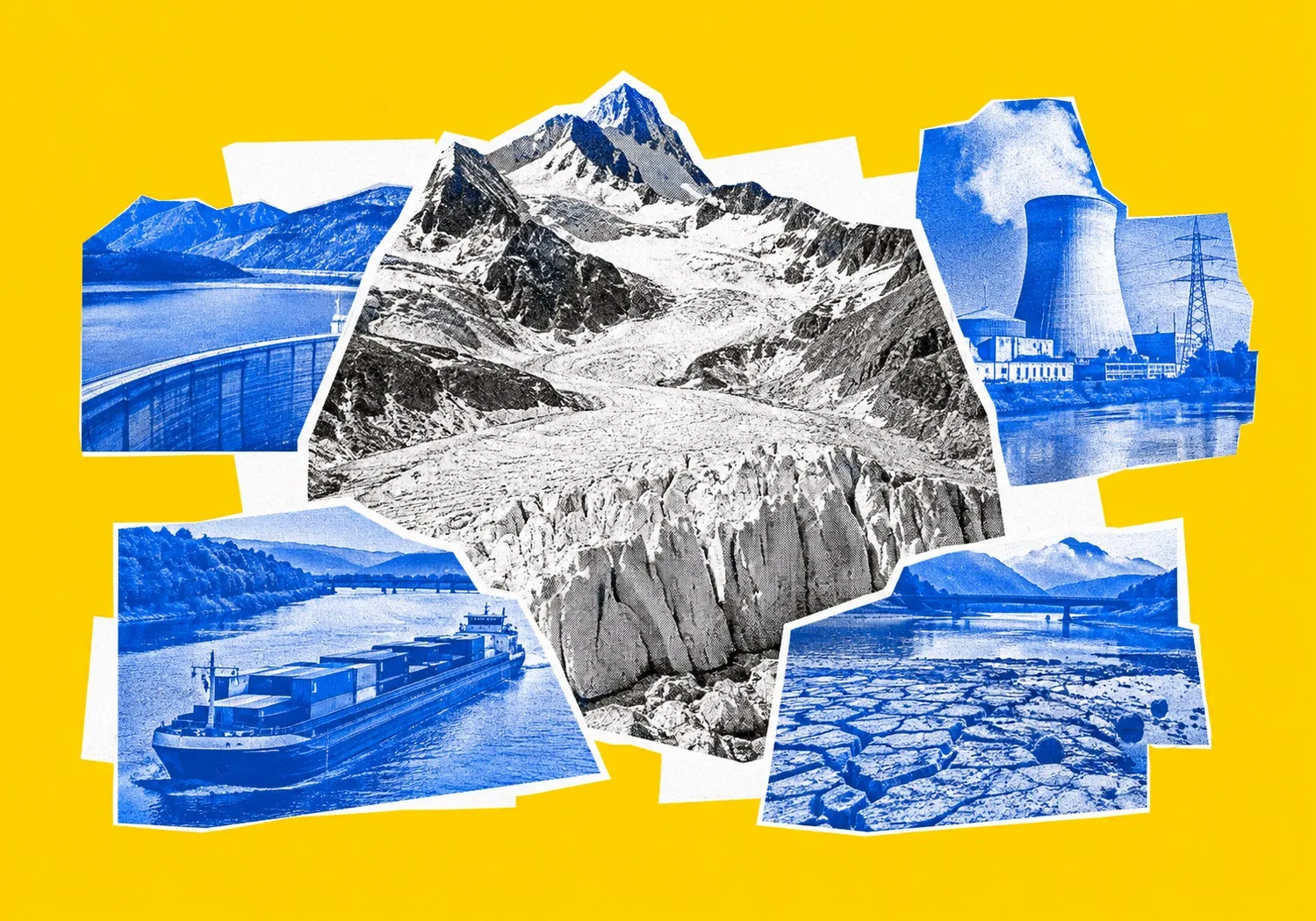
Switzerland lost 5.5% of its remaining glacier ice in the first eight months of 2026 alone - part of a catastrophic 19.4% drop over the last five years. But what looks like an Alpine environmental crisis is rapidly turning into a systemic shock for Western Europe, as shrinking meltwater reserves threaten Rhine cargo flows, hydroelectric capacity, and power grid stability across the continent.
The measurements, published on October 1 by the Swiss Academy of Sciences and based on the Glacier Monitoring Network, come after a summer in which the freezing level remained above 4,000 metres for 76 days. By September, snow had disappeared from elevations as high as 3,500 metres, leaving exposed ice to absorb direct solar radiation.
Some glacier tongues lost up to 10 metres of ice. The physical changes are already becoming an economic problem.
The Alps are losing their summer reserve
The winter preceding the melt was one of Switzerland’s ten least snowy since systematic records began. That left glaciers with less snow to protect the underlying ice when temperatures rose. Then came the heat.
From May to September, unusually hot and dry conditions persisted across the region. The freezing level reached heights more than twice the seasonal average. The result was not simply another year of retreat. Large glaciers, including Aletsch, Rhône, Clariden and Allalin, recorded their greatest individual ice losses on record.

Several smaller glaciers disappeared altogether. Bella Tola in Valais, Griessfirn in Glarus and Plattalvafirn in the Selbsft massif are no longer part of the landscape in the form in which they had been monitored. Plattalvafirn had already lost 99% of its surface over the previous two decades.
The scale of the melt also produced a peculiar short-term benefit.
Around 2,200 billion litres of water flowed from the glaciers into river systems between July and September. That is more than four times the amount of water consumed annually by all Swiss households for drinking.
It helped relieve drought conditions. It also represented the rapid conversion of a finite reserve into runoff.
That distinction is becoming increasingly important for Europe. A glacier stores precipitation from colder months and releases it gradually during warmer ones. Once enough ice has disappeared, that buffering function weakens. A very large flow during one hot summer cannot compensate for the smaller flows that will follow when there is less ice left to melt.
The 2026 water surge therefore offers little comfort about the years ahead.
A Swiss glacier can become a German freight problem
The connection between Alpine ice and European industry is not immediately obvious. It becomes clearer downstream.
During the summer of 2026, the Rhine, Danube, Po, Loire, Rhône and Seine recorded their lowest average summer discharge since 1992. The Rhine and Danube are particularly important because they carry large volumes of freight through the industrial heart of Europe.
Lower water levels mean barges cannot carry normal loads. Cargo has to be reduced, freight costs rise, and transport schedules become more vulnerable to disruption.

The glacier loss is not the sole cause of low river levels. But the deterioration of Alpine water storage removes one of the mechanisms that has historically helped sustain summer flows.
That matters for an economy built around rivers. The same pattern appears in agriculture. Reliable summer runoff has helped provide irrigation when rainfall is less dependable. As Alpine glaciers shrink, farmers in parts of central and southern Europe face greater uncertainty over the availability of water at precisely the point in the year when demand is highest.
The adjustment will not be confined to the mountains.
Electricity is part of the same problem
Water is also an energy issue.
In July, hydroelectric inflows in Austria and Switzerland fell to as much as 50% below their 15-year averages. Alpine hydropower is particularly exposed because reservoirs and run-of-river plants depend on the seasonal availability of water.
A weaker hydrological system becomes especially problematic during a heatwave. Electricity demand rises as households and businesses use more cooling, while some forms of generation become more constrained.

France faces a related problem from another direction. Lower river flows can limit the availability of cooling water for nuclear power stations. Hydropower and nuclear generation are different technologies, but both become exposed to the same underlying variable when rivers run unusually low.
That creates an awkward problem for European power markets.
The periods in which electricity demand is most likely to rise can coincide with weaker Alpine hydro production and constraints on thermal generation. Solar and wind power can provide additional electricity, but their intermittent nature does not remove the need for flexible generation and storage.
Gas-fired combined-cycle plants can therefore become more important during summer shortages, even as Europe seeks to reduce its dependence on fossil fuels.
The result is a less straightforward energy transition. Losing glacier-fed water does not simply mean losing some hydroelectric output. It changes the conditions under which the rest of the electricity system has to operate.
The infrastructure bill is only beginning
Europe cannot recreate a glacier. It can, however, try to replace some of the functions that glaciers performed. That means more engineered water storage, larger or redesigned reservoirs, systems to retain water, and rules for allocating it during dry periods. Alpine countries will also have to spend more on hazards associated with thawing permafrost, rockfalls and flash floods as mountain conditions change.
None of this is cheap. It also creates a new industrial market. Companies involved in dams, reservoirs, water management and civil engineering stand to benefit from a sustained increase in public investment. Renewable developers may also gain as governments look for additional electricity sources that are less dependent on Alpine river flows.

The adjustment has costs elsewhere. Inland shipping faces a more difficult operating environment. Alpine hydroelectric operators have to deal with greater volatility and declining long-term water availability. Agricultural regions dependent on reliable summer irrigation face a similar exposure.
Consumers ultimately carry part of the risk through electricity and transport markets.
This is why the 19.4% figure is more important than another record melt year considered on its own.
Five years that changed the calculation
Switzerland has lost 65% of its glacier volume since 1850. The decline is therefore not new. What has changed is the speed.
Between 2016 and 2022, about 100 small glaciers disappeared across Switzerland. The year 2022 then established the existing annual record, with a loss of roughly 6–7% of glacier volume. Four years later, 2026 has produced another 5.5% loss.
The five-year figure is harder to dismiss as an isolated weather event. A sequence of low-snow winters and exceptionally hot summers is eroding the ice faster than a normal season can rebuild it.
This is where the distinction between retreat and structural loss becomes important. A glacier that loses mass one year and recovers some of it during a favourable winter remains part of a functioning seasonal system. A glacier repeatedly losing metres of thickness without replenishment is moving towards disappearance.
The smaller glaciers are already showing what that process looks like. The longer-term projections are severe. ETH Zurich research indicates that, under current climate policies, 97% of the roughly 3,200 glaciers in Central Europe could disappear by 2100, leaving around 110. Experts cited in the briefing expect most smaller Alpine glaciers to disappear within 10 to 15 years under present conditions.
There is also a lag built into the system. Even if global temperatures were to stabilise, thermal inertia means that glacier loss at lower Alpine elevations would continue for some time.
So the infrastructure question cannot be postponed until the ice is gone.
Europe has been using a natural reservoir without counting it
For decades, the Alps have performed a service that rarely appears in European infrastructure budgets. Snow and ice have stored water naturally, then released it when rivers, farms and power stations needed it most.
That storage is now being consumed.
The implications reach several systems at once. Lower river flows affect freight. Reduced water availability affects agriculture. Hydropower becomes less dependable. Nuclear plants can face tighter cooling constraints during hot weather. Governments then have to compensate with additional infrastructure, alternative energy capacity, and more complicated water-allocation rules.
Geographical winners and losers will also emerge. Northern Europe and Scandinavia are projected to gain hydropower potential as precipitation increases, while southern Europe faces substantial declines. That does not provide a simple replacement for Alpine water: Europe's river systems and infrastructure are not interchangeable.
The central question for governments is therefore no longer whether glaciers are retreating. That has been established for decades.
It is how quickly European infrastructure can adjust to a continent in which one of its largest natural water stores is being spent faster than it can be replenished.
The 2,200 billion litres released in the summer of 2026 bought Europe some water when it needed it. What it could not buy was another glacier.
Sources: GLAMOS, ETH Zurich, DW, NPR, The Guardian