
Beyond the Border: How Europol’s Balkan Crackdown Signals a Shift in EU Migration Strategy

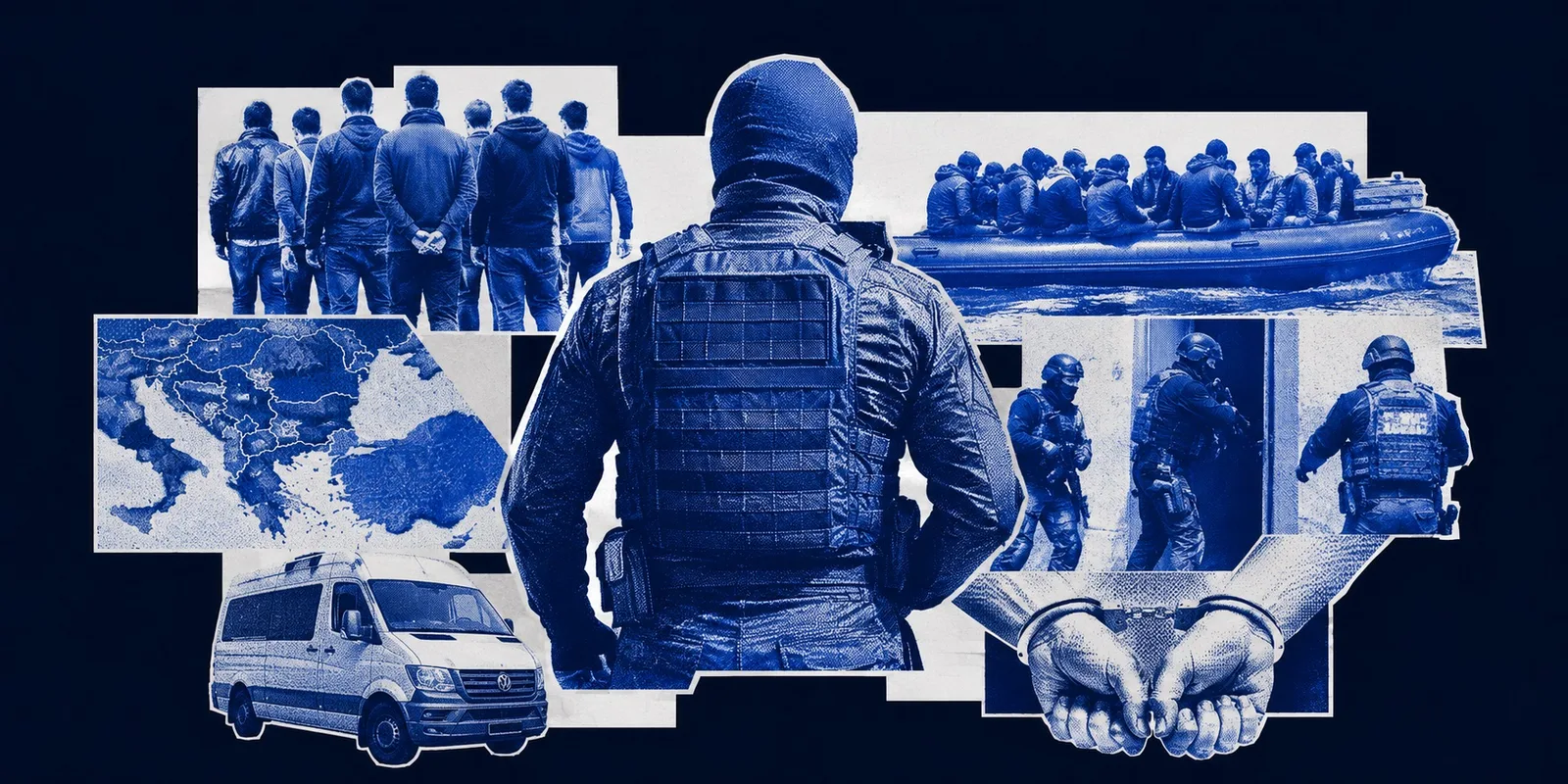
When police in Greece, Bulgaria, Romania, and the Netherlands dismantled a transnational smuggling ring on July 16, they exposed a fundamental shift in European border security. Moving beyond traditional checkpoint interceptions, Europol-backed taskforces are now targeting the logistics, vehicle networks, and financial supply chains driving irregular migration across the Western Balkans.
The operation unfolded simultaneously in Thessaloniki, Athens, Sofia, Bucharest, and Etten-Leur, resulting in seven arrests. It targeted a group made up mainly of Syrian and Egyptian nationals linked to at least 12 smuggling incidents toward Italy.
Its logistics were revealing. Migrants, predominantly from Egypt, Iraq, and Syria, were moved in small passenger cars through Greece, Bulgaria, and Romania before being transferred into heavy lorries for the final leg. The vehicles included stolen cars, cars registered through front companies, and fraudulently rented vehicles.

The arrests were the latest strike in a wider campaign. Since late 2025, Europol-supported taskforces have dismantled networks operating across the Western Balkans, from Bulgaria and Greece to Croatia, Bosnia and Herzegovina, Slovenia, and the Netherlands.
The operation behind the border
The Western Balkans route has long been one of Europe's most important land corridors for irregular migration. A typical journey can begin in Türkiye, continue through Greece or Bulgaria, pass through Serbia or Bosnia and Herzegovina, and then move toward Croatia, Slovenia, Austria, Germany, or Italy.
That geography creates an obvious advantage for criminal networks. The route crosses multiple jurisdictions, each with its own police forces, databases, legal procedures, and investigative priorities. A group that is invisible to one national agency may already be known to another.
The criminal networks have learned to exploit precisely that fragmentation.
A September 2025 operation in Croatia illustrated the scale of the infrastructure. Authorities arrested a high-value target and three accomplices linked to a network that had organized air travel from Istanbul to Sarajevo, arranged illegal foot crossings into Croatia, provided safe houses near Split and recruited drivers from Central and Eastern Europe. The network was linked to more than 600 migrants moved in around 100 separate operations.

Another operation targeting a pyramid-structured network based in Sofia produced 16 arrests. The group arranged crossings from Türkiye into southern Bulgaria, provided accommodation in Sofia and organized onward movement toward Serbia and Romania.
These were not improvised groups operating at the edge of the system. They had management structures, local cells, transport specialists, safe houses and financial channels.
The smuggling economy increasingly resembles a distributed logistics company.
Criminal networks are exploiting the legal economy
The most important shift in the way these groups operate is not simply greater sophistication. It is their ability to move between legal and illegal systems without always needing to break the law at every stage.
Commercial air travel can bring migrants from Istanbul to Sarajevo under legal entry conditions. The illegal part of the journey begins later, when the network arranges clandestine border crossings.
Vehicles may be stolen, rented fraudulently or registered through front companies. Drivers can be recruited from countries far from the point where migrants first enter Europe. A car registered in one jurisdiction may be used to move people through several others before being abandoned or replaced.
That is why vehicle fraud is not a side issue in these investigations. It is part of the infrastructure.

The same logic applies to money. Informal systems such as hawala allow payments to move between people and locations without passing through conventional commercial banking channels in the same way as a standard international transfer. For a criminal network operating across Türkiye, the Balkans and the EU, that flexibility can be valuable.
The result is a system that does not have one headquarters, one border crossing or one obvious financial account to seize.
It has nodes.
Europol does not arrest people. That is precisely the point.
The role of Europol in these operations is often misunderstood because the agency is present at the centre of major international investigations but does not have the power to make arrests.
National authorities still conduct raids and take suspects into custody.
Europol provides the connective tissue.
During joint operations, investigators can cross-check suspects, vehicles, documents, and other data through the Europol Information System. Secure communication takes place through SIENA, while QUEST allows automated queries against relevant Europol databases during operational activity. Europol analysts map relationships between suspects and criminal structures, deploy experts during action days, and help coordinate information that would otherwise remain scattered across national agencies.
The agency's value lies in turning separate investigations into one picture.
A suspect arrested in Greece may be connected to a vehicle registered through a company in another country. A driver operating in Croatia may appear in intelligence from Slovenia. A financial intermediary may be linked to a network whose operational leadership is based in Sofia or Athens.
Without cross-border data, those links can remain invisible.
With it, a series of apparently separate offences begins to look like a single criminal enterprise.
The EU has now begun to give this model a more permanent institutional foundation. Regulation (EU) 2025/2611, adopted in December 2025, established the European Centre against Migrant Smuggling, or ECAMS, and formalized a broader framework for information exchange, financial investigation and operational cooperation.
The significance of ECAMS is less about creating another European acronym than about institutionalizing a method.
From border patrols to intelligence architecture
For years, the political debate around migration has often been framed around physical barriers, patrols and interception. Those tools remain part of the system. But the operations across the Balkans point to a different battlefield.
The crucial question is increasingly not where a person crosses a border.

It is who arranged the journey, who paid for it, who supplied the vehicle, who recruited the driver, who provided the safe house and where the money ultimately went.
That requires a different type of security architecture.
Operational Taskforces allow countries affected by the same criminal network to work together around a shared investigation rather than waiting for one national case to develop independently. The Western Balkans taskforce established in 2023 brought together Bosnia and Herzegovina, Croatia, Germany and Slovenia. A separate framework targeted networks operating through Bulgaria and Greece.
The approach is designed to close the gaps that criminal organizations exploit.
The shift is particularly important because overall illegal border crossings into the EU fell by 40% year-on-year in the first quarter of 2026, even as pressure continued to move between routes. A reduction in crossings does not necessarily mean that the criminal infrastructure has disappeared. It can mean that the system has adapted.
When one route becomes more difficult, the network changes the route.
When maritime movement becomes more heavily policed, the Balkans may gain importance. When a border crossing becomes too risky, migrants may be moved through another country. When police identify a vehicle fleet, the network turns to rental fraud or different intermediaries.
This is why the fight cannot be reduced to the physical border. A border may stop one vehicle. Intelligence can expose the organization that operates dozens of them.
The bottleneck between the Balkans and Schengen
The border zone linking Bosnia and Herzegovina, Croatia and Slovenia has become particularly important because it sits at a critical junction between the Western Balkans and the Schengen area.
For smugglers, the region offers a complicated operational environment: multiple jurisdictions, difficult terrain and a direct connection to the EU's internal transport network. The movement of migrants through the area can involve guides crossing borders on foot, safe houses and drivers who are not necessarily based in the countries where the operation begins.
That complexity creates risks for law enforcement, but it also creates opportunities.
A network does not need to control an entire route. It can specialize in one section. One group arranges the journey to Sarajevo. Another organizes the crossing into Croatia. A third provides transport toward Western Europe.
This division of labour makes the criminal enterprise more resilient. Arresting one driver may have little impact. Identifying the coordinator who connects several cells can be far more consequential.
That is why the arrest of a high-value target matters more than the number of people detained in a single raid.
The cost of making smuggling harder
The new model is likely to make operations more expensive and less predictable for criminal groups. Encrypted devices, fraudulent vehicle documentation, safe houses and financial intermediaries all become potential points of exposure when investigators can connect information across borders.
But pressure on networks can also make the journey more dangerous.
When criminal groups lose access to familiar vehicles or routes, they may turn to more concealed and risky forms of transport. The use of heavy lorries for the final movement into Italy is one example of how logistics can become more dangerous as law enforcement pressure rises.
The people most exposed to that danger are the migrants themselves.
This is one of the uncomfortable realities of intelligence-led enforcement. Disrupting the network can weaken its business model, but it does not automatically eliminate the demand that sustains the market. A more fragmented and covert smuggling system may become harder to detect while also becoming more dangerous for those trapped inside it.
The strategic calculation for European governments is therefore broader than arrest statistics.
They need to make the criminal infrastructure difficult to operate without allowing it simply to mutate into a more concealed form.
Schengen's security problem is also an intelligence problem
There is a political consequence to this institutional shift.
The integrity of the Schengen area depends on the ability of European states to maintain open internal borders without allowing those borders to become an advantage for organized crime. That balance is difficult to preserve if national agencies cannot see the same criminal network moving across several countries.
Centralized intelligence cooperation offers an alternative to permanent internal border controls.
The logic is straightforward: if police in Greece, Bulgaria, Croatia, Slovenia, Romania, and the Netherlands can identify the same people, vehicles, and financial structures, the need to reimpose barriers between those countries becomes less compelling.
But that model also creates a new dependence. The effectiveness of European internal security increasingly depends on databases being connected, information being shared quickly, and national authorities trusting the intelligence infrastructure around them.
The European border is no longer only a line on a map.
It is becoming a network of databases, encrypted communications, financial investigations, and police relationships extending from the first point of contact with a smuggling operation to the final destination in Western Europe.
The criminal groups understood this before European institutions fully did. They built networks that could cross borders faster than the law enforcement systems designed to pursue them.
The latest operations show Europe trying to reverse that advantage - not by building one larger wall, but by building a security system capable of seeing the entire route.
Read also:
- As the EU’s new Migration and Asylum Pact and Return Regulation enter practical implementation in mid-2026, the bloc is rolling out its toughest border and asylum controls in decades. Nearly ten years after the 2015 crisis, Europe has established a unified system featuring accelerated border screening, cross-border deportation enforcement, and offshore return hubs - fundamentally rewriting the rules of the Schengen area.
- Europe is quietly replacing the United States as one of the world's most attractive destinations for highly skilled international students. As Indian enrolment shifts toward EU universities, education is becoming more than a soft-power asset - it is emerging as a strategic instrument for addressing labour shortages, strengthening industrial competitiveness and reshaping Europe's position in the global race for talent.
Sources: Europol.