
Beyond Rearmament: How Poland Is Building NATO’s First 'Total Defence' Model

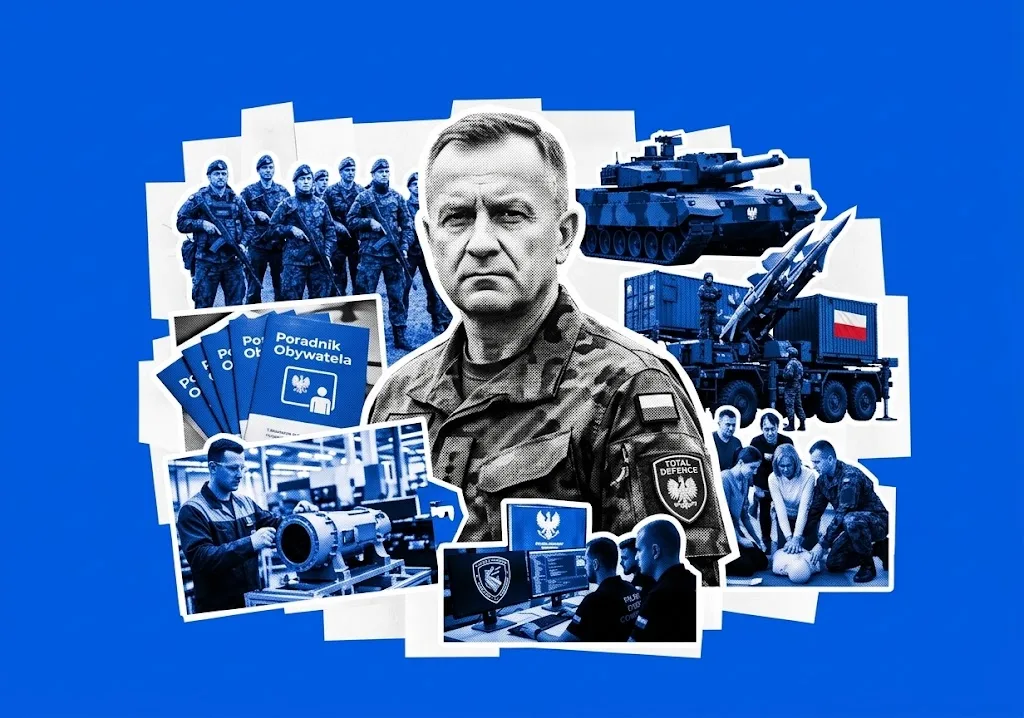
Poland's military expansion is often seen as a massive hardware buying spree - from US Abrams tanks to Apache helicopters. But a wave of new domestic ammunition contracts, air-defence orders, and nationwide civilian training programs reveals a deeper strategy: Warsaw is building a self - sustaining defense ecosystem designed for a prolonged European crisis.
That combination is becoming increasingly important on NATO's eastern flank, where the question is no longer simply how many advanced weapons a state can buy. It is whether the state can generate forces, replenish ammunition, maintain equipment and keep essential civilian functions operating under pressure.
From procurement to force generation
Poland's military expansion is often measured through its large foreign purchases. The Abrams programme is one visible example. The country is also moving towards a $10bn acquisition of 96 AH-64E Apache attack helicopters, supported by a new US Foreign Military Financing loan guarantee signed in September.
The financial architecture matters because it allows Warsaw to accelerate major acquisitions without treating each purchase as an isolated budget decision. The latest $4bn guarantee brings total US FMF credit backing for Poland close to $20bn. An offset agreement worth about PLN550m also gives Polish facilities the ability to service T700 engines used by the Apache fleet.
The result is not simply a larger inventory of US-made platforms. It is an attempt to build the infrastructure around them.
That distinction matters in a prolonged security crisis. Tanks and helicopters create combat power, but only if maintenance, ammunition, logistics and trained personnel can keep them operating. Poland's procurement strategy is increasingly addressing those supporting layers at the same time as it acquires the headline systems.
The Piorun programme illustrates the point from a different direction.
On September 11, the Polish Armaments Agency signed a roughly PLN3bn executive contract with MESKO, part of state-owned Polska Grupa Zbrojeniowa, for thousands of Piorun missiles and launchers through 2030. More than 80 per cent of the order is intended for Polish forces, while the remainder is destined for Lithuania, Latvia and Norway through the EU SAFE financial instrument.
This is both a procurement contract and an industrial policy decision. Poland is using defence spending to expand production capacity at home while embedding its manufacturing base into a wider European security market.
Why ammunition matters more than another headline weapon
The less glamorous part of Poland's rearmament may prove just as important as the tanks and helicopters.
MESKO has secured contracts covering small-arms ammunition, 23mm and 30mm ammunition and other medium-calibre rounds. One small-arms agreement is worth about PLN1bn, while separate contracts for 23mm and 30mm ammunition total hundreds of millions of złoty.
These are the products that disappear rapidly in sustained combat.
For years, European defence planning could operate on the assumption that sophisticated equipment would be purchased from international suppliers and that relatively small professional forces would be sufficient for most contingencies. The security environment described in the briefing requires a different calculation. A country preparing for a large-scale and potentially prolonged conflict needs not only advanced platforms but the ability to replenish high-consumption stocks.
That is one reason Poland's industrial shift is strategically significant.
Orders placed with Polish and Central European suppliers reached about PLN30.4bn in 2025, almost four times the 2022 level. Contracts announced for Polish enterprises during the MSPO defence exhibition reached approximately PLN119bn.
The scale indicates that localisation is no longer a marginal feature of procurement policy. Defence spending is being used to reshape the supply chain itself.
For Warsaw, relying more heavily on Polish and regional production can reduce exposure to disruptions involving distant suppliers and create a domestic capacity for replenishment. For the wider region, it also creates a potential division of labour in which national industries become components of a broader European defence ecosystem.
The Piorun arrangement is an early illustration of that model: Polish manufacturing, European financing and procurement by several NATO partners are being tied together.
The civilian side of the equation
The other half of Poland's strategy is less visible in defence exhibitions.
The Ministry of National Defence has extended its wGotowości programme through November 2026. The voluntary course is open to adult Polish citizens and covers basic security, first aid, crisis response, survival skills, cyber hygiene and civil-defence fundamentals. Defence Minister Władysław Kosiniak-Kamysz has set a target of training up to 400,000 citizens by the end of 2026.
That is a very different proposition from traditional military recruitment.
The programme does not attempt to turn hundreds of thousands of civilians into soldiers. Its purpose is to give a wider section of society basic capabilities that become relevant when a crisis extends beyond the battlefield.
The voluntary 16-day Train Like a Soldier programme occupies a position between the two systems. Conducted at around 30 military units, it provides basic military training while covering accommodation, equipment, insurance and financial compensation.
Poland is therefore building several layers of readiness rather than relying on a single manpower model.
This distinguishes Warsaw's approach from European countries that have moved towards mandatory service or more coercive reserve mechanisms. Croatia has reinstated mandatory service, Denmark is extending service to 11 months, while Finland, Sweden and the Baltic states operate broader compulsory-service systems. Germany's 2026 model introduces mandatory questionnaires for 18-year-old men alongside selective medical assessments. France has launched a voluntary 10-month military service.
Poland's current model remains predominantly voluntary on the civilian and basic-training side. That matters politically, but it also reveals a different way of thinking about mobilisation: preparedness can be expanded through a large civilian pool without immediately converting the entire system to compulsory service.
The industrial state behind the military state
The more fundamental change is therefore not the number of tanks in Polish units. It is the growing overlap between defence planning, industrial policy and civilian resilience.
PGZ and its subsidiaries, including MESKO, sit at the centre of that effort. Contracts for missiles and ammunition give domestic manufacturers long-term order books, while partnerships involving companies such as CRW Telesystem-Mesko and WZE extend the industrial network beyond a single prime contractor.
Other recent agreements reinforce the same direction. Poland has contracted for PCL passive radars to monitor eastern border airspace and for more than 1,000 remotely initiated underwater mine-destruction charges.
Not every component of this system is produced domestically. The Abrams and Apache programmes remain heavily dependent on US technology and financing. Poland's strategy is therefore not autarky.
It is selective interdependence.
Warsaw is retaining access to the capabilities it cannot or does not want to reproduce domestically while concentrating local investment on areas where sustained supply is particularly important. That creates a more regionalised defence economy without severing the transatlantic industrial relationship.
The model also gives Central European partners a stake in Polish production. The Piorun contract's allocation to Lithuania, Latvia and Norway through SAFE is significant precisely because it connects national industrial capacity with European financing mechanisms.
The cost of making readiness permanent
There is a harder question beneath the industrial expansion: how long can this model be sustained financially?
Credit-backed procurement accelerates the arrival of military capabilities, but it does not remove their cost. Loan guarantees make borrowing easier; they do not eliminate repayment obligations. Nor does the purchase price of a weapons system represent its full lifetime burden. Tanks, helicopters, missiles and ammunition require maintenance, training, infrastructure and replenishment.
Poland is effectively committing itself to a defence system whose costs will extend well beyond the signing of individual contracts.
That creates a different fiscal logic from the emergency procurement of a few high-value platforms. Once domestic production lines, reserve structures and civilian training programmes are established, they acquire institutional momentum. The state must sustain them if the strategic benefits are to remain.
For Poland, that may be the central challenge of the model now taking shape. Building a large defence industrial base and a population capable of basic crisis response can make military spending more resilient to supply shocks. But it also makes defence preparedness a permanent economic commitment rather than a temporary reaction to a deteriorating security environment.
The significance of the Abrams arriving this week is therefore less about the 35 tanks themselves than about the system being built around them: missiles that can be produced in Poland, ammunition contracts designed for sustained supply, financing that accelerates foreign acquisitions, and a civilian population being trained to operate through crises.
The eastern flank is being prepared not merely to field more weapons, but to keep functioning when those weapons become necessary.
Sources: Ministry of National Defence of Polandб Money, Polsat News, Defence24