
Beyond Car-Free Sunday: Brussels Uses Annual Driving Ban as Stress Test for Urban Mobility

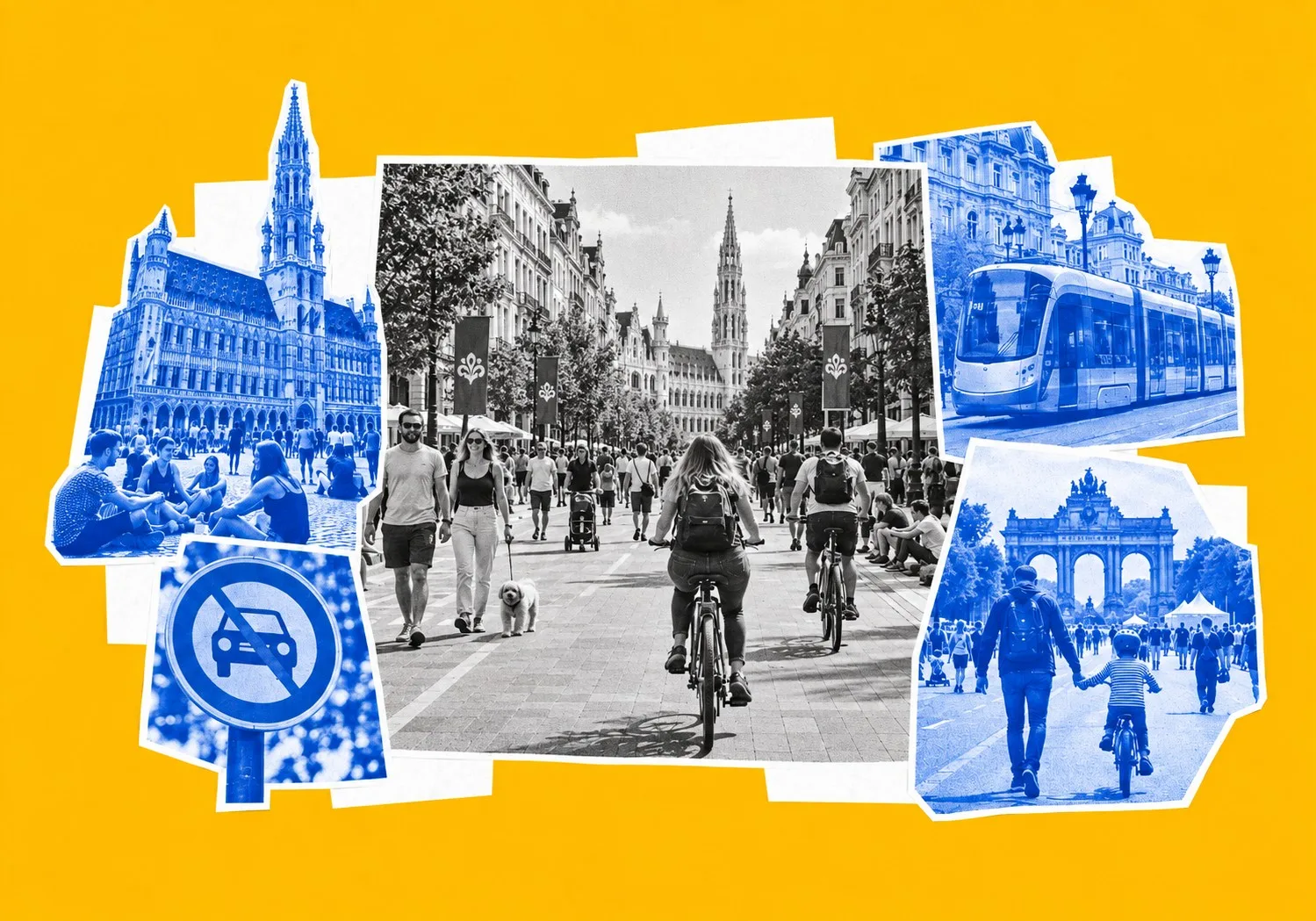
On Sunday, 20 September 2026, police checkpoints went up across the boundaries of the Brussels-Capital Region at 9.30 am. For nine and a half hours, private cars were barred from all 19 municipalities. Non-resident drivers were turned back at the perimeter or directed into outer park-and-ride lots and regional railway stations. Avenues usually clogged with traffic were handed over to pedestrians, cyclists, and free buses.
To casual onlookers, the closure—the centerpiece of European Mobility Week—looks like a civic street festival. Pop-up brunches filled the pavement outside the Beursschouwburg cultural centre. Street parties spread through local squares in Ixelles and Saint-Gilles. Events linked to the Festival of Migrations occupied major thoroughfares.
Behind the festival atmosphere lies a calculated operational test.
Regional authorities use the annual shutdown to gather hard traffic metrics, test public transport capacity, and evaluate how the urban grid copes without private vehicles. What appears on the calendar as a community holiday serves in practice as a large-scale stress test for permanent driving restrictions, low-emission enforcement, and the reallocation of urban street space.

Testing the Infrastructure of Decarbonisation
Shutting down private transport across an entire metropolitan region creates immediate demands on public infrastructure. To carry the city’s population, regional transit operator STIB-MIVB suspended fare collection on its metros, trams, and buses, running reinforced service schedules throughout the day.
The event coincided with an operational milestone. September 20, 2026, marked 50 years to the day since the opening of the Brussels Metro on September 20, 1976, alongside a century of municipal bus operations.
Over five decades, the underground network has logged nearly five billion passenger journeys. To mark the date, STIB-MIVB opened its Jacques Brel depot, giving the public access to its maintenance bays and battery-electric bus fleet.
The day’s logistics required precise regulatory exemptions. Emergency vehicles, public buses, and essential permit holders were allowed onto the roads, but under a regional 30 km/h speed limit. Street-hail taxis operated without extra paperwork, while ride-hailing drivers needed specific permits, reducing their presence on the roads.
For urban planners, the outage provides an empirical baseline. Environmental agencies measure drops in nitrogen dioxide and particulate levels, while transit controllers watch how active-mobility corridors handle peak demand when cars disappear.
Rebuilding the Post-War European City
Brussels is not acting in isolation. Across Western Europe, municipal governments are undoing post-war urban layouts that prioritised private vehicles above all else.
Decades ago, planners cut wide roads through historic city centres and built sprawling suburbs premised on universal car ownership.
That framework is breaking down under EU air-quality mandates, municipal carbon targets, and public health pressures. Town halls are reallocating budgets from road maintenance to bus electrification, expanded tram tracks, and low-emission zones.
The primary obstacle to this shift is political. Reassigning road space from driving lanes and parking bays to cycle paths provokes predictable friction among suburban drivers, freight haulers, and local businesses.
By framing road closures as an annual public event, officials lower resistance to change. Residents experience the practical reality of a city with fewer cars, making permanent restrictions—such as low-emission zone expansions and pedestrian zones—easier to pass later.
Winners, Losers, and Urban Trade-offs
This policy direction creates clear divisions between different groups in the capital.
Public transit operators, active-mobility groups, and environmental regulators gain obvious ground. STIB-MIVB uses the high-profile day to demonstrate its operational capacity and build support for future capital expenditure. Restaurants and cafes in central pedestrian zones see increased footfall, while environmental agencies secure clean data sets to justify tighter air-quality standards.
The costs fall elsewhere. Suburban commuters face longer trips and mandatory detours around the perimeter. Commercial delivery operators and ride-hailing services face operational delays and compliance costs during closure hours.
The divide between inner-city residents and outer-ring commuters remains politically sharp. While central districts benefit from quieter streets and lower pollution, outer suburbs still lack the public transport links needed to make car ownership optional.
Park-and-ride facilities along the Brussels Ring intercepted thousands of cars on Sunday. This shows that suburban commuter hubs must be expanded before permanent vehicle bans can be introduced wider out.
From Temporary Ban to Permanent Policy
Traffic resumed as normal after 7.00 pm on Sunday evening. The policy debate, however, moved straight back to permanent measures. European Mobility Week runs through September 22, yet the real impact of the driving ban will be measured in long-term regulatory changes.
City governments across Europe are tracking the Brussels experiment. As EU climate targets draw closer, the pressure to turn temporary closures into permanent road reallocations is mounting.
Whether these changes stick will depend on public transport operators maintaining high service levels without triggering endless budget deficits. The annual car-free day is no longer just a pleasant Sunday break. It is a live blueprint for the permanent redesign of European capitals.
Sources: Euractiv,The Brussels Times, Brussels Morning