
AI Boom Puts Pressure on Europe’s Data Centre Construction Capacity

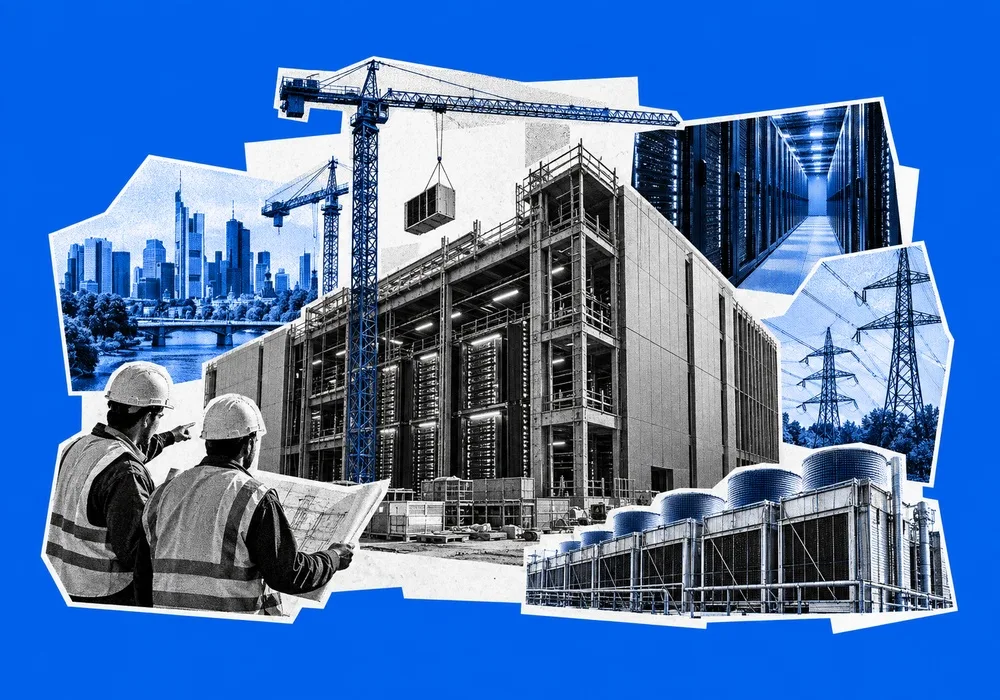
Europe’s AI expansion is putting pressure on the construction industry as shortages of specialised contractors and workers add another constraint to the rapid development of data centres. At the same time, limited access to land and electricity is pushing new projects beyond traditional European hubs.
Europe’s rapid expansion of artificial intelligence infrastructure is creating a new constraint for the continent’s digital ambitions: there may not be enough construction capacity to build data centres at the pace required by rising demand. The pressure is extending beyond computing equipment and electricity supply to contractors, engineers and specialised workers needed to deliver increasingly complex facilities.
The European Union has set an objective of significantly expanding its data centre capacity over the coming years as demand for AI and cloud computing accelerates. Meeting that target will require a large increase in construction activity, at a time when the sector is already facing shortages of skilled labour and growing competition between major infrastructure projects.
Construction capacity becomes a bottleneck
Data centres have become one of the most sought-after segments of the European construction market. Research by Turner & Townsend cited by Consultancy.eu found that data centres moved into the top position among construction sectors experiencing the strongest demand in the EU, ahead of residential construction and industrial and logistics facilities.
The pressure is particularly pronounced among specialist contractors. Turner & Townsend found that more than 70% of the 112 markets it analysed globally were experiencing tightening or overstretched contractor capacity for data centre projects. European markets including Berlin, Dublin, Geneva, Zurich and Amsterdam are facing increasing competition for companies capable of delivering highly specialised facilities.
The shortage is particularly acute in mechanical, electrical and plumbing work, which is central to the construction of modern data centres. According to the research, 87% of European construction industry respondents reported shortages of qualified workers in these areas. This creates a practical limit on how quickly projects can move from investment decisions to completed facilities, even when financing and demand are already in place.
AI is changing the geography of data centres
The construction challenge is developing alongside a broader shift in where new data centres can be built. Access to electricity, available land and grid connections is becoming increasingly important as AI facilities require substantially more power than many conventional data centres.
JLL has reported that hyperscale campuses planned for 2026–2028 are expected to be located significantly farther from major European markets than projects delivered between 2022 and 2025. Greenfield developments now represent a much larger share of the future pipeline, reflecting the difficulty of expanding large facilities in established data centre hubs where land and electricity connections are increasingly constrained.
This is gradually changing the geography of Europe’s digital infrastructure. Frankfurt, London, Amsterdam, Paris and Dublin remain major data centre markets, but developers are increasingly considering secondary locations where large sites and power capacity can be secured. For governments and local authorities, this is turning data centre development into a broader infrastructure and planning issue rather than simply a private-sector real estate investment.
Demand is accelerating
The scale of the expansion is reflected in the European market pipeline. CBRE expects the European data centre market to reach around 13GW of capacity by the end of 2026, representing significant year-on-year growth. Demand from AI applications is also increasing rapidly, with colocation contracts linked to AI workloads expanding sharply during the first half of the year.
The established European hubs are already operating with limited spare capacity. JLL estimates that Frankfurt, London, Amsterdam, Paris and Dublin together have several gigawatts of operational capacity, with additional capacity under construction and further projects in the planning pipeline. Vacancy rates remain low, particularly in some of the largest markets, leaving developers competing for available land, power, contractors and equipment.
This combination of strong demand and limited supply is increasing the importance of construction timelines. Delays in obtaining specialist labour or contractors can have consequences beyond individual projects because developers are operating within an infrastructure market where electricity connections, equipment and suitable sites are already subject to long lead times.
Electricity is another constraint
The construction bottleneck is emerging at the same time as Europe faces a growing challenge over the energy requirements of digital infrastructure. The European Commission estimates that data centres consumed around 68 TWh of electricity in the EU in 2024. That figure could rise to approximately 114 TWh by 2030, while faster-than-expected adoption of AI could push demand even higher.
For developers, access to electricity is therefore becoming one of the main factors determining where new facilities can be located. Existing hubs may have strong connectivity and established digital ecosystems, but insufficient grid capacity can make additional large-scale developments difficult or slow to deliver.
The result is a growing connection between Europe’s AI strategy and its energy and infrastructure policies. Expanding computing capacity requires not only new buildings and servers but also additional generation, transmission and distribution infrastructure. Planning decisions made by governments and grid operators today will influence where Europe can accommodate the next generation of AI facilities.
EU investment raises the stakes
The European Commission is also seeking to accelerate the development of large-scale AI infrastructure through public investment. In July, it launched a call for up to seven AI Gigafactories, supported by up to €10 billion in EU and national funding and expected to mobilise at least €20 billion in private investment. The facilities are intended to bring together advanced computing, cloud infrastructure, connectivity and energy-efficient data centre capacity.
The initiative highlights the scale of Europe’s ambitions, but the construction constraints identified by Turner & Townsend point to a less visible challenge. Funding and access to advanced chips can accelerate AI infrastructure only if Europe can also provide the physical capacity required to house, power and operate it.
For European policymakers and investors, the emerging challenge is therefore increasingly about coordination between several infrastructure layers. Land availability, grid connections, planning approvals, specialist equipment, construction contractors and skilled workers all need to expand in parallel. A shortage in any one of these areas can slow the delivery of new AI capacity.
Europe’s ability to expand its AI infrastructure will consequently depend not only on how much capital is available or how quickly computing technology develops, but also on the capacity of its construction and energy systems to support the buildout. The competition for contractors and specialised workers shows that the physical delivery of AI infrastructure is becoming a strategic constraint in its own right.
Sources: Consultancy.eu, CBRE, Turner & Townsend, JLL, European Commission