
AfD weighs softer EU stance as it seeks path to power in Germany

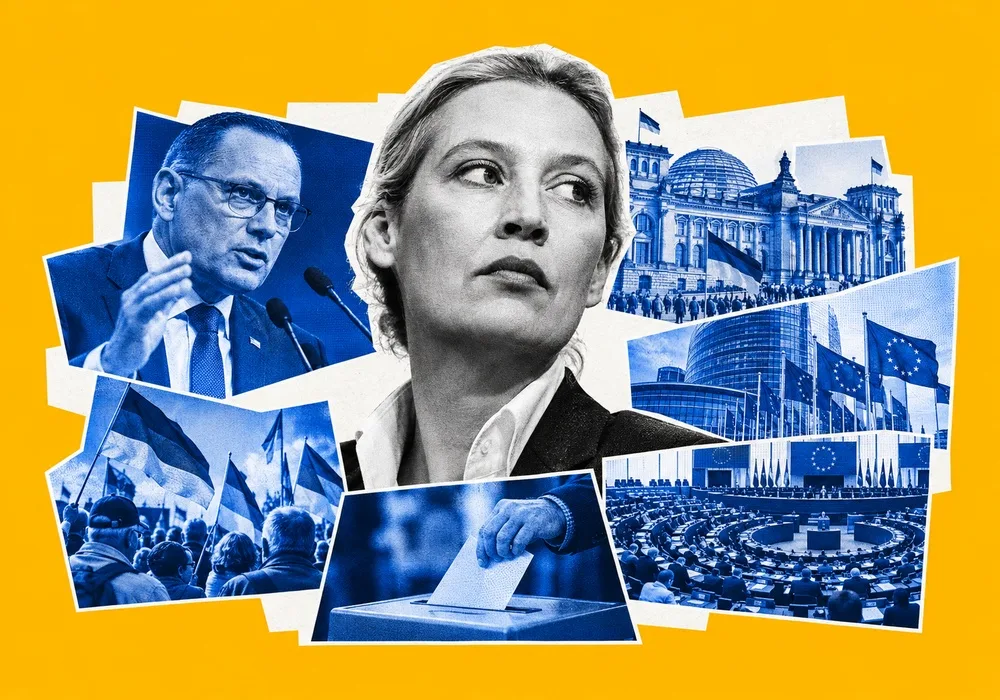
Germany’s AfD is considering a shift from its traditional demand for withdrawal from the euro and potentially the EU towards renegotiating the bloc’s treaties and restoring powers to national governments. The strategy comes as the party consolidates its position as Germany’s main opposition force, wins state elections and prepares for a possible route into federal government by 2029.
Germany’s far-right Alternative for Germany (AfD) is considering a major adjustment to its long-standing opposition to the European Union, reflecting the party’s transformation from a protest movement into a political force preparing for a possible route to government. An internal strategy paper seen by Reuters proposes renegotiating the EU treaties and turning the bloc into a looser alliance of sovereign states rather than immediately pursuing German withdrawal. If negotiations failed, the document would leave open the possibility of a referendum on Germany’s EU membership. The proposal does not represent a move towards supporting European integration, but rather an attempt to translate the AfD’s Eurosceptic agenda into a strategy that could be implemented by a future governing party.
The timing of the debate is particularly significant because the AfD has strengthened its position across Germany. At the 2025 federal election, it won 20.8% of the vote and became the country’s second-largest political force, while in September 2026 it emerged as the strongest party in elections in Saxony-Anhalt and Mecklenburg-Western Pomerania. These results have demonstrated that the party’s support is no longer limited to protest voting and that it can compete for first place in major regional elections. Although Germany’s mainstream parties continue to reject cooperation with the AfD, its growing electoral strength means that the question is increasingly shifting from how to exclude the party from government to how the political system will respond if that strategy becomes harder to sustain.
From EU withdrawal to reshaping the EU
The AfD was founded in 2013 largely around opposition to the eurozone bailout policies adopted during the European debt crisis. Its programme subsequently developed into a broader rejection of deeper European integration, including demands for Germany to leave the euro and eventually withdraw from the EU if fundamental reforms could not be achieved. The new strategy would soften the immediate demand for withdrawal without abandoning the underlying objective. Instead of leaving the European system at the outset, the party would seek to renegotiate the treaties, strengthen national veto powers and give member states greater freedom to opt out of common policies.
The strategy paper reportedly calls for national opt-outs in areas including migration, fiscal policy and jointly issued European debt. This would amount to a fundamental change in the way the EU operates, as many of the bloc’s recent efforts have focused precisely on developing common instruments in these areas. The AfD’s proposed model would effectively move the EU towards a much looser confederation in which national governments retain considerably greater control over economic and migration policy. A referendum on German EU membership would remain an option if the party concluded that such a restructuring could not be achieved through negotiations.
That approach could also be politically easier to sell to German voters than an immediate demand for withdrawal. Leaving the EU would raise questions over Germany’s access to the single market, the future of the euro, trade, investment and the country’s position within Europe’s security architecture. A campaign for treaty renegotiation allows the AfD to frame the same political objective in terms of restoring German sovereignty rather than dismantling Germany’s European relationships. It gives the party more room to argue that it is seeking to reform Europe rather than simply abandon it.
Germany’s political balance is changing
The proposal comes as the AfD’s relationship with the German political system is undergoing a fundamental change. The party remains excluded from federal government because the CDU/CSU, SPD, Greens and other mainstream forces have maintained a political firewall against cooperation with it. Yet this strategy is becoming increasingly difficult to reconcile with the AfD’s electoral performance. The party’s second-place finish at the 2025 federal election and its subsequent victories in eastern Germany have established it as a permanent force in German politics rather than a temporary protest phenomenon.
The September 2026 state elections provided the clearest evidence of this shift. The AfD won the largest share of the vote in both Saxony-Anhalt and Mecklenburg-Western Pomerania, while Chancellor Friedrich Merz’s conservatives suffered significant setbacks. The results have increased pressure on Germany’s established parties to demonstrate that they can address the economic, migration and security concerns driving voters towards the AfD. If those parties fail to do so before the 2029 federal election, the question of whether the AfD can eventually enter government will become increasingly difficult to avoid.
This makes the party’s internal policy debates more important than they were several years ago. A movement preparing to govern needs a strategy for relations with the EU, Germany’s largest economic and political framework, rather than simply a list of objections to European integration. The AfD’s current discussion suggests that it is beginning to develop such a strategy. Its objective remains deeply Eurosceptic, but the proposed method is more gradual, institutional and potentially compatible with a future governing role.
A challenge to the EU from inside
For the European Union, the implications could be more significant than a straightforward German withdrawal. Germany is the EU’s largest economy and one of its central political powers, meaning that a government committed to systematically returning competences from Brussels to national capitals would have considerable influence over the direction of the entire bloc. An AfD-led government could therefore seek to weaken European integration while remaining formally committed to EU membership. That would allow Germany to use its weight inside the institutions to reshape the rules rather than simply abandoning them.
The areas targeted by the AfD are also central to the EU’s future development. Migration policy has become increasingly Europeanised, while common borrowing has expanded since the pandemic and the energy crisis. The bloc is also under pressure to develop stronger common industrial, defence and energy policies as competition with the United States and China intensifies and Russia’s war against Ukraine continues to reshape European security. A German government seeking extensive national opt-outs could make further integration substantially more difficult.
The potential impact would extend beyond institutional questions. Germany has historically been one of the main engines of European integration, even when Berlin has disagreed with individual EU policies. A fundamental change in Germany’s position would therefore affect the balance between Berlin and Paris, the future of eurozone governance and the ability of EU governments to agree on common fiscal and security instruments. The political centre of gravity of the Union could move towards a more intergovernmental model in which national capitals regain powers that have gradually shifted to Brussels.
The AfD is benefiting from Germany’s wider political strain
The party’s rise is closely connected to broader weaknesses in Germany’s political and economic model. The country is struggling with weak industrial growth, high energy costs, increased competition from China and the consequences of the collapse of its previous energy relationship with Russia. At the same time, migration and asylum policy remain among the most politically divisive issues in the country, while public frustration with the ability of successive governments to deliver reforms has weakened trust in established parties.
These pressures have allowed the AfD to connect several different forms of dissatisfaction into a single political narrative. It presents migration as a question of national sovereignty, economic stagnation as a consequence of political mismanagement and EU integration as a constraint on Germany’s ability to determine its own policies. The result is a broader challenge to the political consensus that has shaped Germany since reunification. Its electoral growth therefore reflects not only the strength of the AfD but also the difficulty experienced by mainstream parties in providing a convincing response to the country’s structural problems.
President Frank-Walter Steinmeier has warned that Germany is experiencing political divisions that recall some of the dynamics of the Weimar era, including growing support for extremist parties and declining confidence in democratic institutions. His warning reflects a broader concern within Germany that the established political system is losing its ability to absorb social and economic dissatisfaction. The AfD’s growing strength has become one of the clearest expressions of that problem, particularly as the traditional parties remain committed to excluding it from government while struggling to prevent its continued electoral expansion.
The 2029 election is becoming the strategic horizon
The AfD’s proposed European strategy should therefore be viewed in the context of its longer-term ambition to enter federal government. The party still faces major obstacles, including opposition from all major mainstream parties and significant resistance among parts of the German electorate to its more radical positions. But its recent electoral performance means that the possibility of a future AfD role in government can no longer be treated solely as a theoretical question. The 2029 federal election is increasingly becoming the horizon against which the party is developing policies that could go beyond opposition politics.
The EU strategy is part of that preparation. Rather than demanding an immediate break with Europe, the AfD could attempt to enter government promising to renegotiate Germany’s relationship with the EU and restore powers to the national level. Such a policy could attract voters who support greater national sovereignty but remain wary of the economic and geopolitical risks associated with leaving the Union altogether. It would also allow the party to maintain its Eurosceptic identity while presenting itself as a more pragmatic governing force.
The proposed strategy still has to be formally approved by the party and could face internal resistance, particularly from figures who have historically supported a much harder line on the euro and EU membership. But the fact that such a document is being debated at a time when the AfD is winning state elections illustrates how its political priorities are changing. The question is no longer simply whether Germany should leave the European project, but whether the AfD could use political power in Berlin to fundamentally change what that project looks like from within.
For the European Union, that may ultimately be the more consequential scenario. A German withdrawal would be an extraordinary rupture, but a Germany governed by a party seeking to turn the EU into a looser association of sovereign states could produce a slower and more systemic transformation. The AfD does not need to take Germany out of Europe to challenge the European model: it could seek to redefine the model from the inside.
Sources: Reuters, Deutschlandfunk